
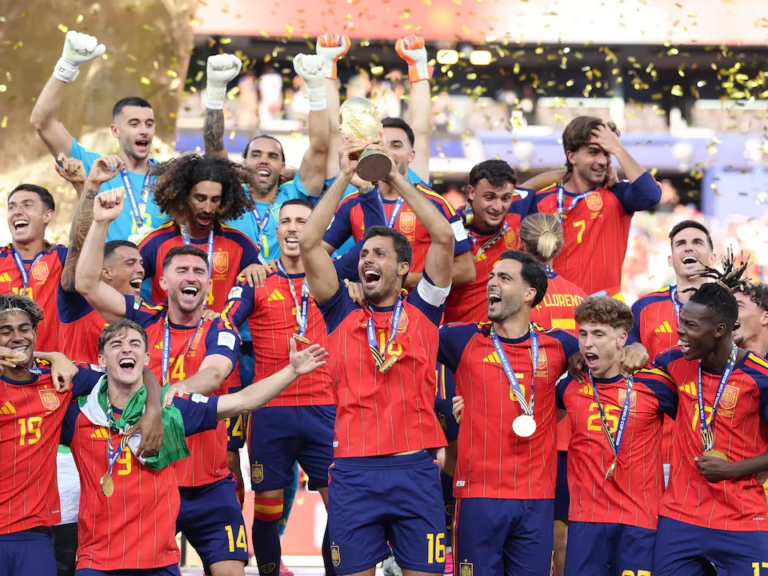
Following an anxiety-inducing 1–0 victory for Spain in the Finals on Sunday and a whopping 39 days, the 2026 FIFA World Cup has finally come to a close. Spain will walk away from the tournament $51 million richer, a record-breaking award for the World Cup. Yet that figure pales in comparison to the billions of dollars spent on betting markets, with the World Cup Final perhaps representing the largest gambling event in history.
Controversial prediction markets, such as Kalshi and Polymarket, surged in use during the World Cup. While nominally offering the ability to bet on everything from the weather to Trump speeches, currently such markets are essentially used as just another sports betting platform. According to data from Statista, in April, before the World Cup and NBA Finals, nearly two-thirds of the over $20 billion in “trading” volume on Kalshi and Polymarket was traded on sport-based markets. Other sources peg that number closer to 90 percent.
Unlike traditional sports betting, where the House sets the odds, in a prediction market, participants purchase “future contracts” based on a typically binary outcome with the prices determined by supply and demand (i.e., the ratio of money bet on an outcome versus the total amount of money bet). This somewhat pedantic difference has huge ramifications for the platforms: Traditional gambling is regulated by strict state-by-state regulations. In contrast, a highly sympathetic federal government regulates the alleged financial instruments used on prediction markets. (Whether this difference is real is the subject of ongoing, contentious litigation in U.S. courts.)
From an economic perspective, prediction markets differ from traditional gambling because the absence of the House allows the markets to publicly aggregate information that is otherwise widely dispersed among the populace. The prices determined by the market thus should approximate the actual chances of a particular outcome occurring based on the available information society currently possesses. This is what economists call the Efficient Market Hypothesis. Because of this promise, economists—such as the late Nobel laureate Kenneth Arrow—supported prediction markets far before their recent attainment of commercial success. Of course, the alleged benefits of prediction markets—which proponents use to justify the current hands-off approach to their regulation—flow from the belief that prediction markets are effective at aggregating information. Naturally, this raises the question: Are prediction markets actually good at predicting?
To answer this question, I turned to my most recent obsession, the World Cup, to see if prediction markets could outperform an “educated guess.” My stand-in for an educated guess was the results of The Athletic’s “Pick’em,” a voluntary poll that allowed Athletic subscribers to choose who they thought would win a particular match, essentially a nonrandom survey of readers interested in soccer. (Catering to sports enthusiasts, The Athletic was acquired by the New York Times in 2022 and serves as the Times’ sports section.) The table below summarizes the number of games for which Pick’em, Kalshi, and Polymarket correctly predicted the winner.
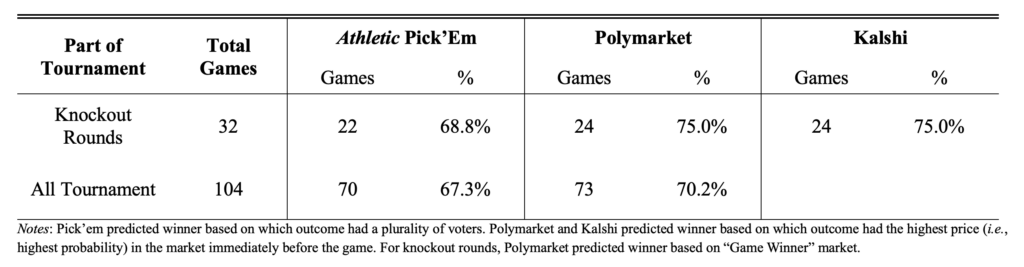
The above result was admittedly unexpected: The prediction markets outperformed The Athletic readers, correctly predicting the outcome of several more games.
While the economic value of better predicting the outcomes of sporting events is dubious, that prediction markets outcompete a non-profit motivated “wisdom of crowds” metric is evidence that these markets may be an effective forecasting tool. Some quick statistics from the World Cup, of course, do not prove that prediction markets will always outperform. But there is growing evidence to support the finding that commercial prediction markets can effectively aggregate information to provide useful insights into the future. To list a few examples: (1) a study of the 2024 election found that prediction markets outperform polling; (2) research from economists at the Federal Reserve found that Kalshi has outperformed other traditional economic forecasts; and (3) Kalshi’s internal research shows that it outperforms Wall Street inflation forecasts.
Being an effective forecasting tool, however, does not negate the harms of gambling, insider-trading, and moral erosion that critics rightfully levy against Kalshi and Polymarket. But their prediction acumen suggests there are trade-offs critics should not simply dismiss when determining how to regulate these markets: Guardrails are desperately needed, but a ban may be a step too far.
Gavin A. Sicard is an economic analyst at Econ One Research, where he works on antitrust and consumer protection matters.