
You don’t have to be an economist to recognize that we are living through an era of diminished competition. You simply must open your eyes and ears. And wallet. Whether paying for airline tickets, groceries, health insurance, concert tickets, ski passes, or video streaming services, consumers have experienced a consistent rise in prices, making things less affordable.
In most facets of our lives, we are confronted by a dominant firm (or two if we’re lucky) plus a fringe set of competitors. Airline passengers typically face two alternatives per route—as of 2018, the average HHI on a route before considering common ownership was just below 5,000, implying two equal-sized carriers. Amazon accounts for over 40 percent of all online retail sales revenue in the United States. Two federal district courts found that Google monopolizes both the search and ad-tech industry, respectively. Social media users congregate on a handful of platforms like Facebook/Instagram or TikTok. Four hotel conglomerates (Marriott, Hilton, Hyatt, and IHG) have acquired formerly independent resorts. Ridesharing is provided by just two companies. Visa, Mastercard, and American Express account for nearly all credit cards issued in the United States. The pattern is hard to miss. Even in markets that are not concentrated, the use of common pricing algorithms can effectuate monopoly outcomes.
So it was striking to see a new paper in the Journal of Political Economy by economists Carl Shapiro and Ali Yurukoglu contending that the current record does not show a weakening of competition—and that many troubling trends are best understood as competition at work. As explained more fully below, their methodology for assessing the evidence would never yield to a finding of increasing concentration in the economy, either because there will never be enough data, or because they can invent just-so stories that are consistent with the evidence. In other words, their methodology seems very rigorous and impressive but cannot detect economy-wide changes in concentration or price/cost markups. It would be akin to assessing climate change by insisting on measuring every millimeter of the earth; because you never have the requisite data, you can never say anything.
For context, Shapiro was the Deputy Assistant Attorney General for Economics of the Antitrust Division of the Justice Department under Obama. Shapiro famously told Congress in 2017 that the reason there was little-to-no enforcement against monopolists during his tenure was that there were “precious few” meritorious cases to bring. Like many others who “served” as regulators and later found comfortable landing spots at expert services firms that defend mergers, Shapiro has since consulted to Amazon, Apple and Google—each of whom has been a defendant in a monopolization case brought the antitrust agencies after Shapiro left. Shapiro also terminated an engagement with the FTC (in a monopolization case against Facebook) under Lina Khan’s leadership.
It is thus not entirely surprising that Shapiro would publish a paper purporting to find no “widespread decline in competition” in the United States. Shapiro’s position in this paper is entirely consistent with his laissez-faire approach as an antitrust “enforcer.”
Shapiro’s co-author, Yurukoglu, made a name for himself by publishing a paper in the prestigious American Economic Review in 2012 that purports to show that bundling of cable networks is economically efficient. The paper finds that average consumer surplus from a forced movement from bundling to a-la-carte pricing would decline. An earlier version of the paper released in 2008, however, came to a different conclusion, more attuned to the concerns of the anti-monopoly movement: “Mean consumer surplus [from a-la-carte pricing] increases by an estimated 36.5% and cable industry profits decrease by an estimated 30.6% as households still receive the networks they value highly, but pay a lower monthly bill.” (emphasis added). Defending exclusionary conduct by dominant firms is helpful in getting published in top-tier economics journals.
Rejecting the Growing Body of Evidence on Concentration
In one swoop, Shapiro and Yurukoglu (hereafter “S&Y”) dismiss the growing body of empirical literature, but also the tangible, lived experience of market consolidation. They claim:
The research underlying these claims [of declining competition] has not generally followed the approach usually taken in the field of industrial organization to evaluating market power, which involves looking at individual firms, markets, or industries in some detail to understand the forces driving change and to detect any anticompetitive conduct or mergers. Instead, these claims are about the US economy overall on the basis of evidence at scale, by which we mean aggregated data available across many industries. (emphasis in original)
Per S&Y, heterodox economists who write in support of the declining competition hypothesis are not following the exacting rules developed by certain members of the industrial organization (IO) community, consisting mostly of professors at elite universities. These particular experts, whose pro-monopoly positions are amplified in The Economist and other defenders of neoliberalism, have conveniently designed a research heuristic that precludes using industry structure as a means to predict prices (or price/cost markups), under the rationale that industry structure is “endogenous” to the price-generating system. Indeed, the structure-conduct-performance paradigm reigned supreme for decades until the new empirical IO framework took over and banished all such studies from publications. Now an economist gets published by writing things like “Within the field of industrial organization, the structure-conduct-performance approach has been discredited for a long time.”
What S&Y seem to be complaining about here is that economists who write in support of the declining competition hypothesis rely on industry-level aggregated data, as opposed to transaction-level data for a given defendant in an antitrust case. But use of industry-level data occurs in academic research for good reason—researchers can’t subpoena transaction-level data from a company, as can a private or public antitrust enforcer. S&Y insist that concentration metrics are not informative unless they are applied to a relevant antitrust market, or a collection of goods that are close economic substitutes. In any event, the examples of declining competition in tech industries provided above, including the two federal court decisions finding monopolies in search and ad-tech are sector-specific; we don’t need an independent concentration study to confirm what has already been found. Moreover, because antitrust markets are generally narrower than industry-wide metrics—a relevant antitrust market is defined by the smallest set of services over which a hypothetical monopolist could exercise power—it follows that these papers likely understate the level of concentration in the relevant antitrust market.
Celebrating Concentration
S&Y turn the mounting evidence of concentration on its head, suggesting that winner-take-all markets actually benefit consumers through vigorous competition on the merits:
As we assess the empirical evidence and identify key areas for future research, we find it useful to contrast the decline-in-competition hypothesis with the much cheerier view that many of the changes we have seen in the structure and performance of US industries represent healthy competition that has delivered benefits to the public. We call this the “competition-in-action” hypothesis. For example, if a few “superstar” firms in an industry grow by delivering greater value to customers on the basis of their superior ability to adopt and use new technologies that involve higher fixed costs and lower marginal costs, we would expect both concentration and price/cost markups to rise, along the lines developed brilliantly by Sutton (1991, 1997).
Notwithstanding that Shapiro consults to many of these “superstar firms,” the authors are reducing structural transformation to a purely technological and cost-based story. Omitted in this vigorous defense of corporate behemoths like Apple, Amazon and Google are network effects, intellectual property regimes, tax arbitrage, labor suppression, financializaton, regulatory choices, and political lobbying—as if none of these things play any part in shaping market outcomes and enabling durable market power. For example, Uber seized the ridesharing market in large part by engaging in regulatory arbitrage, misclassification its drivers as independent contractors and evading requirements to buy taxi licenses.
Sticking with ridesharing, S&Y oddly cite to a recent paper by Castillo (2025) as evidence that “sophisticated pricing algorithms serve to increase consumer and total surplus.” Castillo’s findings relate to Uber’s practice of surge pricing. Of course, S&Y make no mention of the various ongoing litigation against firms that use a common algorithm to fix prices, including the RealPage and Yardi litigation. A closer look at Castillo’s findings reveals that the findings are not as glowing as S&Y indicate:
Welfare effects differ substantially across sides of the market: rider surplus increases by 3.57% of gross revenue, whereas driver surplus and the platform’s current profits decrease by 0.98% and 0.50% of gross revenue, respectively. Riders at all income levels benefit. Among drivers, those who work long hours are hurt the most, especially women. (emphasis added)
In other words, any benefits to riders come at the expense of drivers, particularly women. To S&Y, this outcome provides some societal benefits. Apparently, harm to workers, in their view, justifies some modicum of cost savings to Uber riders. One might remember that the NCAA recently tried this same economically bankrupt “consumer benefit” argument to justify its “amateurism” restraint in Alston, which resulted in losses at the District Court, Ninth Circuit, followed by a 9-0 thrashing from the Supreme Court.
S&Y assert that rising concentration at the industry level is just as consistent with their “competition-in-action” hypothesis as with the decline-in-competition hypothesis. But how can these IO economists confidently assess that dominant firms are “delivering greater value to customers on the basis of their superior ability to adopt and use new technologies,” rather than obtaining their dominance by exploiting loopholes, leveraging political influence, or engaging in exclusionary conduct? Indeed, many of these corporate leviathans acquired their way into power. Google’s acquisition of DoubleClick made Google dominant in the ad stack. Facebook acquired Instagram to maintain its hold over social media. Amazon has made 117 acquisitions since 1998, including Alexa Internet, Audible, Zappos, Quidsi, Whole Foods, and Ring. As demonstrated by Kwoka (2017), since the 1990s, U.S. companies have been free to pursue most horizontal mergers and can only expect real scrutiny, let alone a challenge, from the agencies at very high levels of concentration. Bogus (2025) explained, via a case study of General Electric, how firms and an economy centered on M&A and financial engineering tend to neglect welfare-increasing, long-term undertakings like investment and R&D.
Put differently, S&Y claim that concentration evinces competition on the merits, ignoring all of the non-meritorious–and often anticompetitive–ways many firms have achieved dominance. We should reject their premise because winning does not prove the game was fair.
And regardless of how markets became so concentrated—competing on the merits or via anticompetitive conduct—employers in concentrated markets can exercise power over both consumers and workers. A new study in the Journal of Economic Perspectives shows that in concentrated markets, workers receive lower pay that is equal to a roughly eight percent decrease in their lifetime consumption. More on this in the section (below) on the declining labor share.
Rejecting Evidence of Growing Price/Cost Markups
After dispensing with the evidence on growing concentration, S&Y turn to inventing alternative stories to explain the evidence on growing markups. “Our reservations are based on problems with both measuring and interpreting trends in price/cost markups.” As I write this essay, the amount of pre-tax profit generated per every dollar of operational expense has increased from around five cents per dollar for much of the 20th century to over 20 cents per dollar in recent years. As S&Y even acknowledge, “a widespread increase in markups would warrant further examination as to its underlying causes, especially if observed in conjunction with a widespread rise in profits.”
S&Y state that “Simply observing that price/cost markups rose as revenue was reallocated to firms with higher markups does not help us distinguish between the decline-in-competition hypothesis and the competition-in-action hypothesis.” Yet when making inferences about market power, the means by which (historically) high markups were secured doesn’t matter. As Shapiro appreciates, having worked in antitrust matters, market power is defined as the ability to raise prices over competitive levels, often proxied by marginal costs. So if marginal costs fall, as S&Y speculate, but prices don’t fall to those lower cost levels as a result of competition, that too is an indication of market power.
S&Y try to debunk the findings of De Loecker, Eeckhout, and Unger (2020), which used Compustat data to estimate price/cost markups for publicly traded firms. De Loecker et al. found that revenue-weighted average markups have risen from around 1.21 in 1980 to 1.61 in 2018—consistent with the declining competition hypothesis. S&Y assert that the fancy econometric modeling in the paper provides “essentially the same” result as using the weighted average ratio of revenue to cost of goods sold (COGS), and that COGS might include many costs that economists consider fixed costs. They conclude that what De Loecker et al. are “actually measuring is something more like a scaled version of the firm’s operating profitability than its price/cost markup.”
So what? To assert that this related measure of markups is economically meaningless, one would have to demonstrate that the way publicly traded companies record COGS has changed dramatically over time, by for example, increasingly moving fixed costs outside of COGS and into other categories, thereby artificially inflating the observed markup. But S&Y never even assert this tendency; if firms’ tendencies to treat certain fixed costs as COGS has remained roughly constant over time, this critique is irrelevant. Finally, to cast further doubt on the findings in De Loecker et al., S&Y cite Conlon et al. (2023), who claim that De Loecker’s markups at the sector-level do not correlate with sector-level price indexes as measured by the Bureau of Labor Statistics. Again, what is this testing? The lack of correlation could occur for myriad reasons, including having too few observations within a sector to study or failing to control for other variables that might affect both series. For example, Table 1 of Conlon et al. show that in five of twelve sectors studied, the number of observations in the univariate regression of PPI growth on the markup growth was below 100; in three other sectors, the number of observations was below 200. As Conlon et al. acknowledge, “This [lack of correlation] does not necessarily imply that no such correlation exists because our analysis is subject to many caveats.”
Spinning Evidence of the Declining Labor Share
S&Y also casually dismiss the notion that a declining labor share indicates declining competition, “given that there are many competing explanations for the decline of the labor share (Grossman and Oberfield 2022), that the pattern seems to be global (Karabarbounis and Neiman 2014), and that many of the same measurement issues that exist with markups and concentration apply to the labor share.” S&Y neglect mentioning any contrary findings, such as Wilmers (2019), who used panel data on publicly traded companies to show that dependence on large buyers lowers suppliers’ wages and accounts for ten percent of wage stagnation in nonfinancial firms since the 1970s.
An economist can easily construct a different story to fit a fact pattern, especially when he can assume the equivalent of no gravity. For example, MIT economist Autor has argued that superstar firms just happen not to utilize (or pay) labor as extensively as the firms they displaced; hence, when superstars take over an industry, the labor share falls. S&Y seize on this explanation, as if they were channeling the gospel. One might wonder, then, why the largest tech firms engaged in a no-poach agreement to suppress competition for worker and thus reduce their pay, as evidenced in the In Re High Tech Antitrust Litigation. And if Autor’s speculation had merit, then why do the largest tech firms now engage in the practice of acquihiring, a de facto acknowledgment of the importance of labor?
There are other reasons to be skeptical of the “superstar” theory for a declining labor share. Consider a not-so-hypothetical fact pattern: Workers at Promoter A (the largest promoter) capture 30 percent of event revenues, workers at Promoter B capture 40 percent of event revenues, and workers at Promoter C capture 50 percent of event revenues. Platform A acquires Platform B outright, and then forecloses Platform C from hiring its workers via non-compete agreements. Platform A reduces its wage share to 20 percent and industry-wide wage share falls to (say) 25 percent. When the industry was less concentrated, Platform A’s workers enjoyed the option of taking their talents elsewhere, which forced Platform A to pay 30 percent. When that outside option was extinguished via acquisition and exclusionary conduct, however, workers were forced to work at a single platform, which allowed Platform A to push down its wage share. Autor (and presumably S&Y) could argue that “superstar” Platform A just happens to pay its workers a low wage share. But the reason why Platform A can pay a lower share is precisely due to the lack of competition. Put differently, employers aren’t assigned a wage share by some exogenous force. The wage share they pay is a function of the labor market in which they compete for talent.
Moreover, that the pattern of a declining labor share “seems to be global” does not undermine the declining competition hypothesis. One would suspect that similar patterns of consolidation or exclusionary conduct by dominant firms (or both) are happening around the world. It reminds one of a standard efficiency defense put forward by dominant firms in antitrust litigation: “My smaller competitors are doing it too. Ergo, it must be competitive!”
Policy Implications
As MIT economist Nancy Rose elegantly explained in Senate testimony in 2021, the debate over what to make of rising markups and concentration misses the point:
There is ongoing and robust debate over the measurement and implications of both aggregate trends and the “winner-take-most” economics of many digital markets. Empirical economists have jumped enthusiastically into this fray, and I discuss the strengths and limitations of this work in my 2019 paper, “Concerns About Competition.” But it would be a mistake to think that the evidence of a competition or competition policy—problem rests solely or even primarily on how these debates are resolved. … But aggregate concentration and mark-up trends or empirical industry studies are far from the only source of evidence on our growing competition problem.
As centrists focus on social conflicts like “wokeism” to divert attention away from our widening inequality problem, IO economists like S&Y have fabricated a distraction to deflect attention away from the obvious failures of competition.
Despite rejecting the decline-in-competition hypothesis, S&Y still purport to “favor strong antitrust enforcement,” though it’s not clear why antitrust would be needed if we are living in a competitive world as they claim—without market power, a single firm cannot effectuate anticompetitive outcomes.
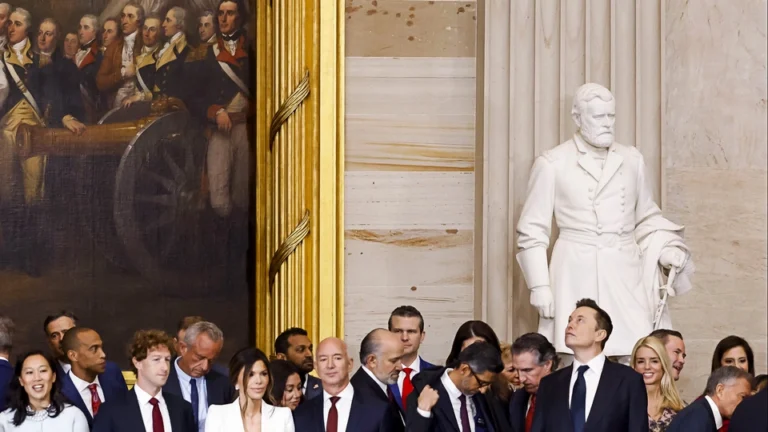
S&Y oddly reject the notion that antitrust can curb a dominant firm’s ability to influence our politics: “Furthermore, very different policies [from antitrust] are used to directly control the political power of large companies, notably the rules regarding campaign finance, lobbying, and media ownership.” By preventing firms from rolling up entire industries via merger enforcement, or by compelling conglomerates to divest key assets previously acquired during the remedies phase of a monopolization trial, antitrust can precisely limit a firm’s political power. Again, one doesn’t have to be an IO economist to observe the CEOs of Amazon, Apple, Google, Meta, and Microsoft seated behind President Trump at his inauguration.
In summary, S&Y make bold claims at the outset of their paper, such as “We explain that the empirical evidence relating to concentration, markups, and mergers does not show a widespread decline in competition.” (emphasis added) But their actual analyses don’t support this claim. What they are really saying in the paper is that it is unclear whether the increase in concentration or price/cost markups are due to a decline in competition or competition in action, and that further research is needed. The paper is effectively click-bait for policy wonks. And by writing this 3,000-word review, I’ve fallen for it.