
Progressives are right to feel that something has gone badly wrong in the way artificial intelligence (AI) is being introduced into society. The anxiety is not abstract. To the extent that graduation ceremonies are any indication, where speakers who celebrated the promises of AI were roundly booed, a small but telling sign that many young people do not experience this technology as an invitation to the future, but as another force being imposed upon them.
Their skepticism is not misplaced. AI data centers compete for critical water resources and contribute to higher electric bills. Military applications guided by AI raise the terrifying prospect of powerful weapons falling into the hands of terrorists or hostile governments. AI-based pricing algorithms can teach would be rivals how to coordinate massive price hikes.
Finally, and the focus on this essay, if perceived by employers as a substitute to more costly labor, or merely as a means to avoid training new workers, AI threatens to inflict massive disruptions in labor markets. Indeed, AI has been shown to have caused job losses already—by The Economist of all places—among recent college graduates in certain fields like computer sciences:
We found that graduates in fields more exposed to AI have suffered markedly worse outcomes. Between 2022 and 2024 graduates in the least-exposed quintile—studying subjects such as education, philosophy and civil engineering—saw their average full-time employment rate fall by just 1.5 percentage points. Those in the most exposed quintile—including computer science, computer engineering and information science—suffered a 6.6 percentage-point drop.
It’s amazing that just a few years ago, many were telling the underemployed to “learn to code.” Turns out, that was not very good career advice. And some universities are actively eliminating certain liberal arts programs that are less exposed to AI disruption.
Progressives are scrambling to design a message that (1) will confront the threat to workers posed by AI, and (2) can be readily distinguished from Trump’s hands-off agenda. In March, Bernie Sanders and Alexandria Ocasio-Cortez proposedlegislation for a moratorium on data center construction until rules are in place to ensure AI doesn’t threaten humanity. In 2024, Chris Coons proposed legislation that would promote the development of AI that aligns with human rights. A recent New York Times essay argued that “[p]rogressives should not only listen to these workers, but also support their labor efforts to pressure large tech companies to be more responsible stewards of this powerful technology.” A good intention, but hardly fodder for legislation. Meanwhile, Trump has been pursuing measures that would preempt AI companies from state regulation.
More than a paycheck
Neoliberals, potentially at the behest of AI benefactors, have filled the policy void with their own proposals. In a May 14 cover story titled “Prepare for an AI jobs apocalypse,” The Economist warned that “As AI firms bid up the price of land and energy, the dollars people earn will go less far. Eventually humans could, like horses in the age of the car, become uneconomical.” The magazine called for a public-wage insurance system, of the kind used in Denmark, to confront the job-displacing threat of AI. The great defender of laissez faire warns that “concentrations of rent must be confronted early, before the power of the rentiers is too great.”
Tech bros are peddling a similar solution to job displacement from AI called “universal basic capital” (UBC). The acronym is a riff on universal basic income (UBI). Of course, Gavin Newsom and other neoliberals are intrigued. DealBook, which too often advances the causes of Wall Street, claimed UBC is “gaining traction in policy circles and Silicon Valley alike.” Never mind that those policy shops are likely funded by AI companies.
Setting aside the dismal prospects of garnering conservative support, the problem with UBC (and UBI for that matter) is that it fails to appreciate the dignity and self-fulfillment in having a job. We are not just consumers; we contribute to society through our occupations as well. As Pope Leo wrote in his encyclical letter on the threat of AI, “Entrepreneurial initiative can indeed be a true vocation, generating wealth and improving lives, rather than a variable that is dependent only on profit. This is possible when it recognizes that the creation of dignified, valuable jobs are an essential part of its proper service to society.” (emphasis added). To the extent AI imposes massive job losses, the remedy must involve replacement jobs, not just a paycheck.
So the first plank of a progressive platform to combat the threat of AI-induced job displacement should include a massive federal jobs program. To secure competitive wages, college graduates need multiple employment options. By eliminating roughly 300,000 federal positions, Elon Musk and other libertarians pulling the strings behind the Trump clown show have been removing public-sector options, rendering workers increasingly beholden to private-sector employers. The result has been rising unemployment among recent college graduates (5.6 percent compared to 3.1 percent for all college graduates) and slower wage growth (relative to a world in which the government was a large buyer of talent). Although there is no need to target specific fields, the program could be tailored to soften the blow to students who majored in a field particularly vulnerable to AI-driven displacement.
An alternative to a federal jobs program is retraining. Color me skeptical. Recall the promises of retraining as a remedy for job displacement from free trade. The requisite retraining remains unclear, as AI threatens to affect myriad labor markets. And workers in government jobs will acquire valuable skills on the job—skills that be honed and monetized later in their careers, potentially in the private-sector.
Internalizing the externality
For the second plank, public policy should impose taxes on firms in industries that inflict massive social costs, whether job dislocations or pollution. As Elizabeth Warren recently wrote in Time, “Taxing AI is one way we make sure the winnings from AI benefit all Americans, rather than channeling them only to the wealthy few.” One possible prescription would tax such firms’ profits at a rate above the normal corporate tax rate. From an economic perspective, we want the firm to “internalize the externality,” by facing the social cost curve rather than the private cost curve.
Crack open any introductory environmental economics textbook and you will find the following figure.
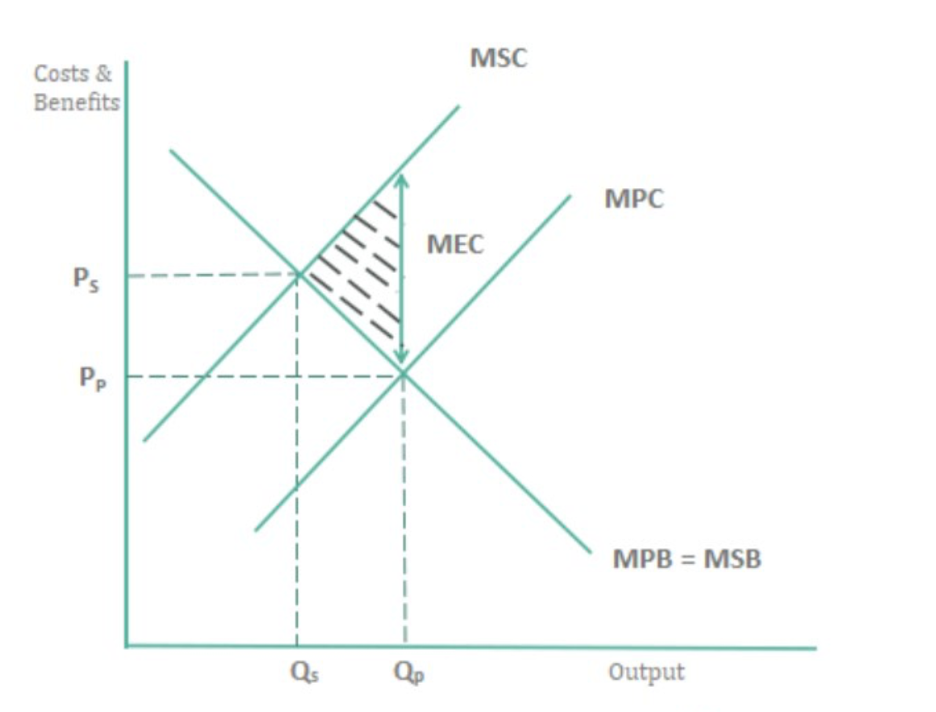
Absent any intervention, market forces will align the marginal private benefit (MPB) with the marginal private cost (MPC), resulting in an output and price of QP and PP, respectively. Had firms been forced to internalize the marginal external costs (MEC), however, the new supply curve would shift upward, resulting in less output QS and higher prices PS. The most direct way to achieve this outcome is to impose a tax on firms that captures the MEC.
Applied here, we should impose a special levy on AI-based companies. If the threat of job dislocation turns out to be overblown, as the chief economist at Open AI intimates, the tax could be adjusted downwards. Given the nascent state of AI, however, I don’t think we have time to measure the external costs with precision, nor calibrate the optimal tax. But that doesn’t mean we should wait for a study. While the United States (perhaps foolishly) never implemented a carbon tax, such taxes have been implemented in nearly 30 countries worldwide, including Canada and the United Kingdom, covering roughly one third of global emissions.
Again, and perhaps surprisingly, The Economist is supportive of a tax on AI profits:
A second category of countermeasures [to prepare for AI-induced job losses] would be better. If employment falls, income that once went to workers is likely to show up as high profits in AI firms, chipmakers, data centres or elsewhere in the supply chain. Clever tax reforms, such as levies on corporate profits that are above a normal return on capital, on land and on natural resources, could capture these rents.
Although the essay doesn’t characterize the problem of lost jobs as an externality, the solution to taming excess profits is similar to curbing a polluting firm. Here, the “rents” captured by AI firms occur because they are capturing the resources that otherwise flowed to workers—that is, they are not internalizing the social costs they are inflicting in labor markets.
Countering Wall Street’s worst instincts
A third and final plank of the progressive agenda is to offset a perverse tendency of Wall Street to reward companies crediting AI for massive layoffs. To Wall Street, labor is a necessary evil that stands in the way of profit-taking. The Wall Street Journal has documented the “Era of the Mega-Layoffs,” citing Snap, Block, and Amazon: “Now, such a company is more likely to get a big stock bump and praise from investors for acting boldly.” So whenever a CEO serves up workers as a sacrifice to the profit gods, her stock soars; the more workers sacrificed, the larger the share lift.
To counter this anti-social incentive, Congress should enact a rule that penalizes companies for mass layoffs announced during earnings calls. Importantly, the penalty would not apply to companies incurring losses or with fewer than (say) 1,000 employees; only those companies (1) that are experiencing rising profits, (2) announce more than 1,000 layoffs, and (3) attribute the layoffs to AI via an earnings call would be subjected to the fines. Companies that profit on American soil partake in a social compact, and part of that social compact is to create and sustain American jobs.
The fine would be equal 100 percent of the avoided wages for the first year after the layoffs. And to avoid the question of how the revenue should be spent by the government, the rule could simply mandate severance payments from the company to workers at those levels.
The Trump administration is moving in the opposite direction—subsidizing AI companies, preempting state regulation, and killing government jobs. So this proposed package would allow progressives to distinguish themselves from the status quo. And it highlights a key stumbling block for other, corporatist agendas such as Abundance: We can’t regulate the worst instincts of companies and Wall Street, on one hand, while defending the oligarchs’ right to profit with impunity, on the other. We have to choose one side. And the side we choose is labor.