
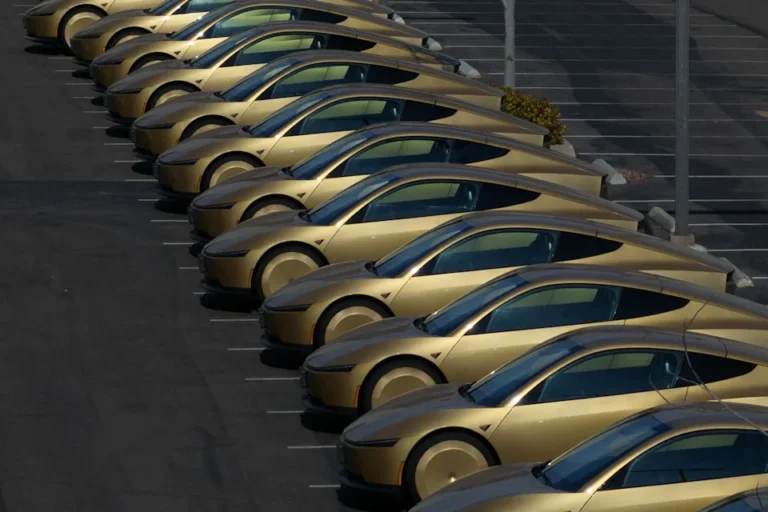
Tesla’s Cybercabs have been all over the news since their viral launch in Austin earlier this month. The two-seater with no steering wheel is not for the faint of heart. But the design of the autonomous vehicle (AV) isn’t as impressive as its growth: Tesla’s fleet increased sevenfold in the three weeks before launch, and Tesla has secured permits for up to 5,000 more vehicles.
On a more optimistic note for labor, in August, Uber and Lyft drivers in California won, after twelve years of organizing, the legal right to unionize. Three chapters of the Service Employees International Union merged to form the California Gig Workers Union, which represents roughly 350,000 drivers statewide and is reportedly the largest single unionization effort in U.S. history.
Prop 22 classifies these drivers as independent contractors, a status that would otherwise block them from unionizing at all. But a 2022 appellate ruling struck down Prop 22’s ban on collective bargaining specifically, and AB 1340 built directly on that opening. The legislation’s main demands were to replace Uber’s and Lyft’s opaque and algorithm-based pay with a transparent rate card that covers the cost of driving, and to establish a fair process before a driver can be deactivated without explanation. New York City drivers already have something close to that—a pay formula that is set and published by regulators.
Surprisingly, Uber and Lyft supported AB 1340, perhaps after recognizing that their efforts to derail it were for naught. Their backing came in exchange for a separate bill, SB 371, that cut their insurance costs.
The bargaining rights granted by AB 1340 could be the first of their kind in the country to be awarded to a job that may not soon exist—AVs after all don’t require drivers, at least not in the same scale.
Credible outside options
To understand what the union won, it helps to think about where a company’s leverage in any negotiation comes from: what each side walks away with if no deal happens at all. Economists call this outcome an “outside option,” the fallback each side has if talks break down.
Right now, drivers have leverage because Uber and Lyft don’t have a real fallback. If there’s no deal, there’s no ride-hailing service in that city. That’s the same leverage any worker has when they’re the only available source of the labor a company needs.
AVs change that fallback calculus, even before they are anywhere close to replacing drivers entirely. Once a viable AV fleet exists in a city, Uber’s and Lyft’s outside option suddenly starts looking much more credible. If the union decides to walk away, the ride-hailing companies can simply say: “We’ll just use AVs to cover for you.”
But it’s not as straightforward as it looks. You would think this threat would only matter if AVs were profitable for the platforms. Why bother using them as leverage if they aren’t? But research on platform competition suggests AVs might not even be a clean win for the companies themselves. If multiple firms race to deploy fleets in the same city, then they will compete away any labor savings by cutting fares to win riders. If that sounds like good news for drivers, it isn’t.
Again, a threat needn’t be profitable to work. It simply needs to be cheaper than paying more. In game theory, a credible threat doesn’t need to be the platforms’ most profitable move; it just needs to be believable enough to change what the union can realistically expect to win at the table.
Watch the trips per hour
Per Gridwide Analytics, Los Angeles and San Francisco, the two biggest markets the new union represents, already have the largest Waymo fleets in the country. If this bargaining-power story is right, the numbers should already show an impact on drivers. Using their data, I compared various measures of output in five AV-active cities—Atlanta, Austin, Los Angeles, Phoenix, and San Francisco—against the national average.
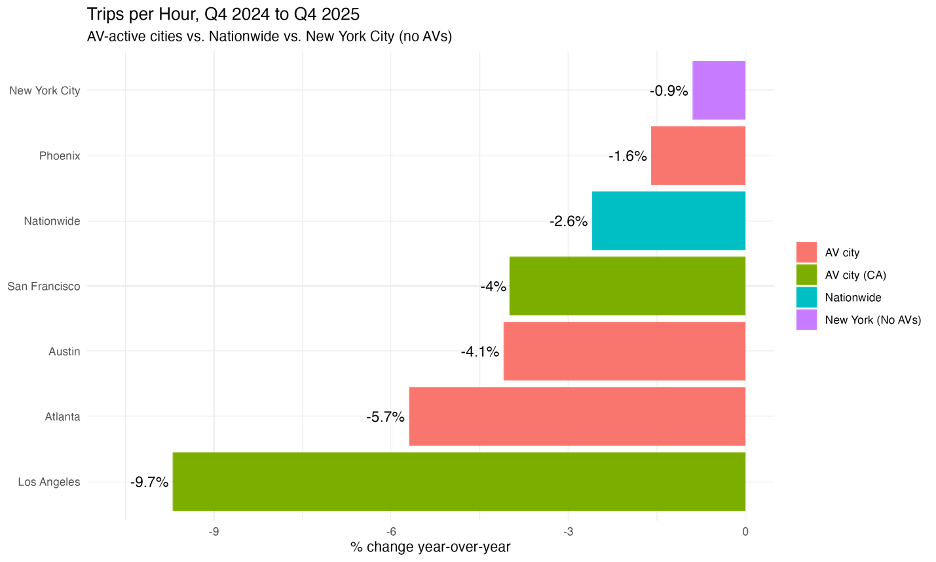
Sources: NYC TLC monthly data (New York City); Gridwise Analytics, “Autonomous Vehicles Impact Report 2026,” p. 8 (all other cities and Nationwide).
As the figure above shows, I find that trips per hour for drivers and driver utilization fell faster in every single one of these cities than nationally. Los Angeles saw the sharpest decline, with trips per hour for drivers down 9.7 percent year-over-year, more than three times the national drop of 2.6 percent. This implies that driverless rides are displacing rides with drivers.
Earnings are a different story. In some cities, such as Atlanta and San Francisco, drivers saw quarterly pay rise because higher per-trip pay and tips made up for the lost rides. In other cities, such as Los Angeles and Phoenix, that cushion wasn’t enough and total earnings fell. For now, companies are making up some of the difference by paying more per ride. But the number that matters most to the threat is how many rides are available, and that keeps falling.
An economist would probably say that correlation isn’t causation, and we don’t know whether AVs are causing trips per hour (with drivers) to decline or something totally unrelated affecting these five cities. To answer that, I used New York City as the benchmark, as the Big Apple doesn’t have any AV presence due to a de facto ban on driverless service. Using the city’s own public driver pay data, trips per hour (with drivers) has remained almost constant, down just 0.9 percent from Q4 2024 to Q4 2025.
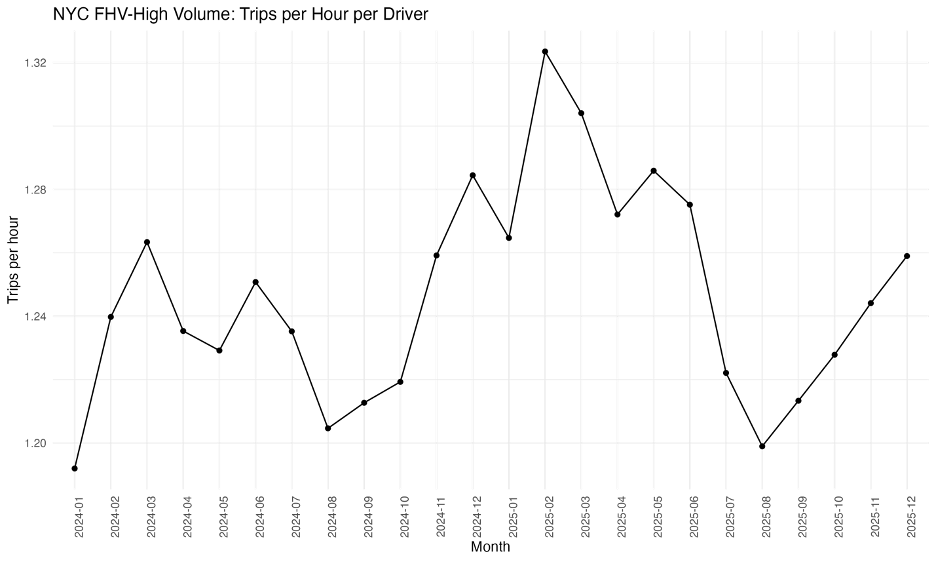
Source: NYC Taxi and Limousine Commission, monthly aggregated FHV data.
A caveat to note is New York’s pay formula already penalizes Uber and Lyft when driver utilization is low, giving the companies themselves a direct incentive to actively manage driver supply. So whatever affected those five cities would probably face higher resistance in New York, simply because the companies there have a financial reason to fight it.
Active regulation can prevent this kind of decline by making it too expensive for ride-hailing companies to let driver activity slide, even once AVs arrive. New York does this on two fronts: the city has a transparent, regulator-set pay formula, and the state requires a licensed human driver behind the wheel of any AV operating on public roads.
Maybe AVs never fully take over, and this all ends up as a footnote. But California shouldn’t let the threat of automation become an excuse to hold back on worker protections. The argument that higher wages will simply push employers toward robots is not a reason to leave workers with fewer protections. If anything, California’s decision to grant ride-hail drivers bargaining rights makes those protections more important as automation encroaches on the space once formerly occupied by humans.
Devesh Ray is an economics graduate student at Columbia University and was a summer analyst at EconOne.