The Supreme Court struck down President Trump’s tariffs in February. The Justices will probably also soon reject his cruel and ahistorical attack on the citizenship of children born in this country. We expect that we will then hear again about how the rule of law is triumphing over a lawless presidency. Should we put faith in our courts to save our democracy? Not quite.
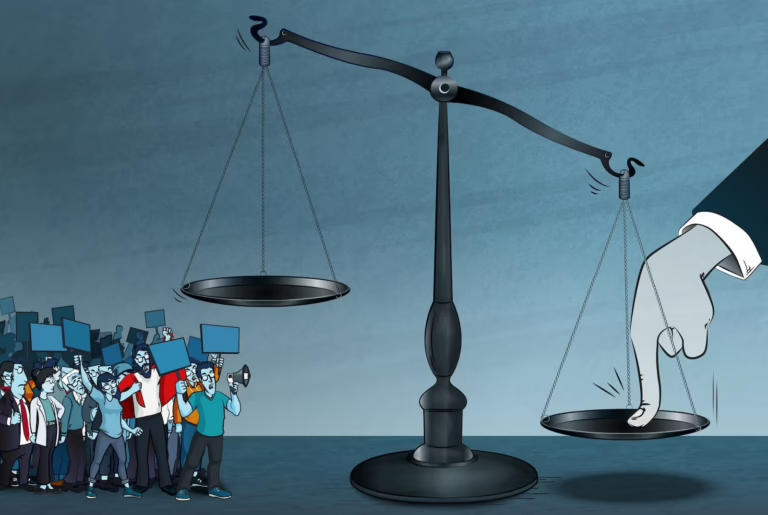
It is true that many lower courts across the country have done their duty and stood up to the Trump administration’s legal chicanery. But the Roberts Court is playing a different game. As others have noted, the key party in the tariffs case was not the Trump Administration but the other side of the “v.”—business interests backed by billionaires, with the support of the Chamber of Commerce. The wealthy almost always win with this Supreme Court, and in too many handpicked lower courts across the country.
Even before Trump stepped back into the Oval, we saw a cynical wave wash over our federal courts on fundamental issues of fairness. Where cases get heard and how they are decided is now completely skewed in favor of the rich, at the expense of decisionmaking by our democratically elected branches of government. The basic rules of litigation, such as who can sue and where, have been basically thrown out the window to rig the system for corporate litigants over people. The unprincipled willingness to do the bidding of corporations that we have seen in too many federal courts is fully consistent with—and may well be fueling—the Trump administration’s cynical disregard for the rule of law. And the Roberts Court is complicit.
A federal district court ruling against the Federal Trade Commission (FTC) in Eastern Texas understandably got less attention than the tariffs decision that same week. But that ruling—unwinding an agency rule requiring merging companies to disclose additional information—highlights the extent to which a decades-long effort, funded by billionaires, to make our legal system friendly to corporate interests has reshaped our judiciary, and in turn our government’s economic policy. Disputes about how our economy should work are now governed by a nearly unshakeable principle: heads the rich and powerful win, tails working people lose. This is not how our democracy is supposed to work. We have even seen some Democratic appointees show fairly shocking deference to corporations seeking leniency under the law, while subjecting plaintiffs seeking the law’s protection to increasingly exacting standards.
Notwithstanding the bravery of certain judges across the country with respect to Trump, the FTC case should be another wake-up call to those committed to core democratic principles of self-governance that our courts as well as administrative law are in dire need of reform. Indeed, consideration of the judges now standing up to Trump is incomplete without an interrogation of the role of the judiciary in getting us here in the first place. And this effort must necessarily extend beyond the Supreme Court’s door at One First Street.
We have written before about the mockery the judiciary has made of Article III standing doctrine and, with it, any notion of fairness or justice in who gets to vindicate their rights in court. While the legally comical developments in Chamber v. FTC (described more fully below) are yet another reminder, the devastation to any effort to build a fairer economy is not the least bit funny.
Through the use of anonymous affidavits touting pinky-promise, speculative harm to generate standing for industry plaintiffs—and with it the grounds to establish the flimsiest of venue claims in hand-selected jurisdictions—federal courts are now firing off advisory opinions in violation of the most basic tenets taught in any introductory class on administrative law. Right-wing judges are falling over themselves to bless the most cynical tactics masquerading as litigation strategy, greenlighting challenges to agency action that have no business being in court, let alone specifically in Texas. These judges, with the tacit and sometimes explicit approval of the Roberts Court, have no problem shredding the credibility of the federal judiciary.
It should be no surprise, even if it is shocking, that the Trump Administration in turn treats judicial orders not to its liking with disrespect. When certain people become accustomed to—or even develop a sense of entitlement about—federal judges becoming political actors who do their bidding, why wouldn’t they view judges who dare to disagree with them as an illegitimate affront?
The Chamber v. FTC Debacle
In 2024, the FTC promulgated new rules under the Hart-Scott-Rodino (HSR) act to help end decades of runaway consolidation across sectors that have robbed communities, working families, and small businesses of independence and choice. In particular, companies would be required to disclose more information about proposed mega-mergers and whether they are likely to be anticompetitive. (The threshold for filing runs above $133 million in 2026 in transaction size, which means the vast majority of mergers and acquisitions do not need to be reported each year.)
Cue the lawsuit in the Eastern District of Texas, with the Longview Chamber of Commerce as co-plaintiffs. You might be wondering where you have heard of the Longview Chamber before. For most people, the answer is likely to be “never.” But some may remember that the Longview Chamber was the local organization that the national Chamber leveraged to challenge certain updates that the Consumer Financial Protection Bureau made to its examination manual in 2022. Those updates incorporated the common-sense and legally obvious notion that discrimination is unfair.
In fact, the Longview Chamber’s case against the CFPB seems to be where the Chamber perfected the standing playbook it deployed in the FTC case: gin up anonymous affidavits promising that “some” of the local Chamber’s members could be harmed by the rule at issue, generate a dubious articulation of some imagined injury, and round it out with ridiculous arguments about the small, local business organization’s relationship to the rule. In that case, the presiding Trump-appointed Judge Cambell Barker signed off all too willingly on this charade, then springboarded off of that holding to produce one of the most egregious abuses of the notorious “major questions” doctrine to date.
But of course, once federal judges stamped their approval on this playbook, business interests were never going to deploy it just against the CFPB. Instead, in a 2025 Texas Bankers Association challenge to an important yet incremental update to regulations that encourage banks to serve their communities—a change that had been approved by every federal banking regulator after painstaking negotiation—the notorious Texas judge Matthew Kacsmaryk signed off on the use of anonymous affidavits to establish standing in the case. Kacsmaryk then used an equally specious application of the major questions doctrine to strike down the underlying regulations.
That line of cases brings us back to Eastern Texas. The Longview Chamber has quickly become a “go to” in the national Chamber’s war on the government’s ability to help working families. For example, that local branch also provided the associational standing hook that the Chamber used to strike down the FTC’s 2024 non-compete rule, which would have ended many of the abusive, lopsided practices that keep working people locked in substandard jobs. That case was yet another one that was shopped to Judge Barker, in this instance actually after the FTC’s opponents failed in a different jurisdiction.
That backdrop helps explain why a case about the FTC’s 2024 HSR merger rules ended up getting mixed up with the Longview Chamber of Commerce. With a population of roughly 233,000 people, it would be fair to wonder just which major corporations in Smith County, Texas, are even covered by HSR reporting, which applies only to companies with tens of millions of dollars of revenue.
The plaintiffs in the FTC case never actually told the court who supposedly would be injured by the new merger rules that they were challenging. Instead, the plaintiffs filed a few declarations from the heads of business organizations claiming that some unnamed member of their group either did or possibly could face harm from the rules.
Here’s a sample of the generic assertions that a federal judge took as sufficient for the Longview Chamber to get standing in the HSR guidelines case:
The Longview Chamber has members that regularly enter into merger, acquisition, or other transactions that meet or exceed the size thresholds for filing a premerger notification form under the HSR Act, including members for which M&A activity is a regular and consistent feature of their business model. Longview Chamber members have already engaged in HSR-reportable transactions this year. In addition, consistent with their past levels of deal activity, members of the Longview Chamber also plan to engage in HSR-reportable transactions in the forthcoming months. These members have been or will be subject to the requirements of the Rule, and thus have incurred or will incur the substantially increased burden and expense necessary to complete the revised HSR notification form.
These bare statements offer exactly as much specificity about which actual entities were harmed or would be harmed as there is evidence to demonstrate the veracity of their claims—none.
The Chamber filed its lawsuit against the new HSR merger guidelines in the Biden era. Surprisingly, the Trump FTC actually at least initially chose to keep up the Biden FTC’s fight to defend the rules by continuing to litigate the case against the Chamber, which the Trump FTC later called a “left-wing . . . activist group.” And even the Trump FTC saw through the Chamber’s standing charade, writing that “Plans and intent based on nothing more than business objectives or aspirations cannot demonstrate a constitutionally cognizable injury.” Did this bother the Chamber’s hand-selected judge? Did he offer even an iota of pushback to the Chamber’s bare assertions?
Of course not. In a ruling on February 12, 2026, Judge Jeremy Kernodle, also of the Eastern District of Texas, gave the green light to the plaintiffs, holding that their paper-thin assertion of standing could hold.
The contents of that ruling are damning. For example, one aspect of standing is that the case has to be “germane” to the plaintiffs’ supposed interests. But Judge Kernodle hand-waved that away:
[T]he Longview Chamber has established that its purpose is to “advocate for policies that promote economic development and job creation,” including by “challenging harmful and misguided federal regulations.” The Longview Chamber has also demonstrated that the Final [HSR] Rule would harm its members and the local economy. This satisfies the “pertinence” between the lawsuit and the Longview Chamber’s purpose.
Think about that: under this gloss on Fifth Circuit precedent, would there be any government action about which an organization stating that its mission is to address “harmful and misguided” regulations would not be able to handpick venue for a challenge?
And given how malleable and ultimately lawless this playbook is, is it really a surprise that Trump and his administration claim that judges operate by “ideology”? Why wouldn’t they think that the federal courts are simply one more tool in their political project? With that fundamentally cynical view of the law, it really should not be surprising that they treat any judge brazen enough to stand up to them as illegitimate—or that they openly call for, and maybe already are, defying judicial orders. Their legal cynicism is not excusable. But it should not be astonishing.
This Madness Must End
The Fifth Circuit’s body of standing and administrative law “doctrine” has developed into an undemocratic and unaccountable blockade on the ability of the government to effectuate nationwide economic policymaking. Skeptical? Remember that this is the Circuit that deemed a tweet reviewable “agency action.” The outlandish standing and venue decisions flowing from three-judge panels in New Orleans have allowed right-wing judges in a single circuit to serve as roving bands of decisionmakers regarding all nationwide economic policy. The courage of certain judges around the country to rule against Trump—including even the Supreme Court occasionally—doesn’t change a thing about that.
The Fifth Circuit’s super-regulators in robes now get the final say over whether democratically elected officials have any ability to regulate nationwide markets and ensure standards of fair dealing to protect working people. The Chamber’s “CFPB playbook” might be great for the bottom line of its members, and a suitable (if shameful) vessel for ideological judges to instill their agenda on the American people. But it is devastating our democracy. People who care about the rule of law cannot allow this untenable situation to remain the status quo.
Fueling these opinions is the Fifth Circuit’s willingness to make a mockery of longstanding precedent. Judges are openly thumbing their noses at fundamental limits on the judiciary. So far John Roberts and his Court don’t seem to care. It is increasingly beside the point whether the Justices are consciously choosing to let billionaires control the federal judiciary. The functioning of our federal courts is broken, the Supreme Court is ignoring the problems when it is not causing them, and working people are paying the price.
The Trump Administration initially appealed the FTC HSR decision to the Fifth Circuit, though it apparently is walking that back now, letting another effort to unrig the economy fall by the wayside. The next Democratic administration, when it takes power, needs a Department of Justice eagerly and aggressively willing to press appeals, all the way to the Supreme Court—not just on the corporate accountability and consumer-protection issues that we have worked on, but on the many, many matters where the nation is reeling under the weight of judicial powergrabs that some still pretend represent principled doctrine. Some may question fighting back or litigating these issues, wondering whether appealing to this Supreme Court will make anything better. But really, can it get any worse? And if the Court blesses this sinister, naked corruption, Congress or another body with authority, such as the Rules Committee for the Federal Rules of Civil Procedure, needs to step in.
The FTC case, and the ones before, should make one thing abundantly clear: if we want our country to actually function, to have a government and democracy that people actually believe in and one that is worth fighting to keep, we must have court reform. Nothing that has happened during the Trump administration changes this crucial fact. We can praise judges who do the right thing without hesitating to pursue the critically important work of reforming our legal system. We must rein in what is happening at the Supreme Court and also what happens in Texas. Both are part of the same cynicism and rigging of the judicial system that has eroded so much faith in our democratic values and the rule of law. And fixing both are a necessary component of reestablishing our democracy.
Seth Frotman was general counsel of the Consumer Financial Protection Bureau from 2021 to 2025. He is a senior fellow at the Columbia Law School Center for Law and the Economy and the University of California Berkeley Center for Consumer Law and Economic Justice.
Brad Lipton was the senior advisor to the general counsel of the Consumer Financial Protection Bureau from 2022 to 2025. He is the Director of Corporate Power and Financial Regulation at the Roosevelt Institute.