Should those of us who believe that the vigorous enforcement of the antitrust laws is in the public interest fear the rise of textualism? After all, textualism is the method of statutory construction that historically was pushed by Justice Scalia, and today it is usually used by the most conservative Supreme Court justices. In cases such as Dobbs v. Jackson Women’s Health Organization, the Court used textualism to overturn well established liberal precedent.
Yet, we shouldn’t fear textualism. It’s even possible that textualism could help promote robust antitrust enforcement. Consider, for example, the original, aggressively populist words of Section 7 of the Clayton Act. It prohibits mergers the effect of which “may be substantially to lessen competition or to tend to create a monopoly.” Notice the “may” language. (Also notice some aggressive language that is beyond the scope of this article, the “tend to monopolize” language. Also notice that the original language of Section 7 contains no efficiencies’ defense!)
Although some recent court decisions use “may” in the way that it usually is defined today, many decisions have re-articulated “may” in ways that give the term a very different meaning. For example, in United States v. Baker Hughes, Inc. (then) Circuit Court Judge Thomas affirmed a district court’s conclusion that “it is not likely that the acquisition will substantially lessen competition….” (boldface added). A similar articulation appeared in In re Cast Iron Soil Pipe & Fittings Antitrust Litig., a requirement that “the effect of the merger is to substantially lessen competition or tend to create a monopoly.” (boldface added).
Other courts have re-formulated the “may” language in the context of implementing a three-part balancing test, including the 3rd Circuit’s 2022 opinion in FTC v. Hackensack Meridian Health, Inc.: “First, the FTC must establish a prima facie case that the merger is anticompetitive.” (boldface added). Recent opinions from the D.C. Circuit have substituted “is likely to” for “may,” including United States v. UnitedHealth Grp. Inc.: “[T]he government must show…that the proposed merger is likely to substantially lessen competition.” (boldface added).
These differing but all conservative re-formulations of “may” have been used in many other recent merger cases as well. They give rise to a question for which textualist analysis was well designed: What did “may” mean when the Clayton Act was passed in 1914? Did it mean the same thing as “may” means today? The same thing as “is likely to” or “will”?
A textualist analysis would attempt to determine what “may” meant when this word was used in the Clayton Act by starting – and in almost all cases ending – with the exact words of the statute. It would ascertain what “may” meant when the statute was enacted by giving this word the plain, ordinary, everyday, meaning it had at the time. But it would ignore the statute’s legislative history.
Justice Scalia’s treatise on textualism, Reading Law: The Interpretation of Legal Texts, emphasized that modern enforcers and courts should analyze how the words and phrases in question were used in leading English language dictionaries of the period and (if applicable) also in contemporaneous legal dictionaries, legal treatises, and cases. Scalia helpfully provided lists of the English language dictionaries and legal dictionaries and treatises he considered “the most useful and authoritative” for various time periods. Two of these lists, for dictionaries and for legal treatises, covered the 1901-1950 period, which encompasses both the 1914 enactment of the Clayton Act and its major amendment in 1950.
All four of the English language dictionaries from this period Justice Scalia considered to be the “most useful and authoritative” defined “may,” but none defined the full phrase, “may be substantially.” What follows are the principle definitions contained in each dictionary. Some of these full definitions are quite lengthy.
The Century Dictionary and Cyclopedia (1904) defined “may” principally as: “…. The principal uses are as follows: (a) To indicate subjective ability, or abstract possibility: rarely used absolutely …. (b) To indicate possibility with contingency….” The Oxford English Dictionary (1908) defined “may” principally as: “The primary sense of the verb is to be strong or able, to have power…. to have power or influence; to prevail (over)…. Expressing objective possibility, opportunity, or absence of prohibitive conditions; = CAN…. Expressing subjective possibility, i.e. the admissibility of a supposition. a. In relation to the future (may = ‘perhaps will’)….” Webster’s Second New International Dictionary (1934) defined “may” principally as, “To have power; to be able…. Liberty; opportunity; permission; possibility; as, he may go; you may be right…. Desire or wish…. Contingency….” Funk & Wagnalls New Standard Dictionary of the English Language (1943) defined “may” principally as: “To have permission; be allowed; have the physical or moral opportunity as, you may go; ….To be contingently possible; as it may be; you may get off….”
The Century Dictionary and Cyclopedia explicitly said that, even though “may” could be used to mean only a theoretical or “abstract possibility,” may was “rarely used absolutely” in this way. Webster’s Second New International Dictionary similarly said, “Archaic Ability; competency; – now expressed by can….” The other two dictionaries did not, however, say that an absolutist or literal usage of “may” to mean even a tiny or theoretical possibility was archaic.
All four dictionaries, of course, defined “may” in terms of a possibility or contingency. None of these dictionaries used anything resembling an “is likely to” or “will” or any other type of “more likely than not” standard that was used in the cases cited earlier.
In addition, for the 1901–1950 period, Justice Scalia listed five legal dictionaries and treatises he considered to be “the most useful and authoritative.”. Three included relevant definitions of the word “may”. The Cyclopedia Dictionary of Law (1901) defined “may” as: “Is permitted to; has liberty to. The term is ordinarily permissive….” Legal Definitions by Benjamin Pope (1920) defined “may” principally as: “The word “may” and like expressions give, in their ordinary meaning, an enabling and discretionary power….. When a statute declares that something “may” be done, the language is, as a general rule, permissive….” Bouvier’s Law Dictionary (1940) defined “may” as “Is permitted to; has liberty to… Where there is nothing in the connection of the language or in the sense and policy of the provision to require an unusual interpretation, its use is merely permissive and discretionary….”
These legal dictionaries and treatises are thus consistent with the uses of “may” in the English language dictionaries of the period. None are consistent with the case law cited above.
Especially in light of “may” being used in conjunction with the phrase “be substantially to lessen competition,” it is highly unlikely that Congress wanted “may” to encompass mergers with only a tiny, theoretical chance of substantially lessening competition. The word “may” in Section 7 of the Clayton Act does not, however, limit the law’s prohibitions to mergers that are “likely” to or “are more likely than not” to or that “will” substantially lessen competition. A possibility or a modest probability should be enough.
This textualist analysis demonstrates that the “may” was intended by Congress to mean exactly what it means to a modern speaker of the English language. To the extent recent cases have deviated from Congressional intent, these cases should be overturned. If the courts accept the conclusions in this article the crucial question for believers in aggressive antitrust becomes: how much more vigorous would antitrust enforcement become? It is impossible to know.
To answer this question one should step back and ask the extent to which conservative judges would honestly and faithfully implement this statute as it was written even though they disagree with this wording? This dishonesty could happen even though judges are, of course, not supposed to substitute their own policy preferences for those of Congress.
Suppose, for example, a particular Circuit Court decided that a textualist reading of Section 7 should block all mergers with only a “non-trivial but modest possibility” of leading to a substantial lessening of competition? Would a conservative District Court judge presiding in that circuit who was sympathetic to corporate mergers find another, result-oriented way to dismiss a challenge to a merger? This type of judge could, for example, find a way to artificially broaden the definition of the market and thereby reduce defendant’s post-merger market share dramatically. Could a conservative judge deliberately find, on the basis of a paucity of evidence, that entry was easy and erroneously conclude that the post-merger firm had no ability to substantially affect competition?
Justice Kagan’s recent dissent in West Virginia v. Environmental Protection Agency challenged the sincerity of the current Supreme Court’s embrace of textualism. She believes they allow their conservative values to override their allegiance to textualist analysis:
Some years ago, I remarked that “[w]e’re all textualists now.” . . . It seems I was wrong. The current Court is textualist only when being so suits it. When that method would frustrate broader goals, special canons…. magically appear as get out-of-text-free cards. Today, one of those broader goals makes itself clear: Prevent agencies from doing important work, even though that is what Congress directed…. [an] anti-administrative-state stance….
The antitrust statutes are populist in their origin and nature, and were written using language that reflects the populist, pro-consumer, anti-monopoly beliefs of the time. Congress certainly intended the Clayton Act to be an aggressive pro-consumer statute. Sadly, this law has largely been rendered ineffective by decades of conservative judicial interpretation.
The Supreme Court’s recent embrace of textualism, however, provides a hopeful path for returning Section 7 to its original meaning and purpose. Whether particular conservative result-oriented justices will embrace the logical implications of textualism, or decide that their adherence to textualist analysis is less important than their political beliefs, is impossible to predict.
Textualist analysis could cause courts to re-examine what they have been doing in Section 7 cases and to analyze this law with a fresh perspective. This could cause them to find and follow Congress’s original, vigorous purpose, rather than to simply follow precedent that often has deviated from the precise language contained in Section 7.
It is safe to conclude that a textualist reading of Section 7 of the Clayton Act should not trouble those who believe in robust antitrust enforcement. But in light of the conservative nature of so many judges and justices and the ease that dishonest judges would have to find ways to reach the results they prefer, it is impossible to predict whether antitrust enforcement will become more robust.
Robert Lande is the Venable Professor of Law, University of Baltimore School of Law. This article is a condensation of part of a law review article on the topic scheduled to appear in the Utah Law Review. See Robert H. Lande, “Textualism As An Ally of Antitrust Enforcement: Sections 2 and 7” (forthcoming) (draft available upon request).
Last week, I had the honor of presenting a paper, co-authored with Jacob Linger and Ted Tatos, on the causes of rental inflation to competition authorities from around the world at the OECD competition conference in Paris. Many factors contribute to rising rents, but one factor hasn’t received much attention: the consolidation of properties by developers within neighborhoods. I’m hoping to change that.
Softening the Beachheads
Before telling you my theory on the nexus between competition and inflation, let me say what it is not: It is not that concentration changed suddenly in 2021, causing an uptick in prices. That’s a straw man invented by Larry Summers and other members of his neoliberal cabal. The real nexus rests with the ability of market concentration to facilitate price coordination, and a small bout of inflation can grease the skids even further.
In December 2021, I was in a courtroom in San Francisco watching a videotape of a Japanese executive whose company was embroiled in a price-fixing conspiracy. And the CEO told the jury that his cartel functioned most efficiently during times of inflation. I nearly fell out of my wooden bench.
He offered two theories, which I have translated into Economese. The first is what I call “Softening the Beachheads,” an unfortunate war analogy. Consumer resistance to price hikes may soften with inflation because there is now a pretext for the price increase. The second is what economists will recognize as a “focal point”—inflation solves coordination problem by providing a floor for future price increases.
Notice that neither theory requires any increase in concentration. The driving force lies with the interaction of inflation with the existing high level of concentration, exacerbated by existing coordination among firms.
The Rental Inflation Problem
Although general inflation began to fall below nine percent in the United States in August 2022, the CPI for “Shelter,” comprised of “Rent of primary residencies” plus “Owners equivalent rents of residences,” continued rising, reaching levels above nine percent. Shelter contributes 32 percent to the total CPI and about 40 percent of core inflation. With the exception of the onset of Covid, housing inflation has generally tracked overall inflation. In 2022, rents were up almost 15 percent in the Miami/Atlanta metro area and by 21 percent in Phoenix. Per Zillow research, renters face growing housing affordability hurdles in the United States; renters in Miami, for example, need to work 96 hours at the average wage to pay the typical rent.
Given its outsized importance, if we could solve the rental inflation problem, we could go a long way to solving the problem of inflation generally. To use a simple analogy, if there was a fire alarm going off in your house, you would want to know the source. Is it coming from upstairs? And once you know the room, you might be able to put out the fire there. You wouldn’t want to apply some generalized treatment, like bulldozing the house.
Some might mistakenly consider the story of rental inflation to be in the rear-view mirror because the Zillow Observed Rental Index (ZORI) has been falling in the last half of 2022.
National ZORI Index (Percentage Change from Last 12 Months)
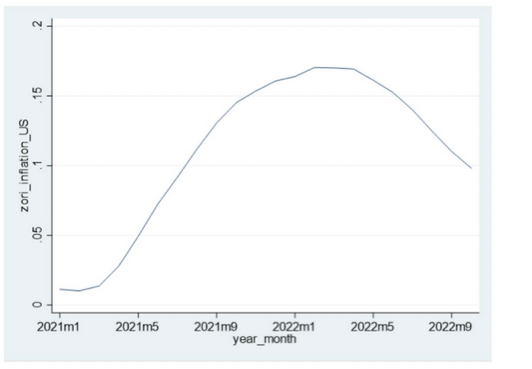
As the figure shows, even by October 2022, the ZORI was still above ten percent, which exceeds the general CPI. More importantly, because the ZORI is a measure of asking rents, the index will display a more pronounced inflation decline compared to the average rents across all rented units, including those already paying rents at prior agreed-upon rates. In other words, we’re not out of the woods.
Economists Have Their Stories
Economists offer myriad competing narratives. The neoliberal crowd tends to look for stories that absolve the companies actually setting prices. Krugman speculates that the demand for remote working from home, initiated by Covid, caused consumers to demand larger household footprints. This isn’t a very a compelling hypothesis, as it wouldn’t explain across-the-board rental inflation, including on smaller, one-bedroom units. A Redfin economist blames migration from the Coastal cities to the Sun Belt, again initiated by Covid. Again, not entirely persuasive, as it fails it to explain rising rents outside the Sun Belt. And the business press, including the speciously liberal New York Times, harps on the claim that higher prices, including for rents, are caused by higher costs; never mind the marginal cost of leasing the last unit of a multi-family residence is close to zero.
Or maybe, just maybe, the companies setting rents are to blame. I realize this is novel stuff, particularly among economists conditioned to reflexively defend market outcomes as efficient regardless of the mechanism behind them. In ten U.S. cities, including Atlanta, Jacksonville, Tampa and Orlando, institutional investors, defined as entities owning over 100 properties nationwide, had previously acquired at least 15 percent of all single-family rental units. This suggests a possible nexus between concentration (in levels) and rental inflation.
Proving the Nexus
We are not the first to examine the nexus between rental pricing and concentration. If you read our paper, you can learn about these studies in our literature review. I’ll call your attention to just one—a Federal Reserve Bank of St. Louis paper finding a connection between institution ownership and rent to income ratios in a metropolitan statistical area. They find that purchases by institutional investors, as measured by the share of properties owned by all institutional investors collectively in a Metropolitan Statistical Area (MSA), increase (1) the price-to-income ratio, especially in the bottom price-tier, the entry point for first-time buyers, and (2) the rent-to-income ratio generally, especially where the housing supply elasticity is high. By treating all institutional investors in the aggregate and thus as if it were owned a single entity, however, the St. Louis Fed study may have overlooked the incremental explanatory power of clustering properties by a single institutional owner in a given neighborhood. Put differently, an MSA with (say) ten percent institutional ownership, split equally across ten owners, could exhibit different pricing dynamics than an MSA with ten percent institutional ownership split equally across just two owners.
To address this evidentiary gap, we used Florida property tax roll data to construct the footprint of property owners in each neighborhood or census tract. We did this for two separate market distinctions: (1) All non-owner-occupied housing properties, and (2) all multifamily properties. This is an animated map of the South Shore neighborhood of River View from 2015 to 222. You can see how these five owners have built up a cluster of properties over time. And that cluster gives them pricing power, both unilaterally and collectively.
We calculate the Herfindahl Hirschman Index (HHI) among property owners in a given Census Tract as the primary explanatory variable of interest. This approach assumes that the Census Tract approximates the area over which renters perceive rental units to act as reasonably close economic substitutes (or in antitrust parlance, a relevant geographic market). We believe this is the case as renters choose where to live based on neighborhood attributes, and neighborhoods can exhibit wide variation within a specific county or city. Yet there is not a consistent geographic mapping of neighborhoods within the social sciences, and Census tracts are often instead used as a proxy. For each of these markets, we estimate the tract-level HHI by summing the squared unit market share values within the tract. The figure below presents a map of tract-level HHIs in 2022 based on unit shares of non-owner-occupied housing properties. Lower HHI areas are colored lighter yellow, while higher HHIs areas appear in dark red. We lacked ownership data for those areas that appear whited out.
Florida Census Tract HHIs in 2022

Source: 2022 Florida Property Tax Roll Data. HHI’s are unit share based.
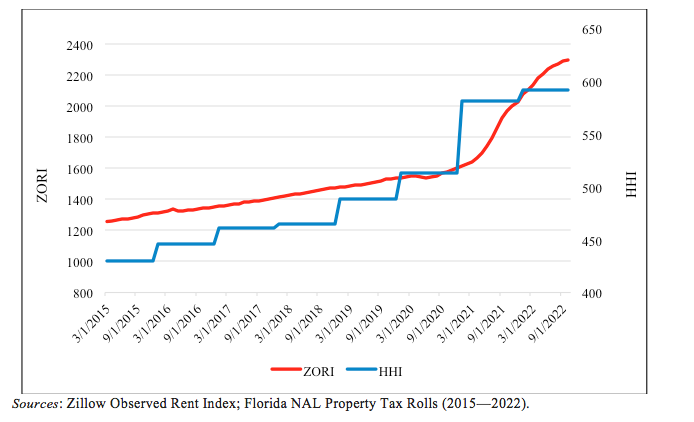
For rents, we utilized the Zillow Observed Rent Index (ZORI), which indexes the mean of the middle 30% of asking rents by month. The figure below plots the relationship between our measures of rents and rental ownership across time for all non-owner-occupied rental markets. Both rents and concentration levels have seen a steady uptick, with an increasing inflationary trend over the last two years.
Florida Monthly Average ZORI and HHI by Census Tract (2015—2022)
Sources: Zillow Observed Rent Index; Florida NAL Property Tax Rolls (2015—2022).
You can see how the ZORI seems to track the average HHI across all Florida neighborhoods. To be fair, this relationship would not explain rental inflation, but instead would suggest that higher concentration is associated with higher rents. There does appear to be a jump, however, in the average HHI at the beginning of 2021, which could be an inflation story—though not the one we’re telling.
To investigate this relationship further, we build a regression model that sought to relate concentration with both rent levels and rental inflation, controlling for other things that drive rents, such as migration. I’ll leave it to the reader to go check out our results. (And for the R-squared nuts on Twitter, you’ll have to come up with a better rejoinder this time!) Our main findings are that both rent and rental inflation in Florida are statistically and economically significantly correlated with the level of concentration within a neighborhood or census tract.
Surrendering to the Chicago School
We are keenly aware of the controversy in industrial organization of using HHI as an explanatory variable in a price regression. (Not much has been written on inflation regressions, but we expect the same critique.) We think the lesson from Whinston and other pioneers in this area is to look for instruments or proxies for HHI, rather than abandoning the exercise altogether. Indeed, we think it was a colossal mistake of liberal economists to offer this concession to Demsetz and the Chicago School, which was set on undermining the structural presumption. And indeed they won and antitrust enforcement was largely feckless over the last 40 years. If you want to learn about our instruments, and how they withstand various tests, you can read the paper.
With regard to policy implications, raising interest rates puts home ownership out of reach of millions of families, driving them to the rental markets, which bids up rental rates, which is one of the primary drivers of inflation. Let that sink in! Our results suggest a different course for arresting rental inflation—namely, for cities or states (or both) to impose an ownership limit on the amount properties an individual owner could control in a given neighborhood. Antitrust enforcement could serve as a check against inflation over the long term, to the extent it is used to fight concentration in rental markets and through the economy writ large; but given antitrust’s glacial pace, the best course now for arresting rental inflation requires going outside of antitrust.

Given antitrust enforcers’ expressed interest in employer power and the potential for market structures and conduct within the remit of antitrust enforcement to harm workers, one natural remedy they might consider is unionization. There is already considerable empirical research to the effect that collective worker organization is an effective counterweight to employer market power. And while no public agency can (or should) force workers to join and be represented by a union, they can encourage (indeed, mandate) that employers remain neutral as workers consider whether to unionize, and with which union. That ‘neutrality’ amounts, in effect, to employers not availing themselves of the range of tactics at their disposal to discourage unionization—tactics the videogame development studio Activision Blizzard is currently making full use of in the face of a nascent union drive, an early effort in an industry that has historically had deplorable labor standards, trading on both the workers’ loyalty to the product and the fact that they tend to be young and hence to have fewer social ties and obligations that would lead them to demand better working conditions. Such tactics aren’t surprising in a company with “an open frat boy environment [that] fostered rampant sexism, harassment, and discrimination,” according to the complaint in a sexual harassment lawsuit filed this past October.
But Activision Blizzard—makers of Call of Duty and other popular franchises—has also agreed to be bought by Microsoft for $68.7 billion and merged into its Xbox Game Studios, a transaction that is currently pending before the FTC and European enforcers. Microsoft entered into a neutrality agreement with the Communications Workers of America for Activision Blizzard that promises to make the path to unionization in the videogame development industry much smoother if the merger is consummated, a development that would be a major step toward cementing the increased worker militancy to have erupted in recent years, particularly among younger workforces. Hence, if the merger is approved, the path forward for unionization in the industry appears bright.
The Microsoft-CWA neutrality agreement represents a union taking advantage of an improved negotiating position due to merger review to score a win on behalf of workers (or rather, to make such a win much more likely in future). A clearer-cut example of the utility of neutrality agreements in merger remedies would concern a merger alleged to harm workers, to which the remedy would be unionization (a second-best outcome to outright blocking a merger). A worthy example when a union neutrality remedy could have been used was Uber’s 2020 merger with Postmates, which the Justice Department declined to challenge but which removed one of very few alternative platform employers for already-disadvantaged gig workers in the rideshare and food delivery business. DOJ should have tried to block the merger, and in the event that attempt was unsuccessful, sought not only employment classification for rideshare and food delivery drivers as a condition for permitting the merger to go forward, but neutrality in any subsequent organizing campaign. Indeed, gig workers are particularly likely to benefit from collective bargaining, but in the past antitrust enforcers have sought to prevent it on the grounds that collective bargaining by non-employees would violate the Sherman Act, in a kind of circular reasoning that has frustrated the thousands of gig workers consigned to an independent contractor status without employment protections, but without any ability to truly operate independently, including by choosing to bargain collectively.
(An alternative remedy would have been to enforce the independence gig platforms promise to workers by ending resale price maintenance and Most-Favored Nations clauses, mandating full, unconditional data-sharing, and prohibiting non-linear loyalty pricing. But that sort of behavioral remedy to a merger has been shown to be difficult to enforce once the merger is concluded, so while the antitrust agencies should indeed enforce the economic independence of bona fide independent contractors, merger control is probably not the best way to do it. Rather, the FTC should look to Section 5 enforcement. The utility of union neutrality as a remedy is that it creates an independent agency to police labor standards.)
Which brings up another example of what not to do in negotiating or sanctioning a neutrality agreement: the proposed legislation to permit “sectoral bargaining” for rideshare and food delivery workers that the New York state legislature considered (but luckily didn’t pass) in 2021. That would have surrendered employment status and already-won labor standards for rideshare and food delivery workers, in exchange for nominal “representation” by company unions who stood to receive a hefty agency fee, plus antitrust immunity for the arrangement and a no-strike pledge. That cautionary tale is a good example of what regulators should not allow, even if (some) unions ask them for it. Which raises the issue that discerning what types of representation are in workers’ best interest requires specialized knowledge and experience with labor relations—exactly the purpose to which the federal antitrust agencies should put their memoranda of understanding with the NLRB and Department of Labor.
There remains one important (depending on whom you ask, paramount) consideration in the Microsoft-Activision Blizzard merger review: whether the merger would harm consumers, even if the neutrality agreement means it would likely benefit workers. This is a vertical merger wherein the manufacturer of one gaming console would acquire the supplier of must-have content for those consoles, potentially disadvantaging manufacturers of rival consoles if the merged firm withholds the must-have content and makes it exclusive to Microsoft’s Xbox. In this case, the leading rival is Sony, the manufacturer of the Playstation console, which competes for the same customer base of avid gamers with Xbox and which would be a substantially weaker price competitor if its products couldn’t carry Call of Duty. On its face, this vertical deal is ripe for a challenge, since Xbox and Playstation are such close rivals for the same consumers and Call of Duty is likely must-have content. However, there have been public reports of a 10-year deal to license Call of Duty to Sony’s Playstation, which would obviate the foreclosure theory of harm if done on similar terms as XBox’s access to it post-merger. It’s possible for Microsoft to make Call of Duty available to Sony, but still disadvantage Playstation-compatible versions of the game relative to Xbox-compatible ones. In such a case, it is hard to distinguish between merger harms—disadvantaging Sony—and merger efficiencies—advantaging Microsoft. What that means is that the success of any challenge would come down to whether Sony is willing to state a public position against it.
Those of us who have encouraged antitrust enforcers to center worker welfare in their competitive analysis have consistently taken the position that harming workers should not offset or counterbalance consumer benefits, as has too often been the case in antitrust policy in the past, when agencies credited merger “efficiencies” that amounted to labor exploitation. Hence, it is difficult now to say that benefits to workers (in the form of much-increased probability of union representation at an otherwise-hostile workplace) should offset would-be harm to consumers. Notwithstanding the neutrality agreement, the proposed merger may still violate the Clayton Act. However, the lesson from this episode is that unions and would-be unions can and should use the tools made available by antitrust enforcers’ interest in labor markets to score victories on behalf of workers and, hopefully, re-engineer the internal political economy and corporate culture of dominant firms with continued business before the antitrust agencies and courts. At the same time, enforcers should be vigilant about ensuring that accommodations reached by unions and employers do in fact benefit workers.
Many have discussed and debated consumer welfare standard (“CWT”). The CWT is the normative economic standard based on Marshall’s consumer surplus theory that many advocate should guide antitrust policy and goal selection.
In our recent paper with Gabriel Lozada, we have categorized the problems with the consumer welfare theory into three general groups: (1) The theory is narrow because it eliminates traditional antitrust goals and populist antitrust goals a priori; (2) Its policy prescriptions are biased in favor of big business and the wealthy, and (3) It suffers from serious internal inconsistencies that have caused most welfare economists to abandon the approach. In this post, we summarize the first categorical problem with the CWT: Only factors that affect surplus matter.
Antitrust goals
According to CWT advocates, if something can’t be measured using economic surplus, it can’t be a goal of antitrust policy. When Judge Bork and other Chicago School advocates rebranded Alfred Marshall’s consumer surplus theory as the CWT, they were motivated by a desire to purge what they referred to as “value judgments” from antitrust policy. These “value judgments” were the traditional antitrust goals of promotion of political democracy and protection of small business that prominently appear in the legislative history of the antitrust statutes and have been recognized by many pre-Rehnquist Court Supreme Court opinions. As an example, Justice Warren wrote in Brown Shoe that “Congress was desirous of preventing the formation of further oligopolies with their attendant adverse effects upon local control of industry and upon small business.” Yet CWT advocates dismiss such concern.
Marshall’s theory served this purpose because it defined economic welfare as economic surplus, the difference between demand and price. Consumers have economic surplus, as does labor (the difference between the actual wage and the reservation wage), as do intermediate sellers. CWT advocates argue that if a policy goal can’t be measured using economic surplus, it is not “objective,” “scientific,” “economically viable,” or whatever methodological adjective they wish to use. Those arguments demonstrate that the choice of CWT advocates is a value-laden policy choice, not one founded in science.
What would Marshall think?
The Chicago School application of Marshall’s theory is not supported by Marshall or modern welfare economics. Marshall himself recognized that welfare was much broader than economic welfare. Marshall and Pigou merely used the term “economic welfare” to distinguish the measurable aspect of total welfare using Marshall’s approach from the rest of total welfare. Indeed, neither economist ever advocated that only what was measurable was a proper goal for government policy. In his day, Marshall supported many policy initiatives that were not strictly measurable using the surplus approach.
Today, major programs initiated by welfare economists are measuring many aspects of welfare that are not directly captured by economic surplus, such as the impact of democracy, health, inequality, sustainability and others, and no welfare economists believe that welfare is limited to economic surplus or is captured by growth of output or GDP. For example, the U.N., the World Bank, the OECD, and many countries have initiated projects to better measure welfare.
There is no economic reason to discard the long standing traditional antitrust goal of dispersion of economic and political power. Stephen Martin has recently made this case. Both Senator Sherman and Senator Hoar, important drafters of the Sherman Act, expressed concern that monopolies would undermine democracy. Members of Congress repeated those concerns when they passed the Clayton Act and the FTC Act. Concerns about democracy were prominent in passage of the Celler-Kefauver Act. These concerns were echoed by Supreme Court Justices. Well, until relatively recently.
Research by welfare economists shows that democracy is a major factor in human well-being and quality of life. Bruno Frey summarizes the literature on democracy and well-being in his book Happiness: A Revolution in Economics, concluding that:
Overall, these results suggest that individuals living in countries with more extensive democratic institutions feel happier with their lives according to their own evaluation than individuals in more authoritarian countries. These results are not prompted by directly asking whether individuals would be happier living in a democracy. Rather, the subjective, self-reported evaluation of well-being has been gathered, independent of the objective political conditions. Moreover, many other influences on happiness are controlled for, and a certain amount of trust can therefore be placed in the results.
Political democracy was an originating Congressional goal. Political democracy matters for human welfare. Can competition policy impact political democracy? This seems likely given the importance of antitrust policy to media markets and high-tech ecosystems. Does it really make sense that because political democracy is not measured by economic surplus, it is not a “scientific” or “objective” goal? Not to us.
An indefensible standard
CWT isn’t a defensible standard, and its entrenchment bars discussion of more useful alternatives. The CWT approach of limiting antitrust goals to those that are measurable using the surplus approach to welfare (an approach deemed unreliable by most welfare economics) is simply not defensible. If competition policy can have a positive impact on a factor that has been shown to have major welfare implications, certainly Marshall’s 1890 theory should not be an impediment to addressing such a goal.
In sum, the CWT is not a tenable approach as an antitrust standard. It does not focus or advance reasonable debate on whether an antitrust goal should be adopted. It is merely a tool to a priori eliminate from the debate all but a very limited range of objectives, but without any principled reason for the limitation. The fact that it eliminated a priori the goals that motivated Congress to adopt the antitrust statutes in the first place should have been a sufficient red flag to render the CWT a non-starter as the foundation of antitrust policy.
Unfortunately, this was not the case.
Even modest progress sometimes meets with hostile resistance. This is what happened when, on November 10, 2022, the Federal Trade Commission (FTC) issued its Policy Statement on the Scope of Unfair Methods of Competition under Section 5 of the FTC Act.
It is a coherent and modest statement. The FTC sought to return antitrust policy to its traditional roots of respecting Congressional intent and Supreme Court precedent. After decades of failed radical Chicago school doctrine that has resulted in significant reductions in competition in the U.S. economy and attendant losses in productivity and growth, it has been clear to many that such a return was necessary. But in the eyes of neoliberal defenders of the Consumer Welfare Standard, it seemed like a catastrophe.
The FTC Policy Statement
In its Policy Statement, the FTC carefully sought to remain faithful to its mission. When Congress passed the FTC Act in 1914, it delegated the work of defining “unfair methods of competition” to the Commission, and the textual prohibition on “unfair methods of competition in or affecting commerce” does not require any market effect of the kind we find in the text of the Sherman and Clayton Acts. The language alone makes it apparent that Section 5 is more general than the other antitrust statutes, and that it must allow for the prohibition of more than the other antitrust statutes.
Congress was motivated in part by its opposition to the rule-of-reason approach adopted in the Standard Oil decision in 1911. Supporters of the Clayton Act and FTC Act feared that a conservative judiciary may not effectively control abuses by big business. As a result, Congress passed the Clayton Act to outline specific practices that were deemed to potentially harm competition, and the FTC Act to establish an agency of experts that would study industries and business practices to define its own rules to protect the competitive process. Section 5 was to be broader than the Clayton and Sherman Acts, but in exchange, it had no private right of action, and only carried equitable remedies.
The FTC Policy Statement is a straightforward execution of that mission. It defines an unfair method of competition as business conduct that goes beyond competition on the merits. The FTC provides a general definition of what that phrase means and offers historical examples of such conduct. The FTC also has the tools to study and publish further guidelines and rules that will elucidate Section 5 proscriptions. Administrative law is nothing new, even if neoliberals treat it as a stunning development in the realm of antitrust law.
The Policy Statement stresses that the FTC seeks to address anticompetitive practices in their incipiency (a major goal of Congress in passing the Act) and an area where the Sherman Act and the Clayton Act has been particularly deficient. One major stumbling block for addressing the future effects of business behavior is Justice Powell’s herculean standards for succeeding in a potential competition challenge to a merger. The FTC’s statement is particularly valuable because it offers a solution to this impediment.
Commissioner Wilson’s Dissent
All this seems like sensible mainstream competition policy. But not to Commissioner Wilson and like-minded thinkers. Her dissent characterizes the Policy Statement as “the work of an academic or a think tank fellow who dreams of banning unpopular conduct and remaking the economy. It does not reflect the thinking of litigators who know that legal precedent cannot be ignored, case-specific facts and evidence must be analyzed, and the potential for anticompetitive effects must be assessed.” After reading the Policy Statement, these comments defy comprehension. Although it is understandable that Commissioner Wilson reverts yet again to ad hominem, there is nothing about unpopular conduct or remaking the economy in the Policy Statement, nor does the statement ignore legal precedent. So, what is going on?
Commissioner Wilson’s dissent makes clear that she is concerned that the Policy Statement is returning antitrust policy to more faithful deference to Congressional intent and Supreme Court precedent, and away from the radical neoliberal approach of deference to big business.
Commissioner Wilson’s Plea For Adoption of The Rule of Reason Standard to…Clarify Ambiguity
Commissioner Wilson argues that the Policy Statement is defective because it should require a Section 5 action to follow the rule of reason. Rather than the certainty Commissioner Wilson claims she desires, adopting the rule of reason will result in the opposite. As Jessie Markham writes, “the rule of reason is no rule at all, but rather a set of vague and inconsistent objectives.” In Maurice Stucke’s estimation, “The rule of reason has been criticized for its inaccuracy, its poor administrability, its subjectivity, its lack of transparency, and its yielding inconsistent results.”
The only consistent thing about the Rule of Reason is that big business always wins. Michael Carrier calculates that in recent decades defendants win in rule-of-reason cases 99 percent of the time. This result is because the rule of reason allows numerous avenues for the defendant to escape liability and relies on consultants and experts—a domain that creates advantages to large corporations.
Commissioner Wilson emphasizes the business justification component of the rule of reason. The Policy Statement makes clear that business justifications remain part of the Section 5 analysis. Yet Commissioner Wilson wants any business justification to be permissible. As John Newman has shown, the courts have already been remarkably deferential to defendants’ justifications for anticompetitive conduct. They have accepted such things as a taste for amateurism, cardholder benefits, the health and welfare of horses, better market penetration, ensuring undivided loyalty, and many other defenses.
In sum, Congressional concern in 1914 about the future of the rule of reason has been prescient, and its solution, the passage of the FTC Act, is still the right remedy for that concern.
Commissioner Wilson’s Fear that the Consumer Welfare Standard Has Been Abandoned
Commission Wilson also faults the Policy Statement for abandoning the Consumer Welfare Standard, and advancing “the welfare of inefficient competitors, ‘workers’ [the quotations surrounding workers are hers, by the way], and other unnamed but politically favored groups – at the expense of consumers.” Perhaps many would have preferred that the FTC repudiated the Consumer Welfare Standard. As we have shown, it is a flawed, biased, and inconsistent theory.
While unfortunate from our point of view, the Policy Statement is fully consistent with the Consumer Welfare Standard. Nowhere does the Policy Statement advocate new goals for antitrust policy. It never mentions or implies anything about inefficient competitors. While the Statement does mention workers and other market participants, the Consumer Welfare Standard can include, at least in theory, the economic surplus of workers and sellers. (In practice, the Consumer Welfare Standard condones a wage-fixing conspiracy against college athletes.)
Perhaps Commissioner Wilson believes that the Consumer Welfare Standard simply means that antitrust applies only to output markets. At one point, she says workers can be protected only “at the expense of consumers.” This statement is patently false.
Commissioner Wilson on Congressional Intent
The dissent does not seriously challenge the Policy Statement’s discussion of Congressional intent or prevailing precedent. At one point Commissioner Wilson states “all legislative history analyses must be taken with a grain of salt,” citing Scalia.
Ignoring legislative history is one thing, but remarkably, Commissioner Wilson does not credit the plain meaning of the words of the statute either, as Justice Scalia would have advised. As we pointed out above, the express language of Section 5 does not include any requirement of competitive effects or analysis of business justifications.
Instead, Commissioner Wilson claims that the 1914 Congress was mistaken because it didn’t anticipate the expanded use of the Sherman Act. But she confuses the role of Congress with that of the agency. Congress has shown no interest in altering the original mission of FTC. Commission Wilson raises the George Rublee memo to President Wilson. She finds the definition of unfair competition significant: “Fair competition is competition which is successful through superior efficiency. Competition is unfair when it resorts to methods which shut out competitors who, by reason of their efficiency, might otherwise be able to continue in business and prosper.”
What Commissioner Wilson seems to find significant is the use of the word “efficiency.” Otherwise, the quotation sounds like fair competition is competition on the merits, and unfair competition is preventing others from competing when they otherwise would be capable of effectively doing so. This is very close to what the Policy Statement says.
In addition, Commission Wilson cherry picks what she reports from the Rublee memo. The memo states in several places that a primary goal of the FTC Act is to protect small business, something Commission Wilson would surely eschew. Yet protecting small business is a part of the portion of legislative history that she endorses.
Commissioner Wilson on Legal Precedent
In the 1980s, the FTC lost several Section 5 cases at the appellate level. These were cases that followed the trend in scaling back antitrust enforcement in accord with the Chicago School and the Reagan administration.
Not coincidentally, Commission Wilson refers to two of these cases in her dissent, but not the earlier endorsement of a broad Section 5 authority found in Supreme Court cases such as Atlantic Refining Co. v. FTC, FTC v. Brown Shoe Co., and FTC v. Sperry & Hutchinson Co. The Court in Sperry stated that the Commission can prohibit practices regardless of their “effect on competition.” Commissioner Wilson dismisses binding Supreme Court precedent by claiming these cases are inconsistent with “modern analysis” (i.e., Chicago School influence).
Instead, Commissioner Wilson endorses three circuit cases from the early 1980s: Official Airline Guides v. FTC, Boise Cascade Corp. v. FTC, and E.I. Du Pont De Nemours v. FTC. It is no surprise that Commissioner Wilson focuses on these three cases. Yet even these cases acknowledge the wide authority of the FTC.
Conclusion
In sum, it is evident that Commissioner Wilson is animated by the Policy Statement’s return to Congressional intent and Supreme Court precedent. The FTC is no longer in the business of clipping its own wings in the interests of big business. Commissioner Wilson is a defender of big business, her own politically favored group. And the group that has benefited from lax antitrust enforcement for decades while everyone else–and the economy as a whole–has suffered.
With the potential for passage of the America Innovation and Choice Online Act (AICOA) and discussion of self-preferencing among Big-Tech platforms ought to come discussion of remedies for that self-preference. Apart from damages and injunctive relief, AICOA is small on discussion about what to do with repeat offenders. Indeed, while other aspects of the AICOA are important and promising, there is not much guidance for courts in the remedies provision, aside from generalist language about the court being able to enter relief as necessary to prevent and restrain the activity.
With or without AICOA, antitrust enforcers have means to eliminate bottleneck monopolies that enable self-preferencing. Bottleneck monopolies lie somewhere along the chain of production and distribution of goods or services. Usually both before and after the bottleneck, the markets are workably competitive. Although there may be many producers of basic inputs, processed in another workably competitive market, the products must pass through the essential facility to reach the final consumer. The monopoly then intervenes in the otherwise workably competitive sequence of markets and confers on its possessor control over access from upstream sources to downstream distribution or consumers. Such a monopoly can exact a substantial amount of wealth by imposing a monopoly charge on those seeking to use its essential facility.
We address the traditional means of curtailing monopoly power of bottleneck owners and their flaws. We propose two potential alternatives that could be better suited to modern day bottlenecks.
The Traditional Problem of Bottlenecks: Self-Preferencing
The problem of vertical integration has been present in virtually every regulated industry. Indeed, the principal reason for regulation has been to assure that a vertically integrated monopoly does not use its monopoly power to create prices that are out of the realm of competition or not in the public interest.
A monopolist in control over the essential facility will generally have an incentive to raise price and restrict output. However, a monopolist that controls the essential facility but competes in the market has tremendous incentive to capture shares of the downstream market.
Regulators have employed two traditional means of “eliminating” self-preferencing: (1) the “Cleaver” and (2) the “Watcher.”
The Cleaver
Structural attempts to remove self-preferencing have led to remedies that sought to sharply cleave the ability and the incentive of holders of essential facilities. Bifurcation of ownership provides, in theory, a neatly carved and observable remedy.
But the problems with such a remedy are threefold. First, as AT&T demonstrates, what was broken up can reunite. Second, cleavers have a way of multiplying the problem rather than remedying it. For example, in DOJ’s initial proposed Microsoft remedy, two monopolies would have been created in the proposed remedy by the DOJ, one over the operating system and one over applications. Third, some bottlenecks are not so easily cleavable.
The Watcher
Conduct requirements that regulate control but not ownership have the potential for remedying the issue, in theory. As an example, when electricity dispatch is done by a vertically integrated firm, its incentives are to exclude independent generators despite regulatory rules that deter such conduct.
But regulatory solutions require the combination of oversight and penalty sufficient to deter future conduct. In many instances in the past, the penalty has merely been to disgorge ill-gotten gains. In prior instances where this has been the remedy, “crime pays.”
Also, regulatory solutions in antitrust are frequently not permanent. To the extent that there is insufficient continued progress in the market toward competition, elimination of the decree can be perilous.
Some Modest Alternatives
If the ownership and control of the bottleneck is redesigned to curtail the incentives to exclude or discriminate, this changes the goals of the operator or owner of capacity. In this revised world, the owner of unused capacity has every incentive to sell it to the highest bidder because it can gain little or nothing by withholding a small piece of the capacity. Similarly, if many owners control a bottleneck that is expandable, they will have the incentive to expand its capacity because they gain little or nothing by restricting capacity. Their gains come from lower cost, easier access to their downstream or upstream markets.
Thus, redefining the ownership and control of the bottleneck is central to harnessing the ordinary incentives of the market process to induce conduct that approximates what would have happened in a functionally competitive market. Yet some bottlenecks involve situations where the users would be best off to have participation in the decisions regarding the structure and operation of the bottleneck itself. These are situations in which shared governance of some kind is important. Such situations call for a collective ownership of the facility involved. We have labeled this the “cooperative” model.
In contrast, in other contexts the operation of the bottleneck is relatively distinct from the activity of its users. In these situations, the central incentive rests in the ownership or control of the capacity of the bottleneck itself. If no one owns (controls) much of that capacity and the rights of use are transferable, then those with initial ownership will have the incentive to sell or assign the use right whenever the price (value) exceeds their own value for the right. This will not eliminate “monopoly” prices at times of scarcity, but the use rights will be distributed based on the value to the buyer-user and not for longer run strategic reasons. We refer to this remedy as the “condominium” solution to the bottleneck problem.
Alternative 1: The Cooperative Model
This model envisions shared user ownership of the bottleneck. Such transformation of ownership should change the incentives governing the operation and potential expansion of the bottleneck.
The individual owner-user stands to gain little by trying to impose a monopoly price on users including itself or by restricting access to the bottleneck by new entrants. So long as there are many owners, the primary objective should be to manage the entity so that it operates efficiently and with as much capacity as possible. The owner’s gains come from their upstream or downstream commercial activity. The bottleneck is a transaction cost and potential constraint.
An example includes grain elevators in the early 1900s. When it was very costly and time consuming for farmers to move grain very far from the farm to a grain elevator on a railroad line, competition among rural elevators was limited. Any region was likely to produce only enough grain on average to support one or two elevators. In only a few areas did farmers have access to as many as three elevators. This conferred on the elevators, especially when only one or two served the area, considerable power to exploit farmers.
Farmers, with help from some grain trading firms, resolved the issue by establishing cooperative elevators. These elevators had on average greater storage capacity than either the vertically integrated elevators or the independent elevators. The results were that farmer revenue went up because the monopsonistic buying practices could be circumvented. The cooperative elevator had sufficient grain that it could fill rail cars and ship to several alternative markets. Thus, the monopsony bottleneck was eliminated.
This and other examples involve enterprises that require substantial continued engagement of the participants in the governance of the enterprise. With such shared governance, the enterprise will be developed and operated with the objective of serving the interest of all participants.
Two characteristics are significant to determining whether a cooperative model for addressing bottleneck power is appropriate. First, when the structure and operation of the bottleneck is complex and interdependent with the users’ activities, the users are likely to find it very important to be directly engaged in the decisions about those issues. Second, where the size of the bottleneck can vary substantially from highly restrictive to very open, again the users’ interest is to be engaged with the decision about scale and that in turn is best implemented by participating in the governance of the enterprise.
The more the bottleneck interacts directly with other aspects of the users’ or suppliers’ activity, the more those parties will benefit from active involvement in the decisions about the nature and scope of the activity. Examples could include an operating system, an electric transmission system, or social media platform. In each, there are a myriad of choices to be made about design and/or location. Different stakeholders will have different needs and desires.
For example,Twitter is currently discussed in terms of singular incentives that fail both users, advertisers, employees and other stakeholders. A cooperative model would require input from users as to changes that devolve the platform (paid checkmarks that allow for impersonation, for example.)
This method requires that no party or group dominates the decision process and all parties recognize their mutual need to make the bottleneck as effective as possible for all users. Enhancing use is a shared goal, and the competing experiences and needs could be negotiated without unilateral action that could devalue the platform.
Alternative 2: The Condominium Model
The condominium model is one in which a distinct entity administers the “facility” in which the occupants “own” their specific units. Examples of such structures include the current rights to capacity on natural gas pipelines, rights to space on container ships, and administration for standard essential patents. These examples all involve situations in which the user has a right to use some capacity or right but the administration of the system rests with a distinct party rather than the kind of cooperative arrangement discussed earlier. In a full condominium analogy, the owners of the units would have the right to terminate the manager and replace it. Thus, if there are several potential managers, the prices of the managerial service would ideally be set by the market.
The central difference between a condominium model and the cooperative one is that the management of the bottleneck is readily separable from the uses being made. Thus, a pipeline manager can operate the pipe while individual rights holders deliver gas to be transported. Such separability between operation and use often involves a facility with fixed capacity such as the pipeline or rail line. The manager can coordinate the use and the owners of access rights are able to use the facility as needed. But this is also a feature of some other more open-ended bottlenecks especially those involving patents or copyrights. There the user is interested in having the right to use the IP, but the management of the licensing process particularly when it involves many potential users is quite distinct. Thus, BMI and ASCAP provide administrative services that link licensees to rights owners beyond anything that any pair of users and owners might accomplish.
Another feature of this model is that it implies that the rights of use/access when constrained will be tradable. Much as a condo owner may elect to rent the condo to someone who values it more. Scarcity creates the potential for discriminatory exploitation when a single monopolist holds those rights. By distributing access rights to many owners, the opportunity for discriminatory or exclusionary conduct is removed and the owner has only the opportunity to earn rents (high prices) from the sale or lease of its capacity entitlement. This dispersion of interests results in a clear change in the incentives of a rights holder. Thus, the finite capacity of the bottleneck should be allocated to the highest and best users as measured by their willingness to pay.
Potential applications of this model in addition to the examples already given include such disparate bottlenecks as trash dumps, airport gates, or an online platform for the sale of goods. Trash dumps provide an interesting parallel to some modern issues. The barriers to entry into trash collecting are low. But there are very few locations for disposing of trash. Private ownership of those facilities confers substantial power on those trash haulers that are vertically integrated. But it would not be hard to require that dumping rights be separated from ownership and operation of the dump. In that case, each rights holder would have the entitlement to deliver a set quantity of trash each year. Provided that such entitlements are sufficiently dispersed, no owner would have an incentive to try to exclude competition but would be willing to sell or lease its rights if other potential users were willing to pay a sufficient premium.
Human genome research could also work under a condo model. The operator would collect and publish data. Such an endeavor would potentially enhance research. Patent pools provide another example. For example, In Re Ciba-Geigy, the FTC required compulsory licensing of certain IP to competitors. An easier remedy would be to have an independent controller with a goal to maximize research.
In the context of Amazon, a controller could optimize product placement, with premium placement occurring for those who value the placement the most, rather than based on who owns the platform. Thus the controller would have as their goal to maximize the value of the platform.
Conclusion
We do not present these solutions as panacea. We anticipate some initial difficulties in implementation. And they may not work for every situation. However, they offer a decidedly better chance of achieving good overall results compared to traditional remedies.
Stakeholders will have incentives to monitor and call out transgressions that go against their interests. This should reduce monitoring costs. Because of the threat of calling out violations, remedying any transgression ought to be more efficient. Abuse would potentially be remedied without any intervention that could draw resources. Moreover, such a remedy would potentially be durable beyond a decree period. However, we propose that such a decree be presumptively renewable with review every five years. And ownership that goes wayward could be “rebooted.” Distortions in the balance of ownership could be reset in the decree review process.
In sum, there is potential for our proposed remedies to prove workable. Highly contentious markets with multiple diverse stakeholders have great potential for success.
On November 1, Judge Florence Pan blocked the Penguin-Random House/Simon & Schuster merger. The Department of Justice’s primary theory of harm was that the merger would harm book authors by reducing advances. The decision prompted economist Hal Singer to ask his Twitter followers whether “the consumer welfare standard—which ranked consumers over workers in the antitrust hierarchy and fixated over short-run price effects—is officially dead?” (The written decision was unsealed on Monday, and the Court concluded that the acquisition “is likely to substantially lessen competition to acquire ‘the publishing rights to anticipated top-selling books,’ which comprise the relevant market in this case.”)
In a series of tweets responding to Singer’s question that echoed his recent scholarship on this subject, leading antitrust law professor Herbert Hovenkamp argues that the consumer welfare standard is very much alive and can accommodate harms to labor. For Hovenkamp, consumer welfare properly understood is a maximum welfare prescription, and thus already takes into account worker interests. While acknowledging that anticompetitive restraints on workers like non-compete and no-poaching agreements do exist, he asserts that these are ultimately secondary to, and should be subordinated under, labor’s alleged larger interest in maximum output in product markets, where its interests happen to align with consumers anyway. In other words, the status quo is fine.
Leaving aside the nearly one in five workers subject to non-compete agreements, who might disagree that labor market restraints are a secondary concern, it’s important to note at the outset how surprising Hovenkamp’s claim would be if it were true. In Hovenkamp’s telling, the coming of the consumer welfare standard in the 1980s rescued antitrust from the bad old days of overaggressive enforcement in the 1960s. However, 1980 happens to be about the time that wages started stagnating, after historically robust growth from the end of World War II into the 1970s. If consumer-welfare antitrust actually did help workers, the effects were so weak that they were swamped by the other policy components of neoliberalism happening at the same time.
But since we can’t rerun the last forty years with everything else held constant except the consumer-welfare revolution, let’s assess Hovenkamp’s case on its own merits. The argument is a simple one: labor is an input into production, and the demand for labor is ultimately derivative of the demand for products. Therefore, maximum output in product markets should not only lower prices for consumers, it should also raise the demand for labor, which would increase both employment and wages. In Hovenkamp’s words:
When product market output is strong and demand is growing, the fortunes of labor rise as well. Here, consumers are very largely in the driver’s seat. They make purchase choices, which in turn determine demand and thus the need for labor. So labor rides on consumer choice.
It would indeed be nice if any opposing interests of consumers and labor could be dissolved through the solvent of maximum output, with consumers winning first but labor nonetheless along for the ride. Alas, it is not so. Distributional conflicts, especially in the antitrust domain, are not so easily avoided.
Output expansion or economic growth is desirable because it has the ability to increase the size of the economic pie, allowing us all to have bigger slices without altering anyone’s relative shares. Hovenkamp is right that strong and growing demand is good for labor at the macroeconomic level, as strong aggregate demand means low unemployment and high worker bargaining power. But aggregate demand is determined by fiscal and monetary policy, not by “consumer choice.” While consumer choice does influence the allocation of demand between this or that good or service, it has no influence on its level. Consumers cannot will demand into existence in a depressed economy in which income and credit are hard to obtain.
When applied to antitrust, Hovenkamp’s desire to shoehorn worker welfare into an epiphenomenon of consumer welfare runs into insurmountable problems. In many instances, antitrust is asked to weigh in on wealth transfers between employers, consumers, and workers. Interests do conflict in the real world, and a monomaniacal focus on consumer welfare assumes away the wealth transfers that are paramount in many cases. Where anticompetitive conduct redistributes wealth from one side of the market to the other—the very cases that antitrust (and all) litigation is concerned, otherwise they would not be litigated—the maximum output rule offers no useful guidance. As a result, with consumer welfare as its lodestar, antitrust doesn’t have anything to say about a merger that would cause such a redistribution from labor.
Hovenkamp’s main case for the unity of worker and consumer interests rests on theories of classical labor monopsony with a uniform wage rate, a special case of monopsony where worker and consumer interests do actually align. Under this model, employers do not take wages as given by a perfectly competitive market. Rather, they have some discretion to set wages by selecting a point on an upward-sloping labor supply curve. While this allows them to pay workers below their productivity, it also makes them reluctant to hire more workers. Because classical monopsonists make so much profit from paying their current workforce less than their productivity, they don’t want to institute the uniform wage increases necessary to attract additional workers. The reason is that a higher uniform wage would mean raising wages for their currently underpaid workers as well. In classical monopsony, output is less than it would be under perfect competition: the outcome is not just an unfair redistribution from workers, it shrinks the size of the overall pie. Under classical monopsony, a maximum output rule would benefit both consumers and workers.
In this highly stylized model of the labor market, it is the power of workers to enforce the social norm of “equal pay for equal work” that actually creates the output-shrinking inefficiency: were the classical monopsonist able to pay each worker an individualized wage (as algorithmic management techniques increasingly allow employers to do), output would actually rise to the perfectly competitive level and the output reduction would disappear. But the unfair and unjust redistribution from labor would remain—employers and consumers would benefit, but workers would lose. In this case, a maximum output rule would benefit both consumers and employers, at the expense of workers.
Moreover, outside the strict assumptions of the classical monopsony model, buyer power in labor markets has the potential to increase output. Monopsony power is a function of workers’ outside options: the more limited the choice of employers, the greater the power of the employer over labor. Classical monopsony focuses solely on the wage rate. But employers don’t care only about wages. As economists from Karl Marx to Carl Shapiro and Joseph Stiglitz have long recognized, labor is a unique input in that “labor supply” does not capture what employers are really after. While the wage rate buys employers a workers’ time, what employers really want is effort. No one hires you for a job just to sit there for eight hours. And effort, just as much as wages, is a function of workers’ outside options: the more limited your choice of employer, the more you fear being fired, and the harder you will work to avoid that outcome. A merger in a labor market or a non-compete clause could therefore raise output—by making each employee work harder.
This is not a mere theoretical curiosity. There is evidence that hospital mergers harm nurses not by lowering their wages, but rather by increasing the number of patients for whom they must provide care. Nurses working harder can raise output and lower prices. Or take the example of Amazon: While it likely uses its monopsony power to pay workers less than their productivity, what it really excels at is extracting literally superhuman effort levels from each worker. The evidence is plain to see in the soaring musculoskeletal injury rates, caused by a super-fast pace of work. Should a hospital merger that increases output by lowering staffing ratios be waved through under a maximum output standard? It turns out there is simply no avoiding these distributional issues, and a “maximum output” rule does not resolve them.
Turning to specific antitrust policies, Hovenkamp singles out two for special opprobrium: the Robinson-Patman Act (RPA), and prohibitions on maximum resale price maintenance (RPM). In the consumer-welfare era, federal government enforcement of the RPA has virtually ceased, and maximum RPM has been permitted under the rule of reason since 1997. However, the RPA did protect workers, but in two ways that are contrary to the logic of output maximization.
First, a properly-enforced RPA would have prevented large retailers like Walmart from out-competing smaller competitors through raw buyer power over suppliers. RPA prohibits the extraction of discriminatory price discounts from upstream suppliers without a lower cost justification. This closes the growth channel through the ability to extract special discounts not available to competitors, but keeps open the growth channel deriving from superior productive efficiency.
Continued robust enforcement of the RPA, by preventing Walmart from squeezing upstream suppliers for price discounts, would have protected workers in a slew of upstream manufacturing jobs that have now been decimated by Walmart’s massive buying power. While the output-suppressing effects of classical labor monopsony are rooted in there being a tradeoff between employee quit rates and the wage rate, these effects do not cross over to monopsony power over non-labor sellers like suppliers to large retailers. In these cases, the buyer is likely to use their power to demand (and receive) more output at lower prices. Once again, buyer power in supply chains may raise output and reduce prices (if Walmart passes its gains on to consumers), but at the expense of firms and workers upstream in these supply chains. This kind of buyer power accounts for perhaps a full ten percent of wage stagnation since the 1970s—about the time RPA enforcement ceased. Once again, this is a distributional conflict that can’t be wished away.
Second, continued enforcement of RPA could also have protected retail jobs at Walmart’s higher-wage direct competitors from this kind of unfair competition. As we now know, Walmart’s entry into local retail markets on the back of RPA violations (along with union-busting and other unfair competitive tactics) has suppressed local wages, even if it raised its own profits and boosted the output of cheap goods. The classical labor monopsony channel was overwhelmed by Walmart’s broader monopsony power over its supply chain. One could argue that the gains to consumers outweigh the harms to workers, but not that their interests are identical.
Turning to maximum resale price maintenance (RPM), the workers affected by these policies certainly do not gain from “maximum output.” In fact, franchisors and other upstream firms use RPM to enforce a low-wage business model on the downstream firms under their control. McDonald’s may well be able to sell more quarter pounders for lower prices under maximum RPM, but at the expense of workers at McDonald’s restaurants. In franchising industries, what vertical restraints like RPM do is enforce a low-wage business model on downstream franchisees, by taking virtually every variable affecting profits out of the franchisees’ choice set—not just prices but suppliers, business hours, and product mix. The effect is to force franchisees to focus intensively on the one variable they can control—lowering labor costs. As one McDonald’s franchisee explained to the Washington Post, when she complained to McDonald’s about its RPM policies the company told her to “just pay your employees less.”
While Hovenkamp seeks to outsource the goals of antitrust law to economic theory, I have argued that economics does not support “just maximize output” as a solution to question of advancing labor’s interests. But even if economics did support Hovenkamp’s claims, the legislative history of of the Sherman Antitrust Act makes it clear that its authors were simply not concerned with neoclassical economic concepts like consumer welfare or maximum output. To the extent these theoretical constructs existed at the time, they were ignored by legislators. Rather, Congress wrote the Sherman Act to guarantee to every person the opportunity to succeed or fail in the market on the basis of fair competition, limit the political power of the wealthy, and, most relevant to our purposes, prevent unfair wealth transfers from consumers, farmers, and labor to large corporations and cartels. In other words, Congress was concerned with the distribution of wealth, power, and opportunity.
Economics does have a role to play in antitrust. Power, wages, prices, and yes, output are all quantities, that must be accurately measured and quantified to help inform new legislation in Congress and competition rulemakings by the Federal Trade Commission. And whatever criticisms one might level at economists, no one else has stepped up to develop better techniques for quantification than us. But neoclassical economic theory cannot be the solvent some want it to be. Economic theory cannot provide the normative values antitrust agencies and courts must use to evaluate competitive conduct, particularly where labor is threatened but consumers are not. Only a democratic legislature can do that. And Congress specified other goals than maximum output when it wrote our antitrust laws.
For decades, one analytical dichotomy has been particularly influential in antitrust law. Courts have drawn a sharp distinction between trade restraints among rivals (or horizontal restraints) and restraints among firms in a buyer-seller relationship (or vertical restraints). The body of judge-made antitrust law treats the former as suspect and the latter as generally benign.
In a 2004 decision, the Supreme Court described collusion among rivals as “the supreme evil of antitrust.” Accordingly, price-fixing and market allocation agreements among competitors are per se, or categorically, illegal. By contrast, the Supreme Court accepted vertical restraints as, at least in theory, useful methods of protecting against assorted forms of free riding and therefore entitled to a strong presumption of legality. The Court in 2018 asserted, “Vertical restraints often pose no risk to competition unless the entity imposing them has market power.” Typically, the government and other plaintiffs challenging vertical restraints must show harmful effect on “output” to establish their illegality.
In practical terms, as a June district court decision shows, this horizontal-vertical distinction means that McDonald’s franchisees cannot come together to agree not to hire each other’s employees, but McDonald’s USA generally can prohibit its franchisees from hiring each other’s employees as a condition of becoming a franchisee—which amounts to the same thing in practice.
Yet this analytical distinction does not withstand scrutiny. The horizontal (bad) versus vertical (good) dichotomy is false as a descriptive matter. Stepping away from judicial precedent on the Sherman Act and examining antitrust law and adjacent areas of law more broadly reveal a more complicated picture. This broader body of law treats certain horizontal restraints among certain classes of actors as desirable. Congress has identified some forms of coordination among rivals in their dealings with powerful buyers as beneficial, such as labor unions and farm cooperatives, and authorized them. And it has not deemed vertical restraints, such as exclusive dealing arrangements, to be generally benign. Further, as a normative matter, remaking antitrust law as instrument for dispersing power requires abandoning a simplistic horizontal versus vertical distinction.
In multiple statutes, Congress rejected the notion of horizontal collusion as the supreme evil of antitrust. Instead, it identified “collusion” among certain classes of actors toward certain ends as socially beneficial cooperation. In the Clayton Act, it authorized an indeterminate set of concerted activities by workers, farmers, and ranchers. The law states:
Nothing contained in the antitrust laws shall be construed to forbid the existence and operation of labor, agricultural, or horticultural organizations, instituted for the purposes of mutual help, and not having capital stock or conducted for profit, or to forbid or restrain individual members of such organizations from lawfully carrying out the legitimate objects thereof; nor shall such organizations, or the members thereof, be held or construed to be illegal combinations or conspiracies in restraint of trade, under the antitrust laws.
Congress offered critical clarification in subsequent enactments. In 1922, Congress passed the Capper-Volstead Act, which authorizes “farmers, planters, ranchmen, dairymen, nut or fruit growers” to engage in collective processing, preparing, handling, and marketing of their products. A similar right was subsequently granted to fishers in 1934. And for workers, Congress, in the National Labor Relations Act of 1935, granted them a statutory right to engage in concerted activity and prohibited employers from dismissing workers for unionization and other collective action. And in authorizing certain forms of coordination among these groups, lawmakers established public oversight of their joint activity, entrusting the Secretary of Agriculture, Secretary of Commerce, and National Labor Relations Board to supervise the cooperation of farmers, fishers, and workers, respectively.
In contrast to the Supreme Court’s generally positive view of them, Congress expressly restricted certain vertical restraints. In Section 3 of the Clayton Act, Congress targeted exclusive dealing (by sellers of commodities) when the effect of the practice “may be to substantially lessen competition or tend to create a monopoly.” In other words, a non-monopolistic firm can engage in illegal exclusive dealing under Section 3. For instance, in a 1949 decision, the Supreme Court condemned exclusive dealing by an oil refiner and marketer that had a 23% share in the wholesale gasoline market in a group of Western states. And it did not stop with Section 3. In the Consumer Goods Pricing Act of 1975, Congress repealed two laws that had permitted states to legalize resale price maintenance agreements between manufacturers and distributors. When signing the bill into law, President Gerald Ford was clear what it would do: “make it illegal for manufacturers to fix the prices of consumer products sold by retailers.”
In statutory law, Congress rejected the horizontal (bad) versus vertical (good) dichotomy, and in doing so, took a nuanced approach. It expressly authorized certain forms of horizontal coordination and condemned particular vertical restraints. Accordingly, the rigid dichotomy is a judicially crafted doctrine and not an accurate description of the antitrust and related statutes.
In light of this statutory history, antitrust advocates and enforcers committed to reviving antitrust as an instrument for dispersing power in the economy should reject the current horizontal-vertical dichotomy. What courts consider collusion is sometimes beneficial cooperation, as Congress recognized. Labor unions permit workers to build power in labor markets and on the job and obtain a fair share of their firm’s wealth. Same with agricultural and aquacultural cooperatives. For many, these organizations are not vehicles for collusion but exemplars of solidarity and a solution to a power imbalance that drives wages and prices below fair levels.
Instead of being criticized for permitting “collusion,” Congress, if anything, should be faulted for not authorizing cooperation among more classes of comparatively powerless actors. Are workers, farmers, ranchers, and fishers the only powerless classes in the economy that should have the right to engage in concerted action? What about fast-food franchisees? Or Amazon flex drivers? Or even newspapers and other media being squeezed by Facebook and Google? Under current and indeed longstanding law, they cannot build power through collective action, despite being subordinated and exploited by some of the largest corporations in the world.
What courts have deemed “efficient” vertical restraints can be instruments of control and domination. Employers have robbed millions of workers of labor market mobility by requiring workers to assent to non-compete clauses. More generally, powerful firms across the economy use vertical restraints to dictate how nominally independent workers and businesses conduct their operations. For instance, Uber and other gig corporations insist their workers are independent contractors and, as such, not entitled to the rights and benefits of employment. Yet, through contract, they minutely control their fares, take-home pay, routes, vehicle condition, personal presentation, and even terms of work and dealing on rival platforms. These corporations have established a system of “control without responsibility” using vertical restraints. The gig economy is not an isolated example or novel, but merely the latest example of vertical restraints being employed as instruments of domination.
Legislators and federal regulators should embrace nuance. Horizontal coordination is sometimes good and sometimes bad; same with vertical restraints. Some restraints among rivals deserve categorical condemnation. For example, employers colluding to cap their workers’ wages or branded drug companies paying generic rivals to stay off the market are two examples deserving such strict treatment. (Ironically, despite its strong anti-collusion rhetoric, the Supreme Court has taken a more lenient approach to both practices in recent years.) While vertical restraints can be tools for subordination, that does not mean they always are and deserving of across-the-board illegality under all circumstances. Exclusive deals between a small manufacturer and a small distributor can provide long-term stability and attract external financing for both firms. And resale price maintenance provisions can induce retailers to carry a new consumer goods product by setting minimum margins.
As these examples show, inverting the current horizontal-vertical distinction would be a mistake. The deficiencies of the current dichotomy—horizontal (bad) versus vertical (good)—do not call for embracing another false dichotomy—horizontal (good) versus vertical (bad)—as an analytical tool. Instead, Congress and agencies such as the Federal Trade Commission should eschew high-level binaries and, through public input and expert study, establish rules and presumptions for specific restraints.
In a response to a recent speech by FTC Chair Lina Khan concerning merger enforcement, Sean Heather, a Senior Vice President of the Chamber of Commerce argued that “Chair Khan’s FTC would seriously damage the economy’s dynamism.” This statement exemplifies the constant refrain among conservative critics of greater antitrust enforcement that such efforts will result in a weaker macroeconomy.
In April, FTC Commissioner Christine Wilson delivered a talk claiming that the FTC’s endeavor to enforce antitrust law reflects an embrace of Marxism and Critical Legal Studies. Wilson’s screed was rife with errors and misunderstandings about the history of economic thought and philosophy. She concluded that “In Short, perspectives that draw on Marxism and CLS [i.e. those that reject the Chicago School of antitrust] if embodied in antitrust law and policy, will undermine both the incentive and the ability to innovate and will erode the dynamism of the U.S. economy.”
In latest Antitrust magazine, the same argument in support for lax enforcement appears again. This time, Jonathan Jacobson, defending the Consumer Welfare Standard, writes “It [the consumer welfare standard] has held up well for those thirty years, and the U.S. economy has flourished as a result.” Joshua Wright and Douglas Ginsburg proffered the same evidence-free claim in their 2013 Fordham Law Review article: “Indeed there is now widespread agreement that this evolution toward welfare [the consumer welfare standard] and away from noneconomic considerations has benefited consumers and the economy more broadly.”
The specious claim that freeing large corporations from the shackles of regulation will benefit the economy by achieving higher levels of growth and performance has no substantive evidentiary basis. Upon hearing such Panglossian claims repeated ad nauseam, one might be tempted to believe that greater economic growth and universal prosperity has accompanied the Neoliberal revolution. But this is not the case.
Indeed, the neoliberal revolution that occurred around 1980–with the election of Ronald Reagan and the appointment of James Miller III (pictured above) as chair of the FTC–reasserted the dominance of large companies, undermined regulation and antitrust, and destroyed America’s union movement, also harmed the economy. In comparison with the period from 1948 to 1980, the period beginning with the rise of neoliberalism after 1980 saw a reduction in growth, lower rates of productivity, lower investment rates, lower growth rates in wages, and greater inequality.
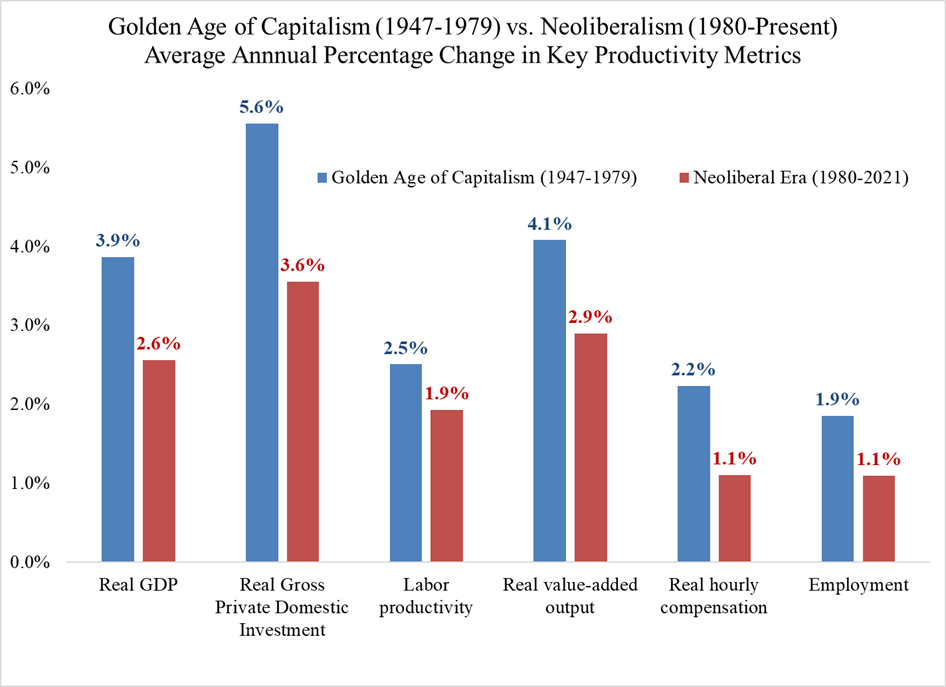
Studies specifically link the inferior post-1980 economic performance reflected in the chart above to the reduction in antitrust enforcement. Gutierrez and Philippon directly tie the drop in corporate investment to rising concentration: “We argue that increasing concentration and decreasing competition in many industries explains an important share of the decline in investment.”
Other papers have examined the relationship between antitrust enforcement and productivity growth. Filippo Lancieri, Eric Posner and Luigi Zingales, citing the seminal work of Robert Gordon, state that “there is no evidence that productivity growth increased as a result of the relaxation of antitrust.” Paulo Buccirossi and his coauthors studied the impact of antitrust enforcement (and other factors) on total factor productivity growth in 12 OECD countries. The authors found the oppositive of the conservative claim: “Our results imply that good competition policy has a strong impact on TFP growth.” In 2014 the OECD published its “Factsheet on how Competition Policy Affects Macro-Economic Outcomes.” Again, the basic finding is that “industries where there is greater competition experience faster productivity growth.”
We find no evidence that the reduction in antitrust enforcement that accompanied the ascension of the consumer welfare standard in the 1980s as the lodestar of antitrust enforcement had any positive impact on growth, productivity or investment. The quest for economic growth ostensibly motivates free market ideology; yet this ideology maintains the myth that it serves the social welfare. Economic evidence says otherwise: the neoliberal revolution destabilized the macro economy and has led to inferior macroeconomic performance. FTC Chair Lina Khan and the New Brandeis School continue to advance policies that will benefit growth and innovation, even if it does not help billionaires accumulate even more obscene levels of wealth.
Platform Most-Favored Nations clauses turn private unilateral market power into economy-wide inflation.
It’s fair to say that no one has any good explanations for why post-pandemic inflation has been so hard to tame. But plenty of people think they know what isn’t the cause: concentration and market power on a macroeconomic scale that enables dominant firms to raise prices without fear their customers will leave for the competition (since there isn’t any). Critics, like Washington Post columnist Catherine Rampell and NYU economist Chris Conlon, derisively call this hypothesis “greedflation” to lampoon the suggestion that a sudden epidemic of greed has caused powerful firms to exploit the market power they previously had, but weren’t using, at least not against consumers.
But the idea that dominant firms generally — and platforms in particular — had market power they weren’t using used to be commonplace. And it’s entirely sensible that if they weren’t using their market power then (so as to accumulate more of it), they would use it now. The strategy of predatory pricing is to set a low price to lock in customers and drive out the competition, then charge high prices later to “recoup” losses. For many decades, the prevailing view has been that predatory pricing is unlikely because charging monopoly prices in the recoupment phase will just attract entry, which will make the initial predatory phase irrational to attempt. As Justice Powell wrote in the 1986 case of Matsushita v. Zenith Radio Corp., “predatory pricing schemes are rarely tried and even more rarely successful.” In the 1993 case Brooke Group v. Brown & Williamson, the court held that there must be a “dangerous probability” of recoupment for a predatory pricing claim to succeed. The DOJ last tried a predation theory against American Airlines in 1999 for its conduct defending its monopoly hub at the Dallas-Fort Worth airport. That claim ultimately failed, an underappreciated inflection point in the oligopolization of the airline industry that’s responsible for today’s high prices.
My claim is that platform MFNs are a hidden cause of the current macroeconomic inflation. An economy full of dominant intermediaries, all of whom use MFNs and their non-price equivalents, is an economy primed to turn private unilateral market power into widespread macroeconomic inflation when it comes time for recoupment.
The reason predatory pricing isn’t supposed to work is that recoupment invites entry. But instead, imagine that during the recoupment phase, the incumbent doesn’t just charge a high price for his own product; he also gets to dictate that no one else is allowed to charge a lower price. Then entry isn’t such a potent threat, because entry or no entry, the incumbent doesn’t have to worry about being undercut. That is exactly what so-called Most-Favored Nations (MFN) clauses allow.
The phrase “Most-Favored Nations” clause refers to international trade negotiations, in which two (or more) trading partners agree by treaty to give one another as favorable trading terms as are given to any other trading partner. Such clauses are stronger than setting tariffs at any given level, because they automatically adjust if other trading partners are given better terms, preventing discrimination.
When wielded by a dominant platform, however, an MFN can be anticompetitive. Platform MFNs have a similar structure, but much different economic significance since they are typically imposed by one dominant platform on upstream sellers on the platform, rather than mutually agreed to by trading partners. By using an MFN, a platform is restricting the autonomy by which sellers on the platform can set prices on other platforms, other sales channels (such as brick-and-mortar retail), or direct-to-consumer sales. The point is to prevent other channels from getting preferential terms from the seller, and attracting consumers away from the dominant platform with discounts. Given that the dominant platform can’t be undercut, they don’t have to worry about entry. That, and not assumptions about mechanistic two-sided network effects, is the real reason so many platform industries are monopolized.
Now, consider what happens when a platform starts raising its take rate, the share of gross seller revenue the platform takes as its cut from any sale. In response to this increase in the marginal cost of selling on that platform, the seller would most likely increase price on that channel and decrease the price elsewhere to create a price differential that induces customers to switch. Savings from the lower take rate on the rival platform can be shared with the customer in the form of lower prices. But the MFN bars the seller from steering its customers that way, effectively serving as an anti-steering provision. Moreover, the MFN says that if the seller increases price on the one platform that increased its take rate to cover the higher cost of selling there, it has to raise prices on all channels in order not to steer customers elsewhere. Therein lies the mechanism by which the unilateral increase in the take rate imposed by one dominant platform translates into price rises across all channels of distribution. And dominant platforms have been increasing their take rates quite a bit in the past few years.
How prevalent are platform MFNs? It’s fair to say that most of the platforms that have come to dominate each market segment use them, including rideshare and food delivery apps, mobile app stores, travel booking, and private temporary accommodation. They are typically one of several varieties of anti-steering restraint that dominant platforms impose to lock in counterparties both upstream and downstream. Credit card companies are notorious for preventing merchants from discounting their items for users who don’t pay with a credit card (or pay with a card with a lower interchange fee), requiring them instead to raise their prices for all customers when credit card fees go up. Merchants are even prohibited from simply telling customers that they, the merchant, prefers they pay with cash (or use a lower-fee card). The upshot is a giant transfer of wealth away from customers whose credit isn’t good enough for the cards that offer decent rewards (but still have to pay the high prices merchants charge everyone), with credit card companies taking the lion’s share and the wealthiest customers getting crumbs by way of rewards programs that they think are a great deal.
My claim is that platform MFNs are a hidden cause of the current macroeconomic inflation. An economy full of dominant intermediaries, all of whom use MFNs and their non-price equivalents, is an economy primed to turn private unilateral market power into widespread macroeconomic inflation when it comes time for recoupment. And investors in dominant platforms have been clear that now is when they want a return on their investment. As dominant platforms have increased take rates to recoup the low prices they charged to monopolize the market, in order to reassure their investors during an equity market decline, especially for tech stocks, the MFN means everyone else has to follow suit. That looks to consumers (and apparently to economic policy pundits) like a general price increase that can’t be tied to individual firms, even though, in fact, it can.
You can thank the conservative Supreme Court majority for the current inflation.
How is this allowed, you may ask? Beyond the weakening of predatory pricing caselaw thanks to simplistic theories that disregard the possibility of MFNs, the other area where antitrust enforcement has lost its teeth is against vertical restraints imposed by dominant firms to bind dependent affiliates (of which MFNs are one, potent example). This decades-long failure culminated most recently in the 2018 Supreme Court case Ohio v. American Express.
The majority opinion in that case, written by Clarence Thomas and co-signed by Justices Roberts, Alito, Kennedy, and Gorsuch, gave a green light not only to American Express to raise its take rate without fear that its anti-steering restraints would face challenge, but to two-sided platforms with market power more broadly. It said that harm had to be shown to consumers from the challenged conduct, and that since credit card transaction volume was increasing, output hadn’t been restrained on the downstream side of the platform and therefore consumers hadn’t been harmed. It didn’t even entertain the possibility that anti-steering restraints would enable higher credit card fees and therefore higher prices across the board, and that the higher the fees they enable, the more credit card companies would want to subsidize consumers to use their cards in preference to cash. You can thank the conservative Supreme Court majority for the current inflation.
But that just follows on decades of crediting ostensibly economic justifications for anticompetitive vertical practices like loyalty pricing, which encourages consolidation, monoculture, and supply-chain vulnerability such as we saw earlier this year with the baby formula shortage. It occurred because of a safety violation at one of a very few plants that manufacture baby formula at scale. The reason there are so few is the loyalty-pricing practices invited by state-level Women, Infant, and Children (WIC) programs, which enter monopolistic requirements contracts in exchange for bulk discounts. The original idea was supposed to be that this would save money on a public program and thus be fiscally responsible. The only problem is that it drove consolidation, thus making the industry catastrophically vulnerable to disruptions.
The real “Inflation Reduction Act” should have been a wholesale overturning of the lax jurisprudence of vertical restraints that the federal judiciary has imposed since 1977.
Beyond bad caselaw, however, the other culprit is the absence of any will on the part of Congress to change it. As far as I know, no federal legislation has been proposed to overturn Ohio v. American Express and the whole panoply of lax antitrust jurisprudence of vertical restraints imposed by dominant market actors—despite the fact the 2020 House Majority Report of the Antitrust Subcommittee explicitly called for such legislation. Even as Congress has spent the last year or more decrying high inflation, and the Fed has been tasked with preventing it with the only tool it has, a severe economic slowdown, none of the legal levers available to enhance platform competition and threaten the profits of the economy’s most powerful gatekeepers and middlemen has been pulled.
Any policy agenda to curtail price increases and clamp down on anticompetitive business models like predatory pricing and recoupment should disregard the kinds of theoretical arguments that underlay their legalization in the first place: that consumers somehow benefit from economic coercion, and that entry would “naturally” fix any competitive problem before a court does. The real “Inflation Reduction Act” should have been a wholesale overturning of the lax jurisprudence of vertical restraints that the federal judiciary has imposed since 1977 along these lines.
The good news is that some economists are beginning to recognize the nexus between inflation and market power. Last week, the OECD released a report spelling out the connection in detail, documenting the empirical literature that links higher prices to the exercise of power. Unfortunately, gatekeeping economists — as well as their hangers-on in the tech-billionaire-owned media — still scoff at the claim that market power might be to blame for inflation without considering it on the merits. They should reconsider their tendency to discredit outsiders who might have a better sense of how the economy works than they do. At the very least, they should remember that the first rule of scientific inquiry is to keep an open mind.
For those following me on Twitter, you might know that I’m a bit fixated with inflation, its underlying causes, and how best to arrest it.
Here’s what we know after one year’s worth of controversy: (1) inflation is largely coming from two sectors of the economy, housing and electricity; (2) inflation does not seem to be slowing from interest rate increases, with core inflation of 6.6 percent hitting a 40-year high in September; and (3) neoliberal economists cannot fathom a theory of inflation that doesn’t blame workers.
I will be writing plenty on alternative remedies to arresting inflation, including de-concentration efforts, temporary industry-specific price controls, and FTC enforcement of invitations to collude. But in this piece, I wanted to stick a fork into the traditional view that inflation is best tempered with interest rate hikes.
The theory behind this view is that the labor market serves as a barometer to how hot the economy is running. As unemployment declines, the story goes, workers demand higher wages due to their newfound bargaining power. Profit-maximizing firms raise the price of their products in response to rising labor costs, yielding an inverse relationship between unemployment and inflation, as predicted by the Phillips Curve. Higher interest rates make investment projects less attractive by raising the cost of capital. Slow the labor market by making investments less attractive, demand for workers needed to staff new projects will decline, wages will fall, demand for goods and services by those underemployed workers will decline, and the rest of the economy will naturally cool down.
This theory is badly antiquated. There may have been a time when output and labor markets were competitive, prices were set at marginal costs, and wages were set at a worker’s marginal revenue product. But that time, if it ever existed, has come and gone.
In many industries, particularly concentrated ones with high fixed costs—or industries dominated by what some economists have dubbed “superstar” firms—prices are untethered to labor costs. A pharmaceutical company doesn’t set its drug price based on the salaries of researchers. A gas station doesn’t set its price based on the attendant’s hourly wage. A hotel doesn’t set its nightly rate based on the wages of the cleaning crew. A car rental company doesn’t set its price on the wages of the worker sitting near the checkout booth. A university doesn’t set tuition based on the wages of its adjunct professors. I could go on.
Given the fixed-cost nature of these industries, many prices in the economy are set to maximize revenue, which is purely a function of the demand elasticity facing the firm. Wages don’t enter the pricing calculus, as they too are perceived (at least in part) as a fixed cost.
Now I will grant that in certain labor-intensive industries, such as coffee shops and diners, prices will be tethered to labor costs. But these industries are not the drivers of inflation. Inflation is coming from concentrated industries such as food production, energy, and rent (more on that in my future work).
Even in some labor-intensive industries, such as sports, the price for pay-per-view does not rise with player payouts. Prices again are set based on consumers’ willingness to pay for the product. The players and owners divide a fixed pie, and an increase in the players’ share does not cause prices to rise.
Another reason why wages and prices have become untethered, aside from the evolution of our economy to high fixed cost industries, is growing monopsony power and the accompanying erosion of worker bargaining power. Employers with buying power drive a wedge between their workers’ marginal revenue product and wages, based on the (low) elasticity of supply they face. This markdown below marginal revenue product is the same phenomenon as we see when monopolists mark up prices above marginal costs in inverse proportion to the elasticity of demand they face.
When productivity increases, an automatic increase in wages no longer follows, as monopsony power now disturbs the the mapping from productivity into wages. Put differently, monopsony power has weakened, if not entirely severed, the linkage between prices and wages. Employers with buying power don’t need to acquiesce to wage demands: companies like Amazon and Starbucks have fought desperately against offering even the most meager concessions to workers. And even if they do, they already enjoy a sufficiently comfortable profit cushion that they don’t need to automatically revisit prices. Hence, an increase in wages won’t necessarily lead to an increase in prices.
But don’t take my word for it. A recent paper by two economists, David Ratner and Jae Sim of the Federal Reserve Board, shows that labor market policies that have eroded worker bargaining power are the source of the demise of the Phillips curve, which predicts that inflation rises as unemployment falls. As unemployment fell from 6.5 percent in 2009 to 3.5 percent in 2019, however, inflation showed no signs of increasing, or what is called “the missing inflation” puzzle. Ratner and Sim conclude that the “collapse of workers’ bargaining power” flattened the Phillips curve. The authors point out that, using their models in which workers bargain to keep the price-cost markup as low as possible so that wages and the labor share would be larger, the decline in worker bargaining power can explain the secular decline of the labor share, the secular rise of the profit share observed since the 1980s, and the stock market capitalization ratio.
Take the case of Starbucks, which is fighting off an attempt at unionization. Given the lack of bargaining power among its workers, when Starbucks raises the price of a latte, most of the price hike falls to the bottom line. If the workers were to unionize and demand a greater share of the pie, Starbucks might be less inclined to raise its prices, knowing that some of those gains would now be shared with workers. Continuing this union hypothetical, if workers were to become scare due to a decrease in unemployment, the union could extract higher wages, which likely would be passed on to consumers in the form of higher latte prices—revealing a steeper Phillips curve.
A flattened Phillips curve means that a decrease in unemployment that should, in theory, give workers greater bargaining power, doesn’t have any affect on prices (even if wages modestly rise) and thus inflation. Why? Because the power imbalance is so skewed in favor of employers that the small increase in the scarcity of workers doesn’t materially move the price needle (let alone the wage needle). In the post-Covid era, wage inflation peaked in March 2022 at just 6.8 percent, but for the reasons explained above, that change likely didn’t contribute to inflation, which outpaced wage growth in the same month. As explained by ESI’s Josh Bivens, “If the only change in the economy over the past year had been the acceleration of nominal wage growth relative to the recent past, then inflation would be roughly 2.5–4.5% today, instead of the 8.6% pace it ran through March.”
A flattened Phillips curve also implies severe labor market dislocations would be required to arrest inflation via rate hikes. As explained by Seccareccia and Romero in an INET blog, “the flatness of the relation [between unemployment and inflation] implies an immensely high sacrifice ratio if pursuing a Volcker-style strategy … since it would require excessively high unemployment to get the inflation rate down by even a very small increment.” Former Treasury Secretary Lawrence Summers claims that we now need five years of six percent unemployment to curb inflation.
Despite these horrific tradeoffs, the church of neoliberalism led by Summers, preaches that monetary policy that reduces worker power (by creating unemployment) will eventually albeit painfully lead to lower prices and slowing inflation. Ironically, Summers co-authored a Brookings research paper in 2000, before inflation took hold, in which he argued that to arrest the decline in labor share, “institutional changes that enhance workers’ countervailing power—such as strengthening labor unions or promoting corporate governance arrangements that increase worker power—may be necessary (but would need to be carefully considered in light of the possible risks of increasing unemployment).” It is not clear whether Summers would continue to advocate for worker power in an inflationary environment.
In sum, managing inflation via interest rate hikes is an outmoded school of thought that may have worked when labor markets were more competitive and the power balance between workers and employers was evenly split. Given the severing of the nexus between wages and prices, it is time that we abandon the old tools and explore alternatives that arrest the source of price hikes at their source. This will be the subject of future pieces.
The Democrats are in trouble. With the midterms less than two weeks away, a New York Times/Siena College poll is the latest to show Republicans gain as voters get increasingly anxious about the economy and high inflation. While the Times poll has received a lot of media attention, its findings are hardly surprising. In fact, it has been clear for quite some time that when it comes to the issue that voters are most concerned about — soaring prices — Dems lack a coherent message.
Not that there is a shortage of things to say about inflation that will connect with voters. By now, for example, we know that while inflation is driven by many factors — Russia’s invasion of Ukraine, the breakdown of global supply chains, and the devastating effects of climate change-related droughts on American farmers — one of the primary drivers of US price hikes is monopoly power. Earlier this year, a paper by Boston Fed economists Falk Bräuning, José L. Fillat, and Gustavo Joaquim showed the link between inflation and the increase in concentration over the past two decades. And a Roosevelt Institute paper by Mike Konczal and Niko Lusiani showed that markups increased dramatically in 2021 as companies with market power exploited the pandemic to raise prices above costs. With profit margins at a 70-year high, the Groundwork Collaborative has assembled dozens of examples of CEOs boasting about their ability to jack up prices and pin the blame on inflation during earning calls. Going after corporate price-gougers at a time of surging prices seems like a no-brainer.
It’s not that voters are particularly skeptical of this explanation, either. In fact, despite the best efforts of neoliberal economists to deny any connection between market power and inflation, polls show that a majority of Americans believe that profit-maximization is driving price increases. So why has it been so difficult to rally voters around cracking down on corporate profiteering? Perhaps, as Barry Lynn recently wrote, the problem is a lack of an overarching narrative. Or, as The Lever’s Andrew Perez and David Sirota note, it is a simple matter of Democrats not trying all that much. But it could also be a lack of opportunity: perhaps what has been missing is a story so egregious that it serves as a vivid illustration of how corporate greed exacerbates inflation. After all, every good story requires an attention-grabbing villain.
Enter the Kroger-Albertsons merger. If allowed to go through, the $25 billion deal would combine two of America’s largest grocery store chains into a corporate behemoth that would own Ralphs, Dillions, Safeway, Vons, and many others. It is, of course, a terrible idea that seems about as illegal as a merger can get. For one, the supermarket sector is already highly concentrated: the National Grocers Association estimates that over 60 percent of US grocery sales go to the country’s top five retailers. Moreover, merging the second-largest and fourth-largest grocery store chains would leave consumers in many markets with little to no options beyond Kroger-Albertsons and Walmart.
As Forbes’ Errol Schweizer writes in his fantastic analysis of this merger, the deal would potentially be highly lucrative for investors and company executives. But it would be extremely damaging for workers and for consumers, and especially for suppliers:
“A 5,000 store chain in over 48 states could more easily set payment terms, negotiate shelf space and assortment, and extract better costs and greater trade allowances for promotions, couponing, ad placement and slotting fees.”
Not to mention that proposing such a merger as food prices are increasing 13% year over year is a scandal unto itself. To justify this merger, the companies claim that the merged company would have the economies of scale necessary to reduce prices. But as Matt Stoller and others have pointed out, this is a weak argument. Moreover, it’s the exact same argument Albertsons made when it bought Safeway in 2015.
It would be easier to take these claims seriously if the merged company’s prospective CEO did not brag about how they can get away with raising prices by using inflation as a cover. Last year, Kroger CEO Rodney McMullen boasted that “a little bit of inflation is always good in our business” and added that as long as inflation is around 3%-4%, the company could cite it to justify price hikes since “customers don’t overly react to that.” Weeks later, Kroger raised prices, citing inflation as the reason.
Given its peculiar timing, it is no surprise that the merger has already sparked political backlash. Several Democratic Senators, including Elizabeth Warren, Bernie Sanders, and Amy Klobuchar, have come out strongly against the deal. Klobuchar and Republican Senator Mike Lee, the ranking members on the Senate Judiciary’s antitrust subcommittee, plan to hold a hearing on the deal in November.
In other words, it is a merger only a judge could love. While the FTC will almost certainly try to block this deal, Kroger and Albertsons are clearly counting on merger-friendly federal judges to reject these attempts, as they have done several times this year. Anticipating the regulatory backlash, the companies have offered to spin off up to 375 stores to alleviate antitrust concerns. It is easy to see why they would try to appease enforcers this way: it worked for Albertsons when it convinced the FTC to approve the Safeway merger in exchange for selling 168 stores to local chain Haggen. But as David Dayen and Ron Knox point out, that arrangement failed miserably, and Albertsons soon ended up buying many of the stores it sold at a nice discount.
In any case, FTC Chair Lina Khan is unlikely to take the bait. Khan has criticized similar divestitures in the past and has already set her sights on “the anticompetitive practices of large supermarket chains.” Given the judiciary’s long-standing pro-monopoly bias, the companies may be right that the merger could go through. But this merger may just be so preposterous that even the courts would have a hard time waiving it through.
This deal, in other words, is the antitrust equivalent of Liz Truss’s mini-budget: it is deeply unpopular, would be a complete disaster, and can only really appeal to ideological zealots or those paid to advocate for it. So why even attempt it? Stoller theorizes that the whole thing might be an attempt at financial engineering by Albertsons’ private equity investors, Cerberus and Apollo, to squeeze $4 billion from the company as a “special dividend” before the merger is inevitably shot down.
But whether or not the Kroger-Albertsons deal actually goes through, it represents a rare political opportunity. What better way to encapsulate the connection between market power and high food prices than a merger that promises to increase prices and offers no benefit to anyone but private equity investors and executives? Whether Democrats capitalize on this opportunity or not remains to be seen. But if there was ever a merger that could tie it all together, this is it.