United made news last month when its CEO, Scott Kirby, floated the audacious idea of acquiring American Airlines. Such a move would be blatantly anticompetitive, given the intense rivalry among the nation’s largest carriers. For certain routes, such as Charlotte to Washington Dulles, United and American are the only two carriers offering non-stop service—the deal would create a monopoly on that route. In January, American announced a new service from Chicago’s O’Hare to Maui, which is the only non-stop competitor to United on that route.
A more subtle anticompetitive strategy is taking place under the radar at Chicago’s O’Hare airport. There, United is aggressively over-scheduling flights. Why? Because gates are reallocated every so often by the airport authority, and that reallocation is based on an airline’s flying frequency in the prior year. O’Hare handles about 2,800 arrivals and departures each day. United, already O’Hare’s largest airline, planned to add roughly 200 flights daily, an increase of 34 percent, bringing its total to roughly 780 a day. In the parlance of antitrust, United’s conduct can be understood as foreclosing rivals from accessing a key input (gates).
Many of those additions made little commercial sense—for example, eleven daily flights to Grand Rapids, ten to South Bend, and seven to Peoria. As former Transportation Secretary Ray LaHood noted in March, “I’m delighted when my hometown and other communities get more flights, but these numbers aren’t driven by demand. They are driven by an anticompetitive strategy.”
Because of United’s aggressive expansion at O’Hare, American ended up losing four gates to United during the last reallocation in October; at about six departures per day across those four gates, the outcome amounts to roughly 24 lost American flights per day. In February, United acquired two more O’Hare gates from Spirit (before Spirit shuttered entirely in May). And Southwest is leaving O’Hare this upcoming June in favor of Midway, citing operating challenges at O’Hare; its gates will be divided among United and American. Exit by a major rival is a marker of anticompetitive foreclosure. Presently, United has 99 gates at O’Hare (equal to roughly half of the total gate capacity of 199) compared to American’s 66. As a share of passengers, United controls about 46 percent of the market at O’Hare.
United’s gate hogging—essentially trying to “dehub” a competitor—will inundate an already burdened O’Hare with more traffic and frustrate hundreds of thousands of flyers. To wit, in December of last year, Kirby reportedly told some United pilots that American may have to “dehub” O’Hare. This exclusionary plan has been brewing for a while; in 2017, Kirby reportedly told employees that “I hope to someday take over those [O’Hare] gates that currently have the AA on them.” And in January of this year, Kirby said United would add “as many flights as are required” to stop American from gaining additional gates in 2026.
In April, the Federal Aviation Administration (FAA) stepped-in to ensure relative operational consistency. The agency reduced flights at O’Hare, most of which were United’s, citing over-scheduling and “severe congestion.” The proposed increase in flights, across all carriers including United, would “stress the runway, terminal, and air traffic control systems at the airport.” But the FAA order applies only for the summer travel season (through October), and United could very well try over-scheduling again once the order expires. Notably, when the FAA convened discussions to address United’s over-scheduling, United’s response was remarkably hostile; its executives claimed the government ran the process “like a banana republic” and warned it would be “an existential crisis for the company.”
Dual hubs v. fortress hubs
O’Hare is one of the only airports with a hub for two major airlines, which engenders fierce rivalry between the airlines. So called “dual-hub” competition, of the kind seen at O’Hare, has been good for consumers. Indeed, airline prices fell by nearly four percent at O’Hare in 2025 relative to 2024. In contrast, the CEO of budget airline Frontier explained that “Allowing one airline to control a majority of gates at so-called ‘fortress hubs’ is hurting competition and customers.”
If United is successful in dehubbing American at O’Hare, travelers would face higher fares. United dominates Washington Dulles and San Francisco International Airport (SFO). Measured in terms of share of domestic and international seats, United’s market share is nearly 50 percent at SFO, five times its next largest rival. United has an even larger market share of roughly 70 percent at Dulles. Not coincidentally, Dulles and SFO are two of the most expensive airports in the country for domestic travel according to Finance Buzz.
In myriad, more sophisticated analyses, economists have studied the relationship between airport concentration and fares:
- Borenstein (1989), in a paper published in the Rand Journal of Economics (1989), found that an increase in market concentration on a route is economically and statistically significantly related with higher ticket prices, controlling for other factors that affect prices.
- The Government Accountability Office (1990) estimated that fares per passenger-mile at concentrated airports were about 20 percent higher than those at unconcentrated airports.
- Berry et al. (2006) estimate a structural differentiated product model of the airline industry, and finds that airlines’ ability to command airport dominance premium was limited to the upper end of the price distribution.
- Bilotkach and Pai (2009) find that while the airline’s dominant position at an airport is associated with market power, dominant carriers exercise this power on an average customer rather than a price-insensitive business traveler. Carriers operating a hub at an airport, but not enjoying the dominant position, are shown to charge a quality-based hub premium.
A concentration of gates within a single airline can also lead to worse service for consumers and greater exploitation of local workers. Service degradation can include delayed flights and mishandled baggage. FAA Administrator Bryan Bedford reportedly told airlines in a closed-door meeting the agency was concerned about the ability of O’Hare to function this summer. And when a rival carrier exits an airport, as was the case with Southwest or Spirit at O’Hare, airport workers lose an outside employment option with which to bargain for competitive pay and benefits.
Higher gate concentration could also lead to allocative inefficiency. As noted above, United might acquire gates to fly to less efficient destinations compared to those offered if a rival airline controlled those gates. Simply put, the airline with the most gates can employ a “use it or lose it” strategy rather than routing flights most efficiently.
The competition problem stretches beyond O’Hare
If this problem were limited to O’Hare, it would be bad enough. But airlines with a dominant presence at an airport wield their power, often to the detriment of passengers. For example, Delta uses its power over Salt Lake City Airport to ensure that rival gates, including United’s, are located extremely far from the baggage claim. And British Airways does the same at Heathrow. (Your fearless blogger thought he was going to expire on a walk from the United terminal to Heathrow Express.) It is instead meant to show that whenever an airport becomes beholden to a single carrier, the carrier can influence gate assignments as a means to impair rivals.
Regulators and antitrust authorities should use their tools to prevent an airport from tipping towards monopoly. At roughly a 50 percent market share, United’s foothold at O’Hare is already consistent with market power—that is, the ability to raise prices over competitive levels or exclude rivals. In light of Southwest’s exit from O’Hare, United’s plan to dehub American is the kind of conduct that is generally cognizable under antitrust law. Passengers traveling through Chicago should not have to endure inflated fares and longer delays.
With a few exceptions, in left and progressive American political commentary in the last couple of decades, the use of the word “populist” has suggested right-wing political ideas and attitudes, sometimes with significant anti-democratic notions, especially when associated with working- and middle-class Americans. “Populist” concerns include ending immigration, protecting national borders and a Christian social and cultural heritage, and preserving racial purity and dominance. It is often associated with the supporters of popular political leaders on the right seeking to return their country to its former greatness and social and cultural purity, and to rid the country of unwanted people and corrupting influences.
Most recently, the left and progressives in American have often used the term, for instance, to describe and denounce the support for President Trump’s MAGA followers. This negative use of “populist” is not new to the last decade. Since the1950s, the use of the term to describe popular right-wing political programs and support has grown increasingly common among progressives and left political analysts as well as some academic commentators.
The People’s Party, the “Populists” of the 1890s, were not the “populists” of the last ten years, nor those who earlier supported right-wing ideas. They were born of an American society facing many of the same challenges the country has faced in the last few years. Between the Civil War and the early 20th century, the country witnessed unprecedented growth of industrial wealth—railroads, steel, coal, the telegraph, oil, and others—and in individual fortunes of Rockefeller (the first billionaire in 1916), Carnegie, J. P. Morgan, Vanderbilt, Jay Gould, and others. A rapidly increasing wealth inequality accompanied the rise in individual fortunes. Rockefeller in 1890 controlled 90 percent of the oil industry from production to sale. In 1890, one percent of the population had half of all the nation’s wealth (as compared to 30 to 35 percent in 2022).
Political corruption rose correspondingly. It exploded during the Civil War with the Whisky Ring, followed by Credit Mobilier during Reconstruction. In the 1880s and 1890s, businessmen routinely bribed local, state, and national governments. Tammany Hall was only the best known machine living off fraud and manipulation of politics. Seats in “the Rich Man’s Club”—the U.S. Senate—often went to the highest bidder. Between 1875 and 1885, the Central Pacific Railroad spent $500,000 a year (a little less than $16 million today) on state and national political bribery. In the middle of the depression following the Panic of 1893, the federal government had to borrow $16 million in gold from financiers, including Morgan, because the decline in revenue from taxes the business community and the wealthy opposed.
The Birth of the Populist Party
Neither the Democratic nor the Republican party showed any interest in dealing with these issues, especially the huge disparity between the very wealthy and the mass of ordinary farmers and laborers. Indeed, private armies like the Pinkerton’s were used to defeat strikes, the Homestead strike of 1892 being only the best known. The Populist Party was a response to the disparity and concentration of wealth, the declining wealth coming from a deflationary monetary policy desired by the wealthy, the corruption, and the failure of major corporations to look to anything but their own interest.
The Populist Party of the 1890s responded to these challenges in their Omaha Platform of July 4, 1892. The platform contained the purposes and political goals of the original People’s Party of America, for which the name “Populist” then stood. Its preamble described “…a nation brought to the verge of moral, political and material ruin.” They were pro-democracy. The American democratic system was threatened: “Corruption dominates the ballot box, the legislatures, the congress, and touches even the ermine of the bench; most of the states have been compelled to isolate the voters at the polling places to prevent universal intimidation or bribery.”
The country was on track for economic collapse: “The newspapers are largely subsidized or muzzled, public opinion silenced; business prostrated; our homes covered with mortgages; labor impoverished and land concentrating in the hands of capitalists.” These Populists were not anti-union and opposed only “imported pauperized labor which beats down” workingmen’s wages.” “The urban workmen are denied the right of organization for self-protection…a hireling standing army, unrecognized by our laws, is established to shoot them down….”
Wealth was increasingly inequitably distributed: “The fruits of toil of millions are boldly stolen to build up colossal fortunes for a few, unprecedented in the history of mankind; and the possessors of these, in turn, despise the republic and endanger liberty. From the same prolific womb of governmental injustice we breed the two great classes—tramps and millionaires.” The Populists charged that the national government’s deflationary manipulation of the currency in particular magnified this development: “The national power to create money is appropriated to enrich bondholders. A vast public debt, payable in legal tender currency, has been funded into gold-bearing bonds, thereby adding to the burdens of the people.” The demonetization of silver has added “to the purchasing power of gold by decreasing the value of all forms of property as well as human labor and the supply of currency is purposely abridged to fatten usurers, bankrupt enterprise and enslave industries.”
The platform’s only reference to “conspiracy” appeared in the context of the currency deflation. It complained that silver “has been demonetized to add to the purchasing power of gold by decreasing the value of all forms of property as well as human labor, and the supply of currency is purposely abridged to fatten usurers, bankrupt enterprise and enslave industries. A vast conspiracy against mankind has been organized on two continents and it is rapidly taking possession of the world….[I]t forbodes terrible social convulsions, the destruction of civilization or the establishment of an absolute despotism.”
The platform noted that neither of the two national political parties had done anything in the last 25 years about these problems. The parties’ efforts instead had been channeled “for power and plunder, while grievous wrongs have been inflicted upon a suffering people.” The interests controlling both parties “have permitted the existing dreadful conditions to develop, without serious efforts to prevent or restrain them.” The parties promised no “substantial reform,” so that “capitalists, corporations, national banks, rings, trusts, watered stock, the demonetization of silver and the oppressions of the usurers may all be lost sight of. They propose to sacrifice our homes, lives and children on the altar of mammon; to destroy the multitude in order to secure corruption funds from the millionaires.”
The Populist party, on the other hand, advanced a plan in the Omaha Platform to expand “the powers of government—in other words, of the people…as rapidly and as far as the good sense of an intelligent people and the teaching of experience shall justify… to the end that oppression, injustice and poverty shall eventually cease in the land.” The phrase “man over money,” which the Populists sometimes used, encapsulated the policies of the two old parties as well as promising a new focus on the needs of ordinary people rather than those of the wealthy and the corporations.
The Populist Party summarized the Omaha Platform preamble by condensing it into a series of propositions. “That the union of labor forces of the United States…shall be permanent and perpetual.” That “[w]ealth belongs to him who creates it, and every dollar taken from industry without an equivalent is robbery.” That “The interests of rural and civic labor are the same; their enemies identical.” That “the time has come when the railroad corporations will either own the people or the people must own the railroads, and should the government do so, all its employees should be guided by “a civil service regulation…to prevent the increase of the power of national administration by the use of such additional government employees.” That the country required “a national currency, safe, sound and flexible, issued by the general government only, a full legal tender for all debts, public and private…without the use of banking corporations and “a just, equitable and efficient means of distribution to the people” at a tax of 2% or less and using the Farmers’ Alliance subtreasury plan or “some better system” to regulate the currency and make it flexible enough to avoid excessive inflation or deflation.
A call for intervention in the economy
Far from being opposed to government intervention on behalf of the less powerful, the Omaha Platform called for legislation that would:
- Expand the currency by adding silver and increasing the supply to $50 per person.
- Create a graduated income tax.
- Establish national postal savings banks earnings deposits and “to facilitate exchange.”
- Because transportation was “a public necessity,” provide for the national government to own and operate the railroads “in the interest of the people.”
- Because telegraph and telephone systems were “a necessity for transmission of news,” the national government should own and operate them “in the interest of the people.”
- “The land, including all the natural resources of wealth, is the heritage of all the people, and should not be monopolized for speculative purposes….All lands now held by railroads and other corporations in excess of their actual needs, and all lands now owned by aliens, should be reclaimed by the government and held for actual settlers only.”
- “State and national revenues,” however, should be “kept as much as possible in the hands of the people” by limiting state and national revenues to “the necessary expenses of government, economically and honestly administered.”
The Populists, of course, were products of their time. They could not be 21st century progressives. The Omaha Platform did not contain many issues that have become important to progressives in the last 130 years. The party’s focus tended to be, outside a few urban areas like Chicago, almost exclusively on farmers, although major industrial labor events such as the Pullman strike garnered support in some areas. A slight odor of conspiracy was apparent, particularly regarding international currency developments, as was some hostility to immigration and immigrants.
Women were left out of the Omaha Platform. Women’s suffrage nearly made it in, but was defeated. Nevertheless, women participated widely in the party. The Farmers’ Alliance, the organizational precursor to the Populist party, had more women members—250,000—than the Women’s Christian Temperance Union. Women provided significant leadership to the Populist party, especially in the Midwest (and even sometimes in the South), played important roles in Populist gatherings and political meetings, including as speakers, and contributed their share of letters to the editor in Populist papers, at times mentioning women’s suffrage.
The Populists’ approach to race was marred by white supremacy, although not often explicitly in the Midwest. The South was another matter. There it was a major issue. Some southern Populists actually campaigned for black support, and there were black Populists and some black Populist speakers, and a few even served as members of some state conventions. but But no white Populists in the south, however they might encourage black votes, ever questioned the necessity for segregation, black subordination, and white supremacy.
Despite these failings, the Omaha Platform presented a progressive political program, especially for its time. In the face of corruption pervading state legislatures, congress, even the bench, it was committed to a free ballot and a fair count, even in a few cases for black voters. It supported labor and the right of workers to organize themselves. It opposed the concentration of wealth stolen from those who produced it. It called out the national government for aiding in this theft by contracting the currency, thereby reducing the value of property and human labor in the interest of the wealthy few.
The People’s party instead called for the national government to help the actual producers of wealth, farmers and laboring people, through involvement in the economic life of the nation. It called for the expansion of the circulating currency and partial provision of it, without involvement of the banking corporations, through the sub-treasury system or something similar. It called for the establishment of postal savings banks. It called for national government ownership and operation of the railroads “in the interest of the people,” and sought an end to the alien ownership of land by railroads and other corporations “in excess of their needs” and its reclamation for “actual settlers only.”
Americans, especially those outside MAGA, should not lose the heritage of the Omaha Platform and the late nineteenth century People’s party. We should refute the false popular memory reflected in the widespread use of “populist” to refer to conspiracy-minded, anti-democratic and anti-labor, right-wing voters. We should again embrace the phase used frequently by Populists to summarize their political goals: “man over money.”
Bruce Palmer is a history professor emeritus at the University of Houston, Clear Lake, and author of “Man Over Money: The Southern Populist Critique of American Capitalism,” UNC Press, 1980.
There was a time in American history, after the Civil War, when politicians of many stripes raged at “national banks.” They had something specific in mind—namely, the big financial institutions, concentrated in the eastern United States, and their obscure regulator with the ungainly name, the Office of the Comptroller of the Currency (OCC). These banks formed, in the phrase of the day, “the money monopoly.”
The label, uttered with a contempt rooted in a century of antimonopoly activism, spoke to exclusive right of those banks to issue banknotes—the “currency” in the OCC’s name—secured by holdings of Treasury securities deposited with the government. A small number of banks seated in Boston, Philadelphia, and New York dominated finance, and the Comptroller defended national bank privileges, all under laws signed by President Lincoln.
Historical analogies, to riff on a common saying, seldom repeat but can rhyme, and this story seems impossibly familiar. So, pretty please, with sugar on top, bear with me as I explain the outrage, to anyone who values competition, through the prism of the OCC’s capricious attempt to destroy a law—in Illinois, the Land of Lincoln, no less!—banning transaction fees on taxes and tips collected via credit cards.
A step back in time
If it was the money monopoly in the 19th century, it is the payment monopoly today. And money is no good if you can’t use it as payment for what’s essential or fun in life. Control of money’s usage isn’t that different than control of its creation.
Today the credit card business is dominated by an oligopoly of the megabanks: JPMorgan Chase, Bank of America, Citigroup, American Express, and Capital One, which account for 70 percent of all credit card spending. The debit cards, based on where people have checking accounts, are less concentrated. But both business lines rely on Visa and Mastercard, which dominate card payment processing.
Cards dominate the business of making payments, and it’s not even close by number of transactions. By volume the biggest player is the Automated Clearing House (ACH), thanks to mortgages and business-to-business payments, which is also dominated by the largest banks. Other payment methods are either used at homeopathic levels (cryptocurrency, FedNow) or simply piggyback on the existing payment rails (ApplePay, Venmo). There’s simply no way around the card-based and ACH systems in the modern economy, with former essential for daily transactions.
The system of fee-setting that determines what merchants pay for card transactions only makes sense as a price-fixing conspiracy. Visa and Mastercard, the dominant networks, determine the fees they deduct from merchant sales, and share the money with credit card-issuing banks. The Federal Reserve, under to the 2010 Durbin Amendment, capped debit card fees albeit at a bank-friendly rate. Credit card swipe fees, as they are typically known, are unregulated in the United States.
Banking and monetary policy
The nexus between money and payments is as old as the republic. Until the creation of the Federal Reserve in 1913, banking policy was overwhelmingly about currency, the medium of exchange on which the American economy ran, and control thereof. The OCC and national banks, so called because banks were previously state-chartered entities alone, emerged from the cauldron of Civil War policymaking as a solution to increasingly desperate efforts to finance Union forces that put down the slaveholder rebellion.
Lincoln signed the first of a series of laws in early 1863 that created federally chartered banks required to invest their reserves in U.S. government securities and allowed them to issue banknotes backed by those bonds, and at a stroke, created a massive new revenue source. The laws also sought to tax banknotes issued by state-chartered banks, which had been the antebellum currency of choice, out of existence. In the coming years, comptrollers would forcefully defend the money-issuance monopoly of national banks. Remember that part.
Federal bank chartering was anathema to the many Americans who cheered President Andrew Jackson’s destruction of the Second Bank of the United States in the early 1830s. But southern antimonopolists had chosen the wrong side of history by supporting slavery, and their absence from Congress enabled passage of the national bank laws amid the exigencies of war. Still, approval was a hard-fought effort that required Lincoln’s personal lobbying to overcome popular skepticism of any marriage between financial and political power.
The move made national banknotes as reliable a currency one could have during the most turbulent period in American history. The United States abandoned the gold standard in deed, though not word, in the desperate early phase of the war, so that banknotes could not be redeemed for precious metal. The government issued a new fiat currency whose appearance gave us the term “greenbacks.” Only the promise that they would eventually be withdrawn from circulation made them politically tenable.
From greenbacks to the gold standard
The subsequent 30 years witnessed the victory of what the political scientist Gretchen Ritter, in her study of postwar money politics, Goldbugs and Greenbacks, calls the “financial conservatives” over the antimonopolists, as the country cemented the dominance of national banknotes as the country’s gold-backed currency. Greenbacks were withdrawn from circulation. The gold standard was restored. Silver was “demonetized.” These financial measures shrank the money supply in a way that would be unthinkable today and was outright cruel to the yeoman farmers who needed credit to avoid collapsing into debt peonage.
The country discarded various proposals to break the money monopoly, but not without a fight. The Americans who experienced the rise of 19th century industrial capitalism saw more than the great trusts and the need for what became the Sherman and Clayton Acts. The antimonopolists, who formed clusters in the two major parties and sometimes parties of their own, proposed more greenbacks, “free silver,” and, for you nerds out there, interconvertible bonds.
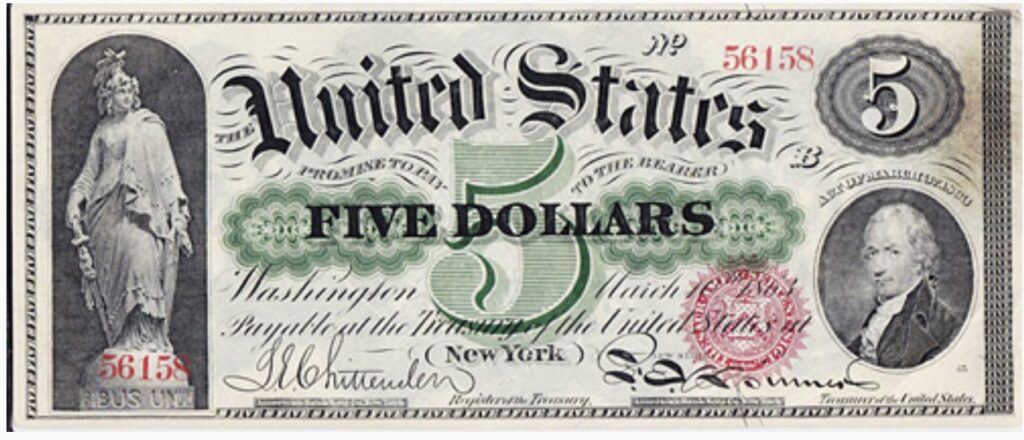
A standout critic of the currency system dominated by national banks after the Civil War was Wendell Phillips, a famous abolitionist who turned to economic issues after Reconstruction as he grappled with how liberation meant more than ending slavery. It was the heyday of grievances against privileged New York types who decisively influenced national economic development through credit allocation, but the Phillips critique of the “money monopoly” embodied hope as well. A man who’d seen the abolition of slavery could believe that the democratic process would free money from the grip of private avarice.
A native son of Illinois, Alexander Campbell, published a pamphlet, The True American System of Finance, that made similar arguments. Campbell was no pitchfork populist; he was well-off from his time in mining and steelmaking and eventually went to Congress as a leading figure in the Illinois Greenback Party, which also sent a U.S. Senator to Washington. He laid out a cogent critique of the national bank system which “places the whole moneyed interest of this great nation in the hands of a few selfish, scheming financiers.” (He also sometimes referred to lenders as “shylocks,” a reminder how critical rhetoric of finance can slide into casual antisemitism.)
Antimonopolists and their antagonists
On the other side stood people like Hugh McCulloch, the first comptroller. The most generous interpretation of his views is that the national bank system was not a monopoly because there was no single institution, as the Bank of the United States had been, in his own living memory, having been born in 1808. The system, he said upon becoming comptroller, “will concentrate in the hands of no privileged persons a monopoly of banking.”
It says something about the power of national banks that being the first comptroller was McCulloch’s steppingstone to Treasury Secretary. They were no low-profile bureaucrats executing policy either; they actively fought the democratization of money and increasing the supply. Comptroller John Jay Knox authored the “Crime of 1873,” as his detractors described the law that effectively locked in the gold standard by banning the silver dollar. Comptroller James Eckels raged against populist calls for fiat money as the Panic of 1893 laid commerce low. Both left office to become … national bank presidents.
With their ideas for alternatives, the antimonopolists were posing simple questions: Should large financial institutions control an instrument so fundamental to our economic life? Should they be allowed extract rents from it? And should the government help them? In the late 19th century, the antimonopolists answered with a resounding “no.”
So did Illinois, though more quietly, just two years ago.
The latest money monopoly
Aiming at one of the softer spots in the argument for swipe fees, Illinois lawmakers banned the fees on taxes and tips associated with transactions at a store or restaurant. If the fees are what merchants pay for the service of card networks, went the logic, then why impose them on taxes and tips, which merchants simply pass on to the government or employees?
The bill won enactment in 2024 despite furious lobbying from banks and payment networks and was then delayed pending a court challenge. And in the advocates’ arguments and even in the judicial response to the legislation, one hears echoes of antimonopoly thought. The merchants, supporters noted, pay swipe fees on money they don’t even get to keep, a straightforward synthesis of why control of the payment system amounts to control of our money.
Predictably, the big banks and payment processors sued to overturn the Illinois law, and they turned to the national banking laws of 1860s vintage, arguing that the Illinois law impinges on the rights of national banks to profit from swipe fees. Judge Virginia Kendall of the Northern District of Illinois (a George W. Bush appointee) flatly disagreed, pointing out who calls the shots: “That is hard to square with a system where Visa and Mastercard do the actual work of fee-setting all for the banks to collect a check. It is even harder to say that type of fee-setting is such a cornerstone of national banking power as to preempt all state intervention.”
In other words, how do the national banking laws preempt entities that are not even banks? Judge Kendall struck at the heart of the price-fixing scheme and how today’s payment monopoly works. For the banks to all set swipe fees openly in concert would draw the attention of even the dumbest antitrust enforcer, so having payment processors do it and then share the cash works out nicely. (A recent Sling essay just explained how involving an intermediary in a price-fixing conspiracy raises the evidentiary burden for plaintiffs.) But if those entities don’t enjoy federal preemption, then states can eat away at this cartel, however incrementally.
The OCC to the rescue
You can read panic in the words of former Comptrollers—having served Republicans and Democrats—who filed an amicus brief in the appeal of the bankers’ loss. “It does not matter which party ‘sets’ the default interchange fees at issue,” the former Comptrollers write, dismissing the notion of price-fixing in 13 words and some scare quotes. They go on to assert that the fees “are indisputably charged and received by national banks as compensation for their lending and deposit services.” It’s about the money, period. Just like the national banknotes of yore.
To the banks’ rescue came Comptroller Jonathan Gould, a former OCC staffer and bank lobbyist with a law firm closely associated with the first Trump administration, Jones Day. Gould has proposed a new regulation clarifying that laws like the Illinois measure are preempted by federal law and to boot issued an order explicitly invalidating what the state had just done. These measures appear to pave the way for anticompetitive practices under the umbrella of the OCC that would go far beyond swipe fees.
The OCC is wasting no time. It issued an interim final rule, rather than slogging through the usual notice-and-comment period for a proposal. (Want to give them a piece of your mind? You have until April 29 to file comments here. It takes effect on June 30.) And the order approves of collective price-fixing of bank fees: It says national banks can receive “charges” that are “set by or in consultation with third parties.” It defines “charge” very broadly: “directly or indirectly, through intermediaries, partners, payment networks, interchanges, or other third parties, assess, collect, impose, levy, receive, reserve, take, or otherwise obtain, including through a fee sharing or similar economic relationship.”
In for a penny, in for a national banknote
On its face, the OCC is paving the way for new versions of Visa and Mastercard, or even RealPage, the much-loathed software that lets landlords share information and fix—that is, jack up—rents. How about a third party that sets and collects late fees, over-limit fees, annual fees, ATM fees, and any other fee banks can lard on and then forwards a portion of the cash to the banks? It’s a realistic scenario. And if the OCC tries to narrow the scope of its rule, how, exactly, will they draw the line between swipe fees and other charges?
Five years ago, I wrote a lengthy piece arguing for the agency’s abolition: “The OCC is less a regulator than a big-bank trade association embedded in the federal government—a lobby with the power to write its own rules.” It was true in the 19th century. It’s true in the 21st century. But for now, let’s leave the Land of Lincoln to its birthright—fighting the money and payment monopoly.
Carter Dougherty is Senior Fellow for Antimonopoly and Finance at Demand Progress. He also writes the occasional newsletter at The Money Trust.
It might seem paradoxical to think that a company that has fallen behind other firms on a major new innovation could at the same time be an anticompetitive leviathan that wields unshakeable monopoly power.
But such is the case for Apple, after it threw in the towel on its failed homegrown AI project, known as Apple Intelligence, in favor of a deal to license Google’s Gemini AI to run under the hood of Apple’s own services.
The failure of Apple Intelligence is a stain on the company, much more profound than some of its obscure and inconsequential failures like the “AirPower” wireless charging mat or a social network for iTunes called Ping. To be fair, other tech behemoths also have failed spectacularly, as evidenced by Meta’s slip into (and prompt retreat from) the Metaverse.
But Apple’s failure to innovate on an epochal technological innovation like AI is the worst failure in the company’s history since the Steve Jobs era—having fallen breathtakingly far behind the state of technology today. Its struggle has been plainly on display for years with Siri, Apple’s once innovative, but now embarrassingly obsolete AI tool. This episode is best understood as a market failure. Apple built its notorious walled garden to foreclose having to compete on things like Siri (or app sales, or integrated cloud storage, or messaging and video calling, etc.) where trapped consumers were forced to accept its substandard Siri chatbot offering, even as the surrounding tech industry was advancing. As a result, Apple was mute to the warning chimes of innovation—unaware of just how far behind it was.
Hey Siri, can you send a message?
In 2011, Siri launched as a native voice assistant users could talk to on the iPhone 4S, taking the world by storm. But in broken, monopolistic markets like the one for distribution of apps and software on the iOS operating system, users are beholden to Apple and have no way to install any fully-integrated AI-powered assistant other than Siri. In the absence of any competitive pressure on Apple to innovate its AI technology, Siri did not advance much in the 15 years after it was initially released.
Siri’s underlying technology, known as “open agent architecture,” was originally pioneered in 1993 at SRI International and was developed into an independent app by 2008. The original Siri app caught the attention of Steve Jobs, who loved the vision of an assistant that could search the internet and autonomously handle tasks for users without them needing to open individual apps or browsers.
Unlike modern AI, Siri was a rule-based AI. Instead of rebuilding Siri’s architecture from scratch, Apple simply updated the original, brittle code. Anyone who has struggled mightily with Siri’s voice dictation to understand plain English—like intuiting whether you said “and” or “in” given the context of the sentence or do maddeningly simple things like navigate somewhere and add in a coffee shop that’s along the route—knows Apple’s technology has hardly advanced over time.
Because of Apple’s penchant for closed ecosystems, Apple waited five whole years to open Siri to developers through APIs to be able to do tasks with other apps.
Modern AI tools like Claude and ChatGPT, on the other hand, are both built on an architecture called Transformer, first introduced by Google researchers in 2017. The key innovation was a mechanism called self-attention—the model learns to weigh every word in a sentence against every other word to understand context and meaning, and can understand the relationships between words. Saying “I saw a bat in the cave” means something very different from “I swung a bat at the game,” and the model can figure out what you’re trying to say by examining the surrounding context dynamically.
But such models only become truly powerful when scaled up massively. They are trained on enormous text corpora, with hundreds of billions of parameters (numerical weights that encode knowledge) over many years. Training involves a deceptively simple objective: predict the next token (roughly, the next word or word-fragment). Do this billions of times across trillions of examples, with a big enough network and enough compute, and the useful, quasi-sentient ability today’s AI is known for emerges.
The result is a general-purpose reasoning engine.
Apple never innovated Siri beyond its original, ancient architecture. With no other firm able to sell users a competing service that would challenge Siri’s centrality given Apple’s walled garden, the company felt no competitive pressures to improve it. Apple’s infamously sticky ecosystem with high switching costs makes iOS users unlikely to switch to Android for more innovative features, even if they wanted to.
Getting lost in your own walled garden
But by 2023, as it became clear AI would be the biggest technological innovation since the internet, Apple had little choice but to change course. Internally fearing its products would become “dumb bricks,” it had to do something. The problem was leading AI firms like Anthropic and OpenAI had already invested many years and hundreds of billions of dollars developing their large language models. Long walled off from the innovative forces of competition, Apple was starting from scratch.
Realizing the company was now years behind, Apple aggressively shifted resources to AI—even canceling its highly anticipated Apple Car project to reassign engineers and capital.
Apple launched a prominent ad campaign in 2024 to promote the upcoming iPhone 16 around Apple Intelligence, touting a dramatic AI-driven revamp of Siri and positioning a useful, AI-driven Siri as the cornerstone of the iPhone’s appeal in the emerging AI economy: the exact kind of revamp consumers had long been waiting for. When Apple Intelligence launched, however, it contained only disappointing rewriting tools, notification summaries, and minor cosmetic improvements to the same poorly performing Siri of old, with no major overhaul. Facing controversy and legal challenges on the grounds its marketing was misleading, Apple quietly pared down its website and winded down marketing of its AI offerings, having failed to deliver. The promised Siri overhaul was delayed, with Apple acknowledging development was taking longer than anticipated.
Apple AI chief John Giannandrea told employees as late as 2022 that he didn’t believe new AI tools like ChatGPT would have staying power, and senior executives reacted with little alarm to ChatGPT’s launch posture that would prove catastrophically costly.
Apple weighed building both small and large language models dubbed “Mini Mouse” and “Mighty Mouse,” then scrapped this contingency in favor of a single large cloud-based model, before shifting gears again, with indecision and organizational failures frustrating engineers and driving some to leave the company. Apple, quite simply, was not used to having to compete.
Internally, Apple’s AI/ML group was mockingly nicknamed “AIMLess” by its own employees, while workers referred to Siri as a “hot potato” constantly being passed between teams without meaningful improvement. The dysfunction ran straight to the top of the product: Siri lead Robby Walker spent his energy on “small wins” like reducing Siri response wait times, and devoted over two years to the project of removing the word “hey” from “Hey Siri,” while fundamental AI capability gaps went unaddressed.
Internal assessments concluded Apple Intelligence lagged behind OpenAI’s ChatGPT by roughly 25 percent in accuracy and that ChatGPT could answer approximately 30 percent more questions—and internal data showed Apple remains years behind its competition.
As a company whose business model is to wall its ecosystem off from competition, Apple also walled itself off from the competitive forces that punish bad products and allow innovation to flourish organically—and much earlier on.
Documents surfaced in the Epic v. Apple antitrust litigation revealed that as early as 2013, Apple executives decided not to bring iMessage to Android because it would lower the barrier for users leaving the platform. Users who hate Apple’s “dumb brick” limitations and dearth of state-of-the-art AI cannot simply swap in Google Gemini or ChatGPT as a system-level default. Consumers and often their households, families, and friends are hostages to Apple’s ecosystem lock-in.
In a genuinely competitive market, Apple would have faced hard revenue consequences for its stagnation years earlier, and been compelled to invest in research and development to create innovative products instead of sitting back and becoming a toll booth that skims off App Store revenue. The Apple Intelligence disaster is the story of a decade of anticompetitive insulation that let Apple take its customers for granted, degrade its own products without losing business, and then face ugly, expensive choices only when the technological gaps became too disastrous and conspicuous.
A company operating under genuine competitive pressure doesn’t spend a decade doing nothing about an embarrassing AI assistant that can’t understand basic grammar, answer basic questions, or do anything even mildly complicated. Apple’s walled garden insulated it from innovative pressures just long enough for the gap between it and the state of the art to become a canyon.
Moreover, rather than owning a world-class AI capability built in-house, Apple now finds itself writing checks to Google to the tune of roughly $1 billion a year to license Google’s AI model, having failed to make its own. The irony of course writes itself: Google already pays an estimated $20 billion per year to Apple to be the default search engine on iPhones, a comical display of industry rent-seeking and monopoly maintenance.
For years, iPhone users have been locked into an assistant that couldn’t handle multi-step requests, routinely misheard commands, and lagged years behind what others do, not because the engineering was impossible, but because the business model made tolerating a broken product a perfectly rational option for Apple’s executives. The result is that consumers who spent a premium on Apple hardware for years were trapped with mediocre technology, and a running joke, then a broken promise, then a marketing scandal, and finally a product that outsourced its intelligence completely.
This is what a decade of an anticompetitive walled garden looks like when the bills finally come due.
Tom Blakely is a Boston-based attorney and federal judicial law clerk who served in the United States Department of Justice, the Massachusetts Office of the Senate Counsel, and practiced at an international law firm. He frequently writes about numerous legal topics. Tom serves on the board of Boston College Law School where he hosted the Just Law Podcast. Tom is an avid sports fan, enjoys the outdoors and splits his time between Cape Cod and Washington, DC.
Price-fixing conspiracies among horizontal sellers are condemned under the antitrust laws as per se offenses. Ditto for wage-fixing conspiracies among horizontal buyers of labor.
At least in theory. In practice, conspiracies are often structured differently than these textbook examples, which has led courts to apply the more exacting rule-of-reason standard to conspiracies that would otherwise be classified as per se unlawful. For example, companies may employ intermediaries at different stages of the supply chain to do their bidding. This tactic often induces courts to classify the conduct as a “vertical” restraint under antitrust law, which requires plaintiffs to prove their case under a heightened evidentiary standard. Yet the presence of a middleman doesn’t substantively change the scheme or reduce anticompetitive effects. That means antitrust defendants can divert attention and resources from the relevant inquiry—whether the scheme harmed consumers or workers—with defenses that they collectively lack power in some relevant antitrust market, or that the conduct was motivated for efficiency reasons.
Here are three quick examples to drive home this point, one in an input market for labor and two in the output market for goods and services.
- No-poach rules: A franchisor issues licenses to franchisees to operate its store. Embedded in the license is an agreement not to hire workers from other franchisees. The agreement has the effect of suppressing wages paid by horizontal competitors in the labor market. But because it involves an intermediary (the franchisor) at a different level of the supply chain, the scheme can be treated under the rule-of-reason framework, thus avoiding per se condemnation.
- Retail-initiated retail price maintenance: A large retail buyer threatens to stop purchasing from a goods supplier (or impose other penalties) unless said supplier can cajole the buyer’s retail rivals to raise their retail prices. The restraint has the effect of raising prices charged by horizontal competitors in the retail market. But because it involves an intermediary (the goods supplier) at a different level of the supply chain, the scheme can be treated under the rule-of-reason framework.
- Common pricing algorithms: A pricing consultant offers to set prices for its clients based on information collected among all clients. The software has the effect of raising prices charged by horizontal competitors in the service industry (think hotel rooms or apartment rentals). But because it involves an intermediary (the pricing consultant) at a different level of the supply chain, the scheme can again be treated under the rule-of-reason framework.
Unfortunately, these are not hypothetical cases. They are happening in the real world, and federal district and appellate courts are establishing caselaw that will hem in future plaintiffs, decreasing their chances of prevailing even in meritorious cases, under the heightened evidentiary standard, and thus discouraging them from ever bring such challenges.
The district court in Deslandes et al. v. McDonald’s employed the rule-of-reason standard to assess the challenged no-poach provision. (Disclaimer: I was the workers’ expert.) In its summary judgment order, the district court ruled that the no-poach provision was an “ancillary restraint” to the franchise agreements “that was output enhancing in the market for fast food,” subject to rule-of-reason treatment. The court also concluded that the no-poach was a “vertical agreement between franchisor and franchisee,” because, in many states, no corporate-owned franchise competed with franchisee restaurants. Under the heightened evidentiary standard, the court was skeptical of whether all McDonald’s stores collectively possessed buying power—a necessary element under the rule-of-reason—because McDonald’s competes against a myriad of fast-food chains in the labor market, and because McDonald’s accounts for a small share of all fast-food jobs.
The Seventh Circuit reversed that decision, indicating that such agreements could be naked restraints of trade, depending on certain factors, making them per se illegal. The case settled before the district court was allowed to opine on class certification a second time. Although I have no insight into the terms, it is reasonable to believe that both parties to the settlement understood the skepticism of the district court towards the merits, potentially leading to compensation substantially below the actual harm to workers that was inflicted by the scheme. To wit, a peer-reviewed paper in the Review of Economics and Statistics by Callaci et al. (2024) showed that no-poach agreements employed by McDonald’s and similarly situated firm suppressed wages by between four and six percent, which would imply underpayments in the range of $400 to $600 million in lost wages per every $10 billion in compensation paid to its workers.
In 2007, the Supreme Court reclassified retail price maintenance (RPM) as subject to rule of reason in Leegin Creative Leather Products, Inc. v. PSKS, Inc. In Leegin and in other standard RPM cases, the manufacturer specifies in its contract with retailers the minimum price at which the retailer can sell the manufacturer’s product—that is, RPM is occurring at the behest of the manufacturer. Economists have recognized, however, that RPM can be anticompetitive if a large retailer is the impetus for it. The issue is particularly concerning when the retailer is a dominant platform, as suppliers are beholden to such a “pivotal buyer.” For example, in February 2026, California sought injunctive relief during resolution of its pending complaint against Amazon, alleging that the dominant platform engaged in price fixing by pressuring major brands like Levi’s and Hanes to ask competing retailers to raise prices on certain products. (The details were unredacted in April 2026.) In response to Amazon’s cajoling, a Hanes employee reportedly responded that the clothing brand had “reached out to Target … to have the prices increased.” Amazon also reportedly told suppliers that it was taking some products down because it did not want to match a lower price. To avoid this same fate, Maxi-Matic (an ice cream maker) allegedly asked BestBuy to do the same. While it is too early to know how the court might assess this conduct, to the extent it is subject to rule of reason, California would have to prove that Hanes has selling power in an underpants market, Levi’s has seller power in a jeans market, and Maxi-Matic has selling power in an ice-cream maker market.
Regarding common pricing algorithms, the Ninth Circuit panel in Gibson v. Cendyn concluded that the licensing agreements between hotels and a pricing-software provider were not even vertical agreements but “ordinary sales contracts,” which need not be reviewed under the rule of reason. To dismiss any vertical relationship between the pricing-software provider and its hotel clients, the Court claimed that “While hotels may use Cendyn’s revenue-management software to maximize profits, the software is not an input that goes into the production of hotel rooms for rentals.” (emphasis added) Yet the revenue-management software is precisely an input in the selling of hotel rooms. Even so, the vertical relationship between software provider and hotel should not move the case outside of per se scrutiny—a price-fixing conspiracy is a price-fixing conspiracy. In November 2025, the Ninth Circuit denied en banc review. Plaintiffs filed for certiorari, but the Supreme Court denied a hearing in April 2026. Absent Congressional action, the opinion would exempt a swath of common pricing algorithms from per se scrutiny—and potentially even rule-of-reason scrutiny—despite a growing literature that such practice can raise prices and facilitate collusion, even in the absence of the sharing of competitively sensitive information.
A Modest Proposal
In a recent issue of the LPE Blog, I described the pitfalls for plaintiffs under the rule-of-reason standard. To review, a plaintiff can lose a case by losing on market definition, even when the anticompetitive effects are clear. Or a plaintiff can prevail on market definition, but exhaust so much goodwill with the court that they lose on antitrust impact. The social costs of using a heightened standard when one is not needed are (1) victims will not be adequately compensated victims for the harms incurred in existing cases, and (2) future meritorious cases will not be pursued in the first instance.
To address this enforcement gap, Congress should classify—and in the case of retailer-initiated RPM, reclassify—the aforementioned schemes meant to effectuate price-fixing (or wage-fixing) via the employment of an intermediary at a different level of the supply chain under per se treatment, eliminating market definition and efficiencies from the evidentiary burdens. That an intermediary was used to achieve the monopoly price (or the monopsony wage) does not change the anticompetitive motivation or effect. Thus, the use of an intermediary should not change the plaintiffs’ evidentiary standard; the end result is still the same with or without the intermediary. If avoiding collusive action to raise prices is one clear goal of antitrust policy, then why permit such ambiguity and give anticompetitive action a roadmap to evade scrutiny?
Cutting Off Other Pathways to Rule of Reason
Finally, the problem identified here is potentially broader than the three examples involving intermediaries to effectuate a price- or wage-fixing conspiracy. For example, judicial precedent in Board of Regents prescribed that certain wage-fixing cases involving student-athletes be adjudicated under the rule of reason. As Ted Tatos and I explained in a recent law review piece, the Court declined to apply the per se rule based on Judge Bork’s logic that some activities (e.g., the length of a half) require coordination for the product to exist (e.g., league sports); the Court reasoned that when some ancillary restraint(s) exist, then any challenged restraint, even if not ancillary, must be adjudicated under the rule of reason. As a result, the district courts in O’Bannon and Alston had to entertain various specious arguments that the NCAA and its experts advanced to cast doubt on the cartel’s market power and posit various “procompetitive justifications” for its plainly anticompetitive conduct. This unfortunate state of affairs was recognized by Judge Milan Smith in his Ninth Circuit Alston concurrence: “I write separately to express concern that the current state of our antitrust law reflects an unwitting expansion of the Rule of Reason inquiry in a way that deprives the young athletes in this case (Student-Athletes) of the fundamental protections that our antitrust laws were meant to provide them.”).
To address cases such as these, Congress could revisit the “ancillary restraint” exemption in cases involving horizonal rivals, which as noted above in Deslandes v. McDonald’s, also moves cases outside of per se treatment. A defendant in a single-firm monopoly or monopsony case could still invoke the ancillary restraint defense. But multiple horizontal defendants in an alleged price- or wage-fixing scheme would be barred from asserting that the restraint was essential for the main or any lawful business purpose to succeed.
On Tuesday in a Manhattan court room, a federal jury confirmed what most American music fans, performers, or venue owners knew to be true: Live Nation and Ticketmaster illegally monopolized concert ticketing and promotion. But the lawyers from the Department of Justice’s antitrust division, who first brought the case, were yanked from the courtroom weeks before. In their place was a collection of 34 state attorneys general, Republican and Democrat alike, who saw the trial through to a landmark enforcement victory.
Over the coming two-plus years, and perhaps beyond, that scene may become a familiar one. For state enforcers, it marks a return to their once-key role in fighting monopoly power.
As important as the Live Nation verdict was for U.S. antimonopoly enforcement overall, it was an even bigger day for the state-level enforcement of our antitrust laws, which is now poised to become the most crucial layer in our federalist antitrust enforcement system. For decades an afterthought in most antitrust matters, the lackadaisical enforcement and outright corruption of the Trump administration has created a need, and opportunity, for state-level enforcement officials ready and willing to hold corporate power accountable.
“In the face of dwindling antitrust enforcement by the Trump Administration, this verdict shows just how far states can go to protect our residents from big corporations that are using their power to illegally raise prices and rip-off Americans,” California Attorney General Rob Bonta said after the verdict came in.
The states’ role in the Live Nation trial calls back to the long history of state enforcers leading the democratic fight against monopolization in America. Since the earliest days of the Republic, states have represented the leading edge in stopping monopolies simply because the pathway from the people to the statehouse is always far shorter than the distance between the public and Capitol Hill. When farmers, workers, and independent shopkeepers first faced abuse at the hands of concentrated corporate power and capital in the decades after the Civil War, they initially turned to their state representatives to take action.
Take action they did. Beginning with Iowa in 1888, 13 states passed antitrust laws before the passage of the federal Sherman Act in 1890, and even more states added anti-monopoly amendments to their constitutions. These pre-Sherman Act laws grew from previous state laws and policies aimed at preserving economic opportunity and a balance of economic power. Framed in a belief in personal liberty — that people should be free to pursue their lives as they wish unfettered by tyranny of any kind — these laws and constitutional amendments banned the tyranny of monopoly in plain language. As reflected in North Carolina’s constitution,: “monopolies are contrary to the genius of a free state” and must not be permitted.
Armed with these new laws against trusts and monopolization, states sued the major trusts dozens of times between the late 1880s and 1902. States filed six lawsuits before the passage of the Sherman Act and won all six, each time forcing a trust to forfeit their state franchise or, in some cases, breaking up the trusts altogether. The state of Ohio sued Standard Oil, and forced it out of business in Ohio, months before Congress passed the Sherman Act and two decades before the Supreme Court would force the trust to dissolve. State penalties made clear the severity of monopoly crimes; in North Carolina, organizing a trust or monopoly could land a person in prison for a decade, while in Iowa, monopolists could face fines of up to 20 percent of a company’s capital stock.
But in the modern era of antitrust, since the end of World War I and certainly since the reinvention of antitrust enforcement during the New Deal, states have been largely sidelined as the feds actively enforced the law. State enforcement seemed so unnecessary by the 1960s, pundits began asking whether it was worth having state antitrust laws in the first place. When states did challenge monopolies and bad mergers, it was often alongside their federal counterparts, who took the lead in investigations and in court.
Then, over the past half century, antitrust enforcement transformed, as did the role states played in policing the economy. During the Reagan administration — the last time federal antitrust enforcement sunk to such embarrassing lows — state attorneys general organized an antitrust task force under the National Association of Attorneys General, where they coordinated multi-state antitrust actions to stop anticompetitive mergers and monopolies. Years later, when the federal government chose to settle the Microsoft monopolization case, state enforcers organized themselves to enforce that settlement for years after the federal government absconded.
But there’s never been a moment in antitrust history quite like this one. The DOJ higher-ups appear not only unwilling to seriously enforce the law — they have allowed Trump-connected corporate lobbyists to capture and corrupt antitrust law enforcement, doing untold damage to the economy and undermining the work of the agency’s dedicated career investigators and prosecutors, who are now fleeing the antitrust division in droves.
This is also a very different moment for state enforcers. Thirty years ago, most state officials had been captured by the same neoliberal, consumer-welfare-based capitulation to corporate concentration that had overwhelmed the federal agencies. Not so today. The growing antimonopoly movement’s dedication to checking corporate power has found a home at the state level, often in ways that sidestep partisan politics and instead rekindle the spirit of those first state monopoly laws and trustbusting actions.
The Biden Administration’s antitrust enforcers, Jonathan Katner at the DOJ and Lina Khan at the Federal Trade Commission, deserve credit here. They brought many of the monopolization cases that are now winding their way to trial, and beyond that, they helped transform the narrative around what’s possible when it comes to government policing corporate abuses. Consumer welfare is no longer the lodestar: Antitrust law was used to protect authors against the threat of a book publishing merger, and to protect artists against Live Nation. Over the past five years, many state enforcers I’ve talked to embraced their role in fighting monopolies and mergers, but said they were hesitant to lead on antitrust because they believed the federal agencies under Khan and Kanter had things under control. They do not feel the same about the administration today.
That’s why state officials are now on the front lines of major fights against concentration. Guiding the Live Nation trial to a liability verdict after the feds abandoned the case is monumental. But eight states are also challenging the $6.2 billion Nexstar/Tenga television merger after the DOJ declined to get involved, and California Attorney General Rob Bonta, and potentially others, seems poised to fight the Paramount/Warner Bros merger regardless of what the feds decide to do.
If states are going to succeed, they’ll need the right tools to do it. Lawmakers in a dozen or more states have introduced significant updates to their antitrust laws over the past several years, including the COMPETE Act in California, which would create a streamlined and enforceable anti-monopoly law in a state with the fourth-largest economy in the world. State attorneys general need more money, too; many AGs offices around the country have just one lawyer working half-time on antitrust issues. That must change if states are going to drive antimonopoly enforcement. But driving they are — today, as they did more than a century ago. Live Nation and its cadre of well-paid lawyers can confirm: The states are ready.
Over the weekend, someone forwarded me a tweet by George Mason economist Alex Tabarrok, who claimed that not one but two new studies provide conclusive evidence that higher minimum wages are a bad thing. Although this tribe shows little sympathy for the plight of workers and despises unions in particular, I thought it was worth digging into the evidence in support of their positions.
Tabarrok’s tweet pointed to his post in Marginal Revolution, which cited two NBER working paper studies, with Jeffrey Clemens, an economist at UC San Diego affiliated with the Hoover Institute, serving as the lead author for both. The first study, from July 2025, purports to show that California’s increased minimum wage for certain workers in the fast-food industry (AB 1228) caused employment in California’s fast-food industry to decline by 2.7 percent. The second study, from March 2026, purports to show that AB 1228 caused food-away-from-home (FAFH) prices in California’s to increase by 3.3 percent. Based on these findings, Tabarrok concluded: “So the policy effectively taxes low-income consumers generally to raise wages for a subset of low-income workers, while eliminating jobs for another subset. Your mileage may vary but I don’t see this as a big win for workers.”
I respectfully disagree. That a higher minimum barely decreased jobs is not dispositive of the policy’s welfare effects on workers. Accepting the findings of the first study, 97.3 percent of California workers affected by AB 1228 benefited from the intervention via higher wages. We balance harms and benefits all the time—think cost-benefit ratios. That’s how policymakers make decisions. We know vaccines have some side effects, but we take them anyway because the benefits outweigh the risks. If a higher minimum wage improves the welfare of workers on net, then the policy should be embraced as a big win for workers.
Clemens et al. (2025) find that employment in California’s fast-food sector declined by a scant 2.7 percent relative to employment in the fast-food sector elsewhere in the United States from September 2023 (when the AB 1228 was enacted, but not yet effective) through September 2024. The wage increase did not actually go into effect until April 2024, just a few months before the end of their study window. The authors would have you believe that California fast-food employers stopped hiring in anticipation of a future wage increase.
Setting this issue to the side, and accepting their estimated effects, out of every 1,000 workers affected by the minimum wage increase, 973 workers earned more per hour and kept their jobs. The authors estimate on page eleven that fast-food pay increased in California by roughly $4 per hour, from $16 to $20. Such an hourly increase would translate into $7,200 more per year for every worker who kept their job (at 1,800 hours per year) after AB 1228 came into effect. Before addressing the welfare losses incurred by the disemployed, that’s a welfare gain of roughly $7 million per every 1,000 workers affected by the policy (equal to 973 workers x $7,200 per year).
On the other side of the ledger, 27 workers per 1,000 affected lost their fast-food job because of the intervention. In a potential Pareto sense, so long as the roughly 973 “winners” from the policy (per every 1,000 affected) could compensate the 27 disemployed with (say) $100,000 annual awards and still be better off—with awards totaling $2.7 million—there is no doubt that the policy was welfare-improving for workers on net (a surplus of $4.3 million to the winners after compensation). With the benefit of hindsight, fast-food workers would have overwhelmingly voted for the wage increase. In Tabarrok’s words, this was a “big win for workers.”
It’s hard to put a figure on the losses, and losing a job is absolutely horrible. But the 27 workers (per every 1,000 affected) who are priced out of the market by the minimum wage increase might find work at the formerly prevailing wages in unaffected industries—recall the law affects only fast-food establishments. Or they might collect welfare payments for a stint. In a world with a better safety net, their welfare would be ensured. So their harms might be mitigated. But even with our intolerably weak safety net, workers collectively are better off by an overwhelming margin, even if the results of the Clements et al. study withstand scrutiny.
Moreover, Clemens and his co-authors acknowledge at page two that two prior studies found little-to-no employment effects from AB 1228:
Because of its relative novelty, this policy has already attracted some analysis. Reich and Sosinskiy (2024) assess AB 1228’s effects on fast-food wages and prices, and use preliminary CES data to examine employment, finding no adverse impact. … Sovich and Hamdi (2025) analyze the effects of AB 1228 using anonamyzed [sic] payroll data from Equifax, which covers 5,000 large employers across the United States. Their analysis focuses on relatively large establishments and finds evidence of offsetting declines in turnover and hiring that net to modest if any impact on employment. (emphasis added)
So now we have three studies on point. Averaging across the three implies a de minimis employment effect from AB 1228 (equal to 2.7 percent divided by three or less than one percent on average). But if you go by Tabarrok’s tweet, it seems that Clemens et al. are the only folks who have weighed in here, they are channeling God, and God tells us that a minimum wage increase is bad for workers.
Balancing worker gains against consumer losses
It’s possible that even if workers benefited on net from AB 1228, consumer welfare losses owing to purportedly higher FAFH prices could swamp the net gains to workers. Before examining the evidence in the companion study, my inclination is to resist such a balancing, as there is no objective way to weight gains to one group (workers) against losses to another (consumers). (Outside of two-sided platforms, antitrust law disallows such balancing for the same reason.) The purpose of raising the minimum wage is to level the playing field for workers in their dealings with dominant employers—that is, it is a pro-worker tool. That some of the worker gains from higher wages come via the employers (via reduced profits) while the residual comes via consumers (via pass-through of a higher wage bill) is to be expected. To wit, Reich and Sosinskiy (2025) estimate that roughly two-thirds of the wage increase from AB 1228 was passed through to consumers in the form of higher prices, meaning that employers absorbed the remainder via lower profits—consistent with the monopsony employer model.
Notwithstanding my views on balancing, the companion price study potentially overstates the impact of AB 1228 on FAFH prices at fast-food restaurants. Here, the treated group are four metropolitan statistical areas (MSAs) in California and the control group consists of 17 MSAs outside California; the BLS only tracks 21 MSAs nationwide for this index. The authors note at page five that “Limited-service and full-service meals together account for over 93 percent of the FAFH basket, with limited-service restaurants comprising approximately 50 percent of the index.” (emphasis added). To the extent that limited-service restaurants serve as a proxy for fast-food, this implies that nearly half of their treated group were not directly affected by AB 1228. If prices increased among full-service restaurants around the implementation of AB 1228 for reasons unrelated to the treatment, their model would attribute that price effect to AB 1228. Anticipating this critique, the authors are quick to credit full-service price effects as “spillovers” from the limited-services segment. The FAFH index also includes deliveries like DoorDash; its drivers sometimes do not even make minimum wage, as they get paid by the order.
Among Tabarrok’s evidence that a minimum wage hike increases prices—or what he calls a “new consensus on the minimum wage”—is a 2020 paper by Renkin, Montialoux, and Siegenthaler, which finds that a ten percent minimum wage increase results in a 0.36 percent increase in food prices. Thus, increasing the minimum wage from $7.25 to almost $8.00 would raise a $100 grocery bill to a whopping $100.36. That negligible increase in the bill is about half of the worker benefit for a single hour of work. Tabarrok is cherry-picking the literature that just barely suggests some negative effects from minimum wage increases. It bears noting that the federal minimum wage has not been raised in almost 17 years. Imagine the outcry among libertarians if the federal government actually made an effort to address income inequality.
Finally, Clemens et al (2026) argue at page three that “an implication of price pass-through is that minimum wage increases function in part as a regressive consumption tax, with costs borne disproportionately by lower-income consumers who spend a greater share of income on affected goods.” But the minimum wage increase is exactly aimed at benefiting those lower-income consumers in the first place. And why exactly are they looking only at the distributional effects on minimum wage rates? Why do they never look at the distributional effects of stock buybacks or executive pay?
An anti-worker bias?
Clemens is a small-government conservative. He has been affiliated with the Hoover Institute since 2021. He contributes to CATO books, co-authors essays about the minimum wage with Michael Strain of the American Enterprise Institute. He’s also the director of the Center for Economic Policy Analysis within the UC San Diego economics department, where in his mission statement, he discusses “how the role of housing supply (or lack thereof) in driving the housing affordability crisis” aka corporatist abundance propaganda. Now there’s nothing wrong with a conservative weighing in on the minimum wage debate. But we should understand where he is coming from, and we should be particularly curious as to whether any of his funders benefit from this research. After all, less pay for workers means greater profits for employers!
Labor economists recognize that in the presence of monopsony power, the imposition of a minimum wage can actually increase employment. When the wage is set moderately above the monopsony price, the intervention is a pure win for workers; there are no losers, only winners. In these cases, the minimum wage serves as a countervailing force against the employer’s buying power, compelling the employer to share more of the marginal revenue product and employ more workers. Even under the monopsony model, a sufficiently large increase in the minimum wage above the monopsony wage might cause the employer to reduce work opportunities, creating winners and losers. Based on the three studies on point, AB 1228 likely did not disemploy any workers, consistent with the monopsony model.
In any event, to assess the net welfare effect on workers, one must weigh the losses of the disemployed against the significant gains to the workers who kept their jobs but now earn $4 more per hour. Using the 2.7 percent employment effect estimated by Clemens et al., AB 1228 appears to be a big win for workers. Let’s celebrate it!
Big Tech is reeling from a pair of recent trial court decisions holding Facebook parent company Meta liable for creating an addictive, abusive service that substantially resulted in adverse mental health impacts for the plaintiffs. In one case, the New Mexico attorney general prevailed in a $375 million lawsuit over Meta’s facilitation of child sexual exploitation. In the other, a California jury found Meta helped to cause a young woman’s thoughts of self-harm and body-image issues.
After years of social media companies running amok—helping to abet genocide, skew elections, and breed radical political polarization—these cases offer many a glimmer of hope that the law might still bind our age’s mega-corporations. And, right on cue, The New York Times opinion section’s resident scold David French arrived at the scene to fret about how the decisions might lead to “open season on the platforms.”
French’s argument, at least when it is not merely aping the somewhat more thoughtful Mike Masnick at Techdirt, is woefully incomplete. French does not even consider the evidence and arguments in the actual trial—prefering to speak in broad flourishes—and advances an articulation of free speech so expansive that it could potentially preclude any regulation of online platforms at all. First Amendment considerations are important and justify serious debate, but they cannot simply exempt Big Tech from all other legal considerations, including countervailing standards of protected speech and product liability. That speech is involved does not short circuit all other legal considerations; every invocation of “expression” does not magically preclude every other law on the book from applying.
From digital town square to editor
Let’s begin with the legal questions that French advances. French’s entire argument is that (a) the speech being disseminated through social media is legal and so (b) any product liability theory is an infringement on the social media sites’ First Amendment rights.
That, though, is quite debatable. The speech being disseminated is actually only mostly legal; it also frequently includes fraud, incitement to violence, and defamatory speech. Last year, a Reuters’ investigation uncovered that Meta actually internally sanctions a degree of fraud in service of hitting their own revenue goals. The platforms are generally not considered responsible, however, for the dissemination of speech that exists outside of the First Amendment’s protections because of a landmark 1996 law that defines online platforms as distinct from publishers.
French somehow manages to make it through his entire column without so much as a reference to Section 230 of the Communications Decency Act of 1996, the single most important legal authority for defenders of social media seeking to argue on free speech grounds. Section 230 establishes that forums and other online hosting platforms are not a type of publisher. Before 1996, any attempt at moderation opened online platforms to claims that they were acting as publishers, making them responsible for the content that they disseminate. So the CDA of 1996 included Section 230 to avoid punishing companies for attempting to police the content on their platforms and encourage a degree of oversight.
The inherent contradiction arises when companies do actively choose to act as publishers. When Elon Musk’s charred remnants of Twitter opt to boost right-wing talking points and suppress left-wing accounts, it is actively promoting some content over others based on the company’s own preferences, rather than a content-neutral distribution of all views that meet the firm’s guidelines. So the real question is whether social media companies are functioning as the “modern-day town square” or instead are engaging in an editorial role. And the obvious answer is that they are largely doing both.
There are reasonable arguments about how the internet is reliant on Section 230 to exist in the shape that we are all familiar with, and about how product liability-based theories of harm like the ones articulated in Meta’s recent losses could be an end-run around its protections. Yet French makes no real attempt to make those points at all. Rather, he opts for the most tedious, generic type of “free speech” deflection, merely invoking the First Amendment without thinking through how it might work at all.
The argument from Masnick that French cites does include a hint of this analytical work. There are valid points around the burden of proof used, whether this functionally neuters Section 230, and whether there is a standard of product liability that can be counterbalanced against free speech rights. But French uses the First Amendment as a fig leaf to avoid arguing the decision on the merits. In particular, there are multiple points where he outlines exceptions to freedom of expression but gives literally zero thought to whether Meta’s actions might fall into any of these buckets. In particular, if Meta’s algorithm is designed specifically to boost speech that engages in true threats or defamation, then it could be held liable under those circumstances. In the New Mexico case, Meta was explicitly being sued for distributing child sexual abuse materials, one of the exceptions French cites.
When speech can be regulated
At the core of this issue are two different legal standards surrounding speech on social media, sometimes complimentary and sometimes contradictory: (1) a standard of editorial discretion, spelled out in Moody v. NetChoice, where an industry trade association unsuccessfully argued that under Section 230, the internet platforms it represented could not be regulated by Texas and Florida laws for biased moderation practices, and (2) the protections for content hosting articulated in Section 230. The former, a 9-0 decision, ruled that curation must be understood as an editorial exercise, while the latter establishes that content moderation itself is not an editorial exercise of the platform’s speech. Section 230 means if I post something defamatory on Bluesky, for example, the defamed party cannot sue Bluesky for hosting it.
This creates an obvious grey area around where types of promotion and design decisions cross over from moderation to editorial functions. And there are important and interesting discussions to be had there!
Yet French has nothing much to say about that, opting instead to gloss over the balancing act that the law is doing.
There are also important legal questions about how far the dissemination mechanisms for speech are shielded by virtue of their association with protected speech. For instance, a newspaper boy who breaks your window by throwing a newspaper through it cannot simply invoke the fact that they were delivering legally protected speech to avoid liability. Likewise, Meta cannot create a system that harms users and be exempt from basic consumer protection and product liability standards.
The catch is that Meta’s delivery system is colorably harmful because of the effect of the speech being delivered; it may be that the information distribution itself is more than most people can handle.
Here’s the crux of French’s argument, again mimicking Masnick:
A social media site isn’t a bottle of alcohol or a cigarette. It’s not delivering a drug. It’s delivering speech. Sometimes that speech is silly and harmless. Sometimes it is toxic and harmful. Sometimes it’s educational or inspiring. But it’s all speech, and in America speech traditionally can only be blocked, censored or regulated in the narrowest of circumstances.
That is, strictly speaking, not true. We regulate speech all the time: RICO and conspiracy provisions, contractual restrictions on expression, fraud, defamation, intellectual property protections, and many many more limitations exist. The First Amendment is not a get-out-of-jail-free card.
For reference, here is the corresponding quote from Masnick:
Lots of people (including related to both these cases) keep comparing social media to things like cigarettes or lead paint. But, as we’ve discussed, that’s a horrible comparison. Cigarettes cause cancer regardless of what else is happening in a smoker’s life. Lead paint causes neurological damage regardless of a child’s home environment. Social media is not like that. The relationship between social media use and mental health outcomes is complex, highly individual, and mediated by dozens of confounding factors that researchers are still trying to untangle. And, also, neither cigarettes nor lead paint are speech. The issues involving social media are all about speech. And yes, speech can be powerful. It can both delight and offend. It can make people feel wonderful or horrible. But we protect speech, in part, because it’s so powerful.
Many smokers don’t get cancer, actually. And I, despite not smoking, got a rare type of cancer in my lung in my mid-20s. All of these harms are about increasing the probability of bad outcomes, not single-handedly causing them. Cancer risk is also mediated by dozens of “confounding factors that researchers are still trying to untangle” including genetics, immune system health, age, and exposure to all manner of things.
Notifications, the algorithm, and other design choices are different from content
Social media is certainly a different beast than alcohol or cigarettes or lead paint, but the analogy misses how the use of social media is distinct from the content of social media. Neither Masnick nor French engage with specifics from the case that are content-agnostic, of which there are several. Both insist that the design features being litigated are necessarily a type of second-order expression because they depend on the entertainment value of the underlying content. But there are a number of issues with that argument.
For one, it simply ignores examples of practices designed to foster a behavioral addiction that are not direct mechanisms of content distribution. For instance, the plaintiff focused significantly on the role of notifications. The plaintiff in KGM v. Meta reportedly received notifications throughout the day from Instagram and Facebook, giving her a “rush” and inducing her to seek bathroom breaks to check them.
Similarly, a targeted algorithm is a design choice that has addictive properties irrespective of the underlying content. Although better content makes the platform more addictive, the design features around recommendations and endless scrolling have addictive properties all on their own. Saying that the algorithm can’t be considered addictive because it relies on a functional layer of content is like saying that alcohol can’t be considered addictive on its own because it relies on a glass to be consumed.
Moreover, while the algorithm itself has some measure of protection as editorial speech under Moody v. NetChoice, if that protection owes to the editorial standard, it opens the door for holding the companies directly accountable for the harms of their speech, including addiction.
This is actually a point French directly agrees with:
For example, just two years ago, I wrote in defense of a federal appellate court decision holding that TikTok was potentially liable for algorithmically suggesting the so-called blackout challenge to a 10-year-old girl who later tried the challenge (which involves voluntarily choking yourself) and died. In that case, TikTok’s algorithm proactively suggested the challenge to the young girl. She did not search for it. As I argued at the time, TikTok should be treated in the same way that we’d treat an adult who urged a child to try a potentially fatal activity. But that’s not what the California case was about. In that case, the fundamental argument was that the design caused an addiction, not that specific speech caused direct harm.
Exactly! TikTok, Meta, and other social media companies should be held responsible for the legal consequences of design functions in the same way that other parties are held responsible for editorial decisions. And that is what the cases are doing, working out how far free speech for design choice extends and then, where it is a matter of editorial expression rather than broad content-dissemination, holding the platforms accountable using general product liability law.
The First Amendment simply cannot be understood as granting carte blanche to any publishing distribution function as long as it delivers speech. While film studios have a right for their art not to be banned, they don’t have a right to lace the popcorn with cocaine to keep you coming to the theater.
“I realized that ‘success’ for nearly all tech platforms meant things like maximizing the amount of time you spend with their product, keeping you scrolling as much as possible, or showing you as many ads as they can.”
— former Google employee, James Williams, explaining why he quit the company years ago
Suppliers owe a duty of care to their consumers. The duty of care applies to ensure every product and service does not cause harm. The supplier of a carbonated drink, a food producer, and a social media platform are all subject to the duty of care.
Manufacturers owe a duty to design products that do not pose foreseeable risks of harm. A defect in design occurs when the product falls below the standard of a reasonable manufacturer in ensuring safety and reliability. Manufacturers also have a duty to warn users of foreseeable risks associated with their products. This duty may overlap with statutory safety obligations under product safety regulations and consumer protection laws. Consumers have a legal right to expect that products they use, or purchase, will not cause them harm.
Social media addiction
Humans are social animals, wired to pursue experiences including friendly interactions in exchange for a reward of a dopamine release in our brain, which pushes us to repeat behaviours. On top of that, behaviours can be acquired through the association between an environmental stimulus and a naturally occurring one. Pairing a product with a naturally occurring stimuli such as catchy music or beautiful scenery can elicit a positive emotional response towards the product. The design of social media platforms, and the evolving algorithms, is rooted in user engagement. Someone posts a photo on Instagram and gets “likes” in return. This reward hacks the brain’s social system where positive strokes are part of community reinforcement, and social standing that causes them to post again, add more “friends,”, like their friends’ posts, and so on, in a spiral of reinforcement. The reinforcement generates feelings of wanting to keep looking at the feed. Those feelings, particularly the feeling of “missing out” when not regularly checking the feed, is what the platforms use to ensure user engagement and return, creating an ideal opportunity to promote, target, advertise and sell products to people.
A positive reinforcement such as the like button on social media platforms is a reward, encouraging behaviour to generate attention. Psychologists call the type of learning in which voluntary behaviours are shaped by reinforcements “operant conditioning,” essentially a reinforcement mechanism that can increase specific “positive” behaviours.
Consumers are not consciously aware this training is taking place, nor are they aware of the risks, nor have they had the consequences brought to their attention by way of clear notices or warnings in language that they understand. Facebook, Instagram, TikTok, YouTube among other platforms exploit human behavior, compete for consumer attention, and, as KGM v Meta et al. and New Mexico v Meta proved, breach statutory duty and are liable for negligence and negligence to warn.
Some studies have shown that people with frequent and problematic social media use can experience changes in brain structure similar to changes seen in individuals with substance use or gambling addictions. The reinforcement of behaviour to return to social media is creating a type of psychological and chemical addiction that platforms dismiss as “engagement.” The addiction of users to social media, particularly of young adults and children whose lifespan lays ahead, is beneficial for platforms who need to gather and sell data for advertising.
Children are most at risk
In addition to the concern that addictive-by-design algorithms are harmful to society in general, our children are most at risk.
In the United States, studies show that up to 95 percent of youth ages 13-17 use a social media platform, and almost 40 percent of children ages 8-12 use social media. From a young age, children and teens have been and continue to be exposed to to inappropriate content on social media that relates to suicide, bullying, exposure to nudity, sexual, and violent content.
Children may be also exposed more than adults to illegal and inappropriate content including misinformation, bullying and contact with predators; teens are exposed to three times more nudity than adults on social media.
Between ages 10 and 19, children undergo a highly sensitive period of brain development; risk-taking behaviours reach their peak, well-being experiences the greatest fluctuations, and mental health challenges such as depression typically emerge. During this period, brain development is especially susceptible to social pressures, peer opinions, and peer comparison.
Frequent social media use may be associated with distinct changes in the developing brain in the amygdala (important for emotional learning and behaviour) and the prefrontal cortex (important for impulse control, emotional regulation, and moderating social behaviour), and could increase sensitivity to social rewards and punishments. An early exposure to technologies and social media in children interferes with cognitive development and emotional regulation.
Social media can provide a sense of connection for some. Yet some social media platforms show live depictions of self-harm acts like partial asphyxiation, leading to seizures, and cutting, leading to significant bleeding. Studies found that discussing or showing this content can normalize such behaviours, including through the formation of suicide pacts and posting of self-harm models for others to follow.
Nearly half of all adolescents aged 13–17 said social media makes them feel worse. Nearly 60 percent of adolescent girls say they’ve been contacted by a stranger on certain social media platforms in ways that make them feel uncomfortable. More than 1 in 10 adolescents have showed signs of problematic social media behavior, struggling to control their use and experiencing negative consequences.
The abuses and exploitation of children in the digital environment are a human rights issue, explicitly protected in the Convention on the Rights of the Child. A platform’s inability to protect children from viewing harmful content, such as information relating to suicide, self-harm and sexual content, which is occurring on platforms owned by Google and Meta, is a violation of the Convention.
Pointing fingers at victims and parents
Meta’s own internal studies under “Project MYST” found parental controls do not curb compulsive use. This study reportedly found that children who had experienced “adverse effects” were most likely to get addicted to Instagram, and that parents were powerless to stop the addiction. Mark Lanier, lawyer for the plaintiff in KGM v Meta et al. showed during the trial that Meta’s internal communications compared the platform’s effects to pushing drugs and gambling.
Pushing blame and responsibility on victims and parents looks to be an attempt by the platforms to ignore or deflect attention from the duty of care imposed by law on them to the benefit of their users. Breach of duty requires only that harm was caused negligently.
The internal documents disclosed in Meta’s litigation, alongside whistleblower testimony, now appear to be indicating that the platforms appreciated the risks and went ahead regardless of the consequences.
The defendants attempted to argue that KGM had pre-existing mental health problems that were not caused by the platform itself and that she consented to the terms of use.
One vital element that is often overlooked because of the “one-size-fits-all” nature of the service on offer is that children do not legally have the ability to provide consent. In most jurisdictions, the legal age of majority for entering contracts is 18. While those under 18 can sometimes enter contracts such as for necessities where they benefit, they cannot be held responsible for any debt they owe. Notices of use presented by platforms for “click here” consents by minors are hence irrelevant to the duty of care.
Duty of care is owed to all, and platforms cannot benefit from their victims’ vulnerabilities under tort law. As established in Koch v. US (2017), the platforms still bear full responsibility for the consequences of their wrongful acts. In any given population, some will be more resilient than others and some will be more likely to be harmed than others.
In addition, when it comes to discharging the duty of care, the person who is signing up to payment and who is the bill payer are usually the parents of the children affected. It is difficult to suggest that they have provided properly informed consent to their children being harmed if there are no warnings from social media about the effects of its use.
In the UK, groups are calling for properly informed consent and providing warnings to children and parents alike on the effects of using social media, including the impacts of the design of its algorithm. Mumsnet, a London-based internet forum, has called for an under-16s social media ban with a cigarette-style health warning, claiming that “three hours or more social media a day makes teens more likely to self-harm,” that teen phone addiction doubles the risk of anxiety, that social media use can increase the risk of eating disorders in young people and that addictive social media use in teens is linked to higher risk of suicidal behavior. Mumsnet has proposed packaging that would look like this:
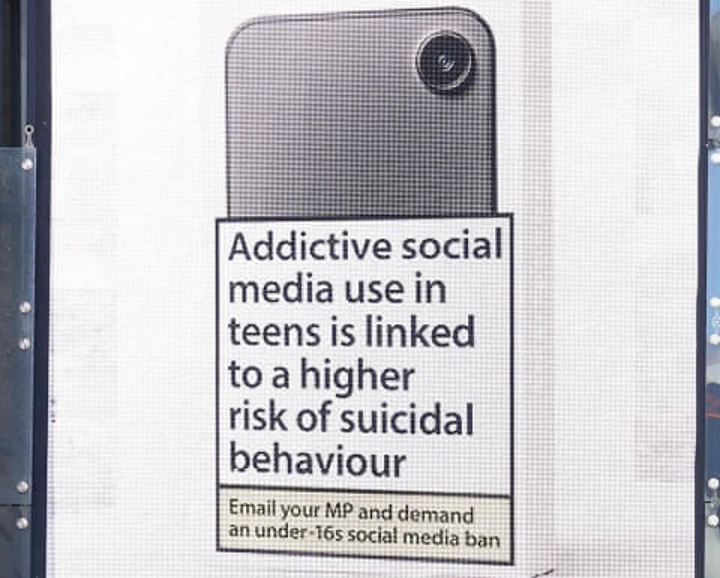
A Mumsnet billboard ad, part of its Rage Against the Screen campaign. Photograph: David Parry/PA. The Guardian.
The irrelevant defense of “free speech”
It’s obvious that in most personal injury cases, “freedom of speech” is not a defence. In a car crash where someone was drunk driving and hits a pedestrian at a crossing, it would be odd for the driver of the car, when confronted with a civil suit for damages, to claim he was talking on the phone at the same time and hence exercising the right to free speech and that in some way that may have contributed to the lack of care an attention to driving, and should be excused.
While bogus as a defense, in the example above the point is at least relevant. It is clearly relevant to the level of care and attention the driver is paying to the pedestrian. In the context of social media, the right of the platform to exercise its right to express itself freely its substantively irrelevant to its duty of care or the discharge of that duty of care.
It has nevertheless been used as a procedural torpedo to prevent state-level cases and legislation from reaching their natural conclusion. Under U.S. law, any freedom-of-speech issue that is raised must be dealt with as a matter for the federal, not state courts. Constitutional matters cannot be decided by states, only by federal courts.
When state legislatures attempt to protect minors from the documented harms of social media, those efforts are frequently met with resistance from Big Tech–backed advocacy groups. NetChoice, for example, has repeatedly challenged child‑safety legislation on First Amendment grounds.
Representing the likes of Google, Meta, OpenAI, X, and TikTok, NetChoice claims it exists to keep the internet “safe for free enterprise and free expression.” In reality, it has used that mandate to prioritise corporate freedom, repeatedly challenging online child-safety laws under the First Amendment.
In NetChoice v. Yost (Ohio), the organization argued that Ohio’s Social Media Parental Notification Act violated free‑speech protections. The Act required minors under the age of 16 to obtain parental consent before creating a social media account. In April 2025, a U.S. District Court held the law unconstitutional and permanently enjoined its enforcement. The State appealed the decision, and as of February 4, 2026, the case is pending before the Sixth Circuit: in the meantime the harms continue while what is a procedural challenge finds its way (slowly) through the court system, as, presumably was the intent of those behind the Net Choice challenge.
Another tactic used by Big Tech is to rely on Section 230 of the Communications Decency Act, which was introduced as new entry protection by the Clinton administration in the 1990s to help fledgling internet businesses get off the ground. It provides limited federal immunity for online platforms that operate as mere conduits for others content, and prevents courts from treating them for liability that would otherwise be incurred as the “publishers or speaker” of content created by other users of the network. This provision has shielded companies such as Google and Meta from some civil claims arising from publisher liability for third-party content, limiting their accountability. KGM v Meta et al. simply took the old duties enshrined in the common law and applied them to new products and services, demonstrating that those duties apply to all in society.
While the free speech argument distracts from the harm caused and the duty of care of platforms at law, it misses the point of the wider public interest that are also at stake. In response to President Trump’s claims that Europeans are engaging in “censorship” when they require platforms to remove illegal content, Margaret Vesthager, former vice president of the European Commission, along with her colleagues, argued that “the accusation of censorship ignores what is at stake”. Vesthager, et al wrote:
There is a profound difference between regulating infrastructure and regulating speech. When we require platforms to be transparent about their algorithms, to assess risks to democracy and mental health, to remove clearly illegal content while notifying those affected, we are not censoring. We are insisting that companies with unprecedented power over public discourse operate with some measure of public accountability.
As we have set out above, the platforms digital systems “engage” with and affect everyone. They do that in ways that have been shown to be harmful, and which may breach their duty of care. Adults are allowed in our society to do dangerous things. But that does not discharge a duty of care on a platform that provides a dangerous product without explaining how its use can be harmful.
On any analysis a minor cannot give consent, let alone consent to being harmed.
Neither KGM. v Meta et al. nor New Mexico v Meta seek to ban social media for adults (or children) solely on the basis of its content, but rather the addictive design of a system that engages people in ways that ensure they feel deprived and need to keep checking if they do not know what is happening on their social media accounts.
Framed as a clash between freedom of expression and regulation, something simple is revealed: Big Tech’s corporate speech is being protected, overriding state laws designed to safeguard children. Combined with First Amendment claims, this tactic reflects a broader strategy by Big Tech: exploiting legal loopholes and procedural tactics to evade accountability, at the expense of children’s safety and democratic state action.
No lesser standard for social media
In sectors like toys, transport, and medicine, the United States and many other countries worldwide take a safety-first approach; products must meet safety thresholds before reaching consumers, with protections in place until proven safe.
Even in America, the tide appears to be turning. At a Senate Commerce hearing in January, Texas Senator Ted Cruz said, “Big Tech loves to use grand eloquent phrases about bringing people together. But the simple reality and why so many Americans distrust Big Tech is you make money the more people are on your product, the more people are engaged in viewing content, even if that is harmful to them.”
Communications devices have only recently become social media platforms that mine people for data. Harm to children is often difficult to know about as they have nothing to compare their experience to; in the world of children, barrages of harmful online content could be “normal.” It is perhaps understandable that the harms being suffered have not been known or understood by the grown-ups.
Now we know.
The tech sector is responsible for 15 percent of global GDP, with TikTok, Meta, Apple and Alphabet among the most valuable and profitable companies in the world. They can afford to take more care, and they should. When it comes to precautionary standards, social media should not be subject to a lesser standard than other industries in our economy.
The Tunney Act, a law that gives judges authority to overturn corrupt merger settlements, has never been used to overturn a corrupt merger settlement. Amid an unprecedented wave of brazen corruption at Trump’s Justice Department, a San Jose federal court seems poised to assert itself, with potentially vast implications.
Regular readers of The Sling will already be familiar with the backstory, although I will offer a rosier outlook than my friend and Tunney Act expert Darren Bush. In January 2025, a mere ten days into Trump’s current term, the Justice Department filed a lawsuit to block the $14 billion merger of Hewlett Packard Enterprises (HPE) and Juniper, the second and third largest providers of wireless network services to large institutions like hospitals, universities, and government agencies.
What might have ushered in a bipartisan era of rigorous antitrust enforcement instead became mired in scandal. On the eve of trial, the Justice Department settled the case over the objections of career staff in the Antitrust Division who had sought stronger terms. That internal conflict led to the ouster of two senior antitrust enforcers. Various other lapses of enforcement, including the DOJ’s recent settlement with Live Nation, have cemented broader public sentiment that if you want to make a deal in D.C., all you have to do is pay the right person to pull the right levers.
This would all be more embarrassing for the Trump Administration if there were actual accountability for abandoning the rule of law. And I’ll get to that. But the novelty of the Trump Administration thus far is not the fact that it bends to corporate power—a bipartisan feature of administrations going back decades—but the brazenness of it all, which has the effect of rendering it banal. That banality is a dangerous predicament, fueling a broader sense of nihilism and helplessness.
A Judge pushes the limits of his authority to thwart corruption
Under these circumstances, the question of whether a federal court can stand up to Trump corruption, relying on a law adopted by Congress to compel it to do exactly that, is more than an isolated test of the adequacy of a single settlement. Rather, it is a critical test of the structural underpinnings of our democracy. More than preserving competition in the relevant market for enterprise-grade wireless local access network (WLAN) services, the Tunney Act review of the HPE-Juniper settlement will determine whether Trump has ongoing carte blanche to unilaterally eviscerate confidence in our government’s enforcement of the antitrust laws—or any law for that matter—free from the havoc wreaked by lobbyist interlopers on behalf of powerful corporations.
This past Monday, I drove myself to San Jose to watch the parties’ final arguments over the adequacy of their settlement agreement. The main legal debate over the Tunney Act is the extent to which the court is obligated to defer to the Justice Department’s judgment as to the adequacy of the settlement. Both the D.C. Circuit and Ninth Circuit Courts of Appeal have long hamstrung the courts’ oversight authority by adopting a policy of deference to prosecutorial discretion.
But as Henry Su, counsel for the Justice Department, began his argument, Judge Casey Pitts struck at the absurdity of restraining judicial authority under the guise of a statute designed to expand it:
“Is the standard under the Tunney Act that I have to conclude that something, no matter how inadequate it might be, is better than nothing? Is that the standard?”
The rhetorical implication is “no.” Even where courts have adopted a policy of deference, they have retained authority to reject settlements that make a “mockery” of the judicial system. But the question is a provocation as much as it is a source of frustration for the court. How can it be that the court would be unable to reject a settlement that is inadequate on its face? How can federal courts so casually reject agency regulations designed to rein in corporate abuse, while cowering under their own authority to curb corporate corruption?
Over the course of the next two hours, Judge Pitts posed additional questions that seemed to reveal disbelief that the proposed settlement was designed to restore, much less preserve, competition in the market. Moreover, Judge Pitts seemed at a loss to think of any merger consent decree that had adequately preserved competition in the relevant market. Of both the Justice Department and HPE, he asked:
“Can you think of a case where a merger was allowed on certain conditions, and the government looked back and said, ‘yeah that looks great, there’s competition in the market’?”
When the Justice Department failed to come up with one on the spot, Judge Pitts offered an example of a merger settlement that had not restored competition: the 2010 consent decree that paved the way for Live Nation’s acquisition of Ticketmaster, now being tried as an illegal monopolization case by the states in the Southern District of New York. And the Justice Department has again attempted to settle that case for meager behavioral restrictions and nominal divestitures. Just one week prior, Judge Subramanian called the circumstances surrounding the Justice Department’s attempted settlement of the matter “mind-boggling.”
Nor did it help HPE’s cause when its counsel offered the 2013 merger of US Airways and American Airlines as a merger settlement that had preserved competition. That settlement is widely, if not universally, condemned as a disaster for the airline industry. Further, it was the product of a similar flavor of political interference by then-Chicago Mayor and Obama acolyte Rahm Emanuel. At the time, the New York Times called the settlement “baffling.” Then-Attorney General for the State of Texas Tom Horne called it “a gross miscarriage of justice and an outrage that the case was dropped.” A 2016 report by ProPublica revealed that Emanuel’s letter on behalf of a cabal of Mayors was written by a lobbyist for the airlines, an unfortunate parallel to allegations that the settlement at issue in these Tunney Act proceedings was written entirely by HPE.
HPE fared little better when parrying against Judge Pitts’ indictment of the settlement. HPE’s lawyer boasted that the settlement required the divestiture of HPE’s “Instant On” business—“a full WLAN business, including contracts, customer relationships, and 100 employees. It’s a $30 million WLAN business.” Judge Pitts fired back, “But the overall business is $4.6 billion.” When HPE’s counsel characterized the mandatory licensure of its “Mist AI Ops” technology as giving up HPE’s “secret sauce,” again Judge Pitts pushed back: “But this is a license to something that will remain HPE’s property.”
It’s not hard to see the gears turning in Judge Pitts’ head, and it’s little reach to suggest that he wants to reject this settlement as inadequate on its face. That’s not a certainty, given that Judge Pitts still has his hands tied by the Ninth Circuit. But doing so would be a stinging indictment of a Justice Department that is exposed on multiple fronts, with little to show for all of its early-term chest-puffing.
“If there was ever a merger where the Tunney Act was meant to be useful, it is this one.”
The inadequacy of the settlement itself is to say nothing of the glaring allegations of corruption that tainted its process. Counsel for the State of Colorado, which has led a team of States intervening to protect the public interest, hammered those allegations. On June 5, 2025, HPE and Juniper met with enforcers at the Justice Department’s Antitrust Division to discuss a potential settlement, and the Antitrust Division rejected it. After that, the Antitrust Division was iced out of all settlement talks. “If they want to disagree with the Antitrust Division, that’s fine, but they went around everyone who knew anything about this case,” argued Arthur Biller on behalf of the State of Colorado.
Biller continued by detailing how HPE and Juniper even circumvented their own litigation counsel, Gibson Dunn and Freshfields, and hired lobbyists including Mike Davis, William Levi and Arthur Schwartz to pull political levers. When lawyers at the Antitrust Division rejected HPE’s initial proposed settlement, HPE went over their heads and wrote the settlement document itself. As Biller put it, “It’s not reasonable, principled decision-making. It is patronage, quite frankly.”
In doing so, a handful of lobbyists brought the entire Antitrust Division to its knees. “The influence Davis and Levi had over these peoples’ jobs was not theoretical,” Biller argued. “They got [former head of the Antitrust Division Abigail Slater] and two senior enforcers fired.”
“And when you combine those disputed facts, along with the egregious circumstances by which the settlement was reached, if there was ever a merger where the Tunney Act was meant to be useful, it is this one.”
At the close of the hearing, Judge Pitts took the matter under submission and indicated he’d issue a decision soon. If Judge Pitts rejects the settlement, as I predict he will, the Justice Department can negotiate a new, stronger settlement, proceed with litigating the case, or perhaps most likely, attempt to dismiss the case altogether. Doing so would leave the States on the hook, once again, to enforce the law amid rank abandonment by the federal government. By now, they’re getting pretty good at it.
It is a strange and exciting thing to see any legislative effort to bolster antitrust enforcement. But Senator Klobuchar’s bill to bolster the Tunney Act is special. Congress enacted the Tunney Act in 1974 to prevent the Department of Justice (DOJ) from resolving antitrust cases through consent decrees that inadequately protected competition or the public interest.
My coauthor and friend, John J. Flynn, was special counsel and Consultant for the Senate Antitrust Subcommittee of the Senate Judiciary Committee at the time the Tunney Act was drafted. In light of the DOJ’s prosecution of Microsoft in the late 1990s and early aughts (and its less than stellar settlement with Microsoft), John and I wrote about the problems in judicial interpretation of the Tunney Act, something I again did after John’s passing and after the 2004 amendment to the Tunney Act. That’s 23 years of watching my friend’s work be corrupted, misinterpreted, and rendered almost meaningless. When courts ignore the will of Congress, change ought to come faster than that.
Thus, I strongly endorse this bill. I write to explain why. I also write to emphasize that this bill is not a perfect bill. Yet I feel with greater time and deliberation, it could yield something that vastly improves the Tunney Act. Because I am not constrained by the legislative process, my viewpoint represents a best-of-worlds scenario, and not necessarily the most pragmatic of worlds.
Nonetheless, in my opinion, this bill remedies some long-standing issues.
What the Bill Does Well
To begin, the bill more clearly delineates the powers of the courts versus the powers of the executive branch. The statute was intended to ensure independent judicial review of proposed settlements once the executive branch invoked the jurisdiction of the federal courts. Over time, the courts—particularly within the District of Columbia Circuit—have developed a body of common law that treats Tunney Act public interest review as meaningless and highly deferential to the executive branch. These decisions have relied heavily on theories of prosecutorial discretion even after the filing of a civil complaint. This interpretation misconstrues the separation of powers—perhaps purposefully. Prosecutorial discretion governs whether to investigate or file suit; it does not govern the judicial act of entering a decree that carries the force of law. Despite Congress’s attempt to correct the D.C. Circuit’s line of cases via the 2004 amendment to the Tunney Act, courts continue to rely on D.C. Circuit precedent to aggrandize the executive branch at the expense of Article III of the Constitution.
Second, to the extent that agencies have engaged in sycophantic surrender of their independence to the president, and seek to serve as executive branch agencies, it makes sense that the FTC be subjected to the same requirements as the DOJ. I have explained how the establishment of “sister agencies” is a gross misreading of the FTC Act, and the structure we currently have would have been better served with a true independent and expert agency. Notwithstanding that concern, harmonization of consent judgment standards brings administrative parity. Moreover, the lack of independence proclaimed by the current FTC Chair suggests the potential for greater executive branch influence, perhaps at the behest of parties.
Third, the bill is motivated in part by increasing reports of White House involvement in the negotiation of antitrust settlements. Without disclosure, courts and the public cannot assess whether consent decrees reflect independent legal judgment or political influence. This is not singularly a President Trump concern (see examples under Democratic governance in the airlines) although it is more frequently a concern with this administration.
Finally, current practice often allows merging firms to close transactions before judicial review is complete, effectively mooting Tunney Act scrutiny and limiting a court’s remedial options. The bill addresses this problem directly, by requiring the parties to hold assets separate pending Tunney Act review. One of my long-time complaints has been parties (perhaps rightly) assuming entry of the decree and merging, with the blessing of the DOJ.
Where the Bill Could Be Improved
This does not mean this bill is perfect. There is much work that can and should be done to improve this bill.
For starters, the bill could stand an even clearer articulation of the powers of the courts versus the powers of the executive branch. Antitrust enforcement includes the investigation, decision to file a complaint, or closing the investigation. In contrast, the decision whether to enter a consent decree, reject a consent decree, or entry of a decree after litigation of a case to final judgment using the equitable powers of the court are judicial functions.
This is the separation of powers that typically occurs with judicial decrees. For example, my second Tunney Act article described how courts have the power to reject plea bargains. There is no reason for the Tunney Act to allow for greater executive encroachment on the judiciary (apart from perhaps the wealth of the parties, which is not a good reason).
The figure below further delineates the difference between application of a court’s equitable powers and Tunney Act review, as it would appear in a Section 2 case, for example.
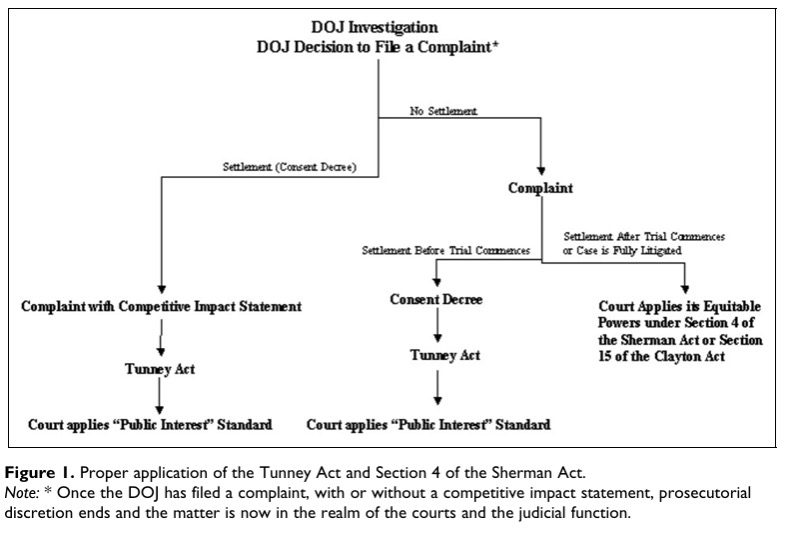
Moreover, this bill does not address the “fix it first” issue. A “Fix it first” typically involves merging parties identifying an anticompetitive risk and proposing to remedy the issue prior to an antitrust investigation. However, another potential method is for the DOJ to negotiate a “fix it first” in problematic avoidance of Tunney Act proceedings. That would be a deliberate circumventing of the Tunney Act process, and this bill does not cure that concern. I have other reservations about this practice beyond the scope of the Tunney Act.
There is still a question of what happens if the D.C. Circuit courts continue to ignore Congress. While this bill makes it harder for them to use Constitutional Avoidance to suggest Congress really didn’t mean what it says, this bill is sufficiently clear that if the courts wish to continue down this path, they raise the risk of asserting courts rejecting any type of settlement—including plea bargains—is unconstitutional.
There is still a question of what happens when a remedy is proposed to a broadly worded complaint, as happened in the American Airlines merger. There, a broadly worded complaint was filed, then the case settled with minimal remedies that did not cover the scope of the complaint. Ultimately, the court could reject the decree on that basis. That may lead to very narrowly written complaints in litigation when the complaint is not written alongside the proposed final judgment (i.e., in anticipation of litigation).
Finally, there needs to be a clearer delineation of when a court exercises its equitable powers versus when it is engaged in Tunney Act review. As in the case against Microsoft, the court erroneously limited the scope of its powers despite the case having already been litigated to final judgment. The Tunney Act does not apply to fully litigated cases, and attempting to shoehorn fully litigated cases into the Tunney Act limits the equitable powers of the court.
In sum, I hope this bill passes, with improvements. Although it won’t save democracy, the bill can restore some meaningful judicial review to an increasingly politicized area of law and perhaps foreclose some windows of corruption.
My works on the Tunney Act:
Darren Bush, The Abdication of Judicial Responsibility and Authority in Consent Decrees and the Dismissal of Congressional Intent by the Judiciary: The Implications of the Misuse of the Tunney Act in the D.C. Circuit, 63 Antitrust Bull. 113 (2018).
John J. Flynn & Darren Bush, The Misuse and Abuse of The Tunney Act in the Microsoft Cases: The Adverse Consequences of The “Microsoft Fallacies,” 34 Loy. U. Chi. L. J. 749 (2003).
Darren Bush, No, The Tunney Act Won’t Save Democracy, The Sling (August 13, 2025).
Zillow is dominant in the market for online rental listings—more formally known as Internet Listing Services (ILS)—which are used by renters to search for and find their next rental home or apartment. Zillow controls over half of this market, per its own estimates. According to Comscore’s visitor-traffic analytics, Zillow overtook CoStar (owner of Apartments.com) in 2022 to become the nation’s leading ILS platform. Redfin, which ranks third, acquired RentPath(owner of Rent.com and ApartmentGuide.com) in 2021.
Zillow competes with online rental platforms in the sale of advertising to property managers of multifamily units. At least in theory.
Just as many branded drugs have paid off generic entrants not to compete, Zillow has tried to maintain its dominance in ILS by paying off Redfin directly, which has drawn the ire of antitrust authorities. In September 2025, the FTC filed a lawsuit against Zillow and Redfin, claiming the companies engaged in an unlawful arrangement not to compete. According to the complaint, Zillow provided Redfin with $100 million and additional compensation in exchange for Redfin’s withdrawal from the ILS market. As part of its deal with Zillow, Redfin allegedly agreed to terminate existing advertising contracts, cease competing in the multifamily advertising space, and act solely as a distributor of Zillow’s listings. The FTC contends that this arrangement extinguished direct competition between the two companies, potentially leading to higher costs and less favorable terms for advertisers of multifamily units.
A recidivist offender
Seemingly unconstrained by antitrust law, Zillow now appears to be using a proxy to exclude another entrant, Homes.com, in yet another market that Zillow dominates—online real estate listings.
In investor documents, Zillow notes that it controls nearly two-thirds of the U.S. real estate audience share for listings. Smaller competitors in this market include Realtor.com, Redfin, and Homes.com.

In the market for online real estate listings, Zillow boasts that its is 2.5 times larger than its nearest competitor, Realtor.com.
Zillow exercises its market power over agents, by charging a premium over the competitive commission rates. Multiple class actions allege that Zillow charges agents commission rates nearly double the industry norm, and it steers homebuyers toward its in-house mortgage products.
So what’s the latest scheme to induce exit by a rival? Enter D.E. Shaw, a large hedge fund that owns significant stock in Zillow. D.E. Shaw is running a campaign, potentially at Zillow’s behest, to demand that Homes.com exit the market for online real estate listings. In a letter to CoStar’s board on February 4, 2026, citing performance issues, the hedge fund insisted that CoStar “develop an alternative strategy for Homes.com that involves exiting, spinning off, divesting, or dramatically reducing spending on the business to breakeven by 2027.” D.E. Shaw’s demand follows on the heels of an identical demand by Third Point in January 2026, another hedge fund that held approximately $184 million in Rocket Companies, the owner of Redfin, as of the fourth quarter of 2025.
The conflict of interest is not subtle. D.E. Shaw holds approximately $204 million across Zillow, Opendoor, Rocket/Redfin, Compass, and Anywhere Real Estate—every significant residential real estate portal and portal-adjacent business that competes directly or indirectly with Homes.com. These competitors stand to benefit if Homes.com exits the real estate listings market, leading to windfall gains for its investors. Neither D.E. Shaw nor Third Point disclosed these competing interests anywhere in their activist letters.
The antitrust concern here has a name: common ownership. Landmark research by José Azar, Martin C. Schmalz, and Isabel Tecu found that common ownership in the airline industry drove up ticket prices by an estimated three to seven percent, and parallel research found similar effects in commercial banking. Although the mechanism differs, the result is the same: investors or platforms with ownership interests across rival firms leverage that position to dampen competition between them.
The competitive threat that Homes.com poses to Zillow
When a homebuyer clicks “Contact Agent” on Zillow’s website, research suggests the buyer is typically not connected to the listing agent but routed to a buyer’s agent who pays Zillow for the lead through commission sharing. Zillow then steers borrowers toward Zillow Home Loans, its affiliated mortgage lender, with agents reportedly required to hit referral quotas to maintain platform access. Under its Flex program, Zillow collects referral fees of up to 40 percent of the agent’s commission (well above the industry norm of 25 percent). when a transaction closes. Those costs are ultimately passed through to buyers and sellers in the form of higher commissions and less flexible pricing. Independent research has found that borrowers using Zillow Home Loans pay thousands more on average, with disparate impacts on veterans, low-income borrowers, and Black borrowers. Similarly, when Rocket acquired Redfin, company explained how it began funneling customers toward Rocket Mortgage. In contrast, when homebuyers click on “Contact Agent” on Homes.com, the buyers reach the listing agent directly, and there is no affiliated mortgage lender.
The competitive threat that Homes.com poses to Zillow is not merely a matter of market share. It is a matter of business model. That distinction creates downward pressure on agent costs across the market. Remove an alternative business model, and Zillow’s pricing power over agents—and by extension, over consumers—faces no meaningful check. Moreover, the anticompetitive effects are the same regardless of whether the hedge funds are acting at the behest of Zillow and Redfin, or instead are acting purely in pursuit of their own financial interests.
Whether Homes.com succeeds on its merits is ultimately a question for the market to answer, not for conflicted hedge funds to dictate. The question for regulators is narrower and more urgent: when investors hold nine-figure stakes in a dominant platform’s competitors, every one of which monetizes consumers through lead diversion, commission sharing, or mortgage steering, while simultaneously using activist pressure to eliminate a well-capitalized challenger, does that conduct warrant the same scrutiny the government has already applied to Zillow’s direct efforts to exclude a rival? The DOJ and FTC have the tools. The common ownership scholarship points the way. Americans, many of whom currently struggle to afford the housing market deserve enforcers willing to ask the question.