
When Kamala Harris briefly mentioned during the presidential campaign of 2024 that companies were gouging their customers, neoliberals kicked into high gear to defend corporate interests. Catherine Rampell called Harris’s prescription “communism,” and Jason Furman and Lawrence Summers mocked any heterodox economists lending support to the notion that companies were profiteering during a crisis.
But with the passage of time and more research—including best-selling books by Lindsay Owens and Isabella Weber—economists of all stripes are slowly recognizing how companies used the cover of inflation to raise prices by more than any true cost increase. Only the company knows the true extent to which its incremental costs have increased; it can exploit this information asymmetry by exaggerating the cost increase to its clients when raising prices, particularly in an inflationary environment. This asymmetry also explain why companies are loathe to pass through cost decreases; why share information with your customer about a private cost decrease?
Two economists at Northeastern University, John Kwoka and Muhammad Shabanpour, tested that proposition of pass-through and found support for profiteering in the airline industry. In a September 2026 working paper titled “Inflation as a Pretext for Raising Prices: A Test of State-Dependent Cost Pass-Through,” the authors estimate how fuel shocks translate into higher airfares across inflation regimes and market structures. The figure below is a replication of Figure 4 from their study, showing how airlines front-loaded a fuel shock under high inflation.
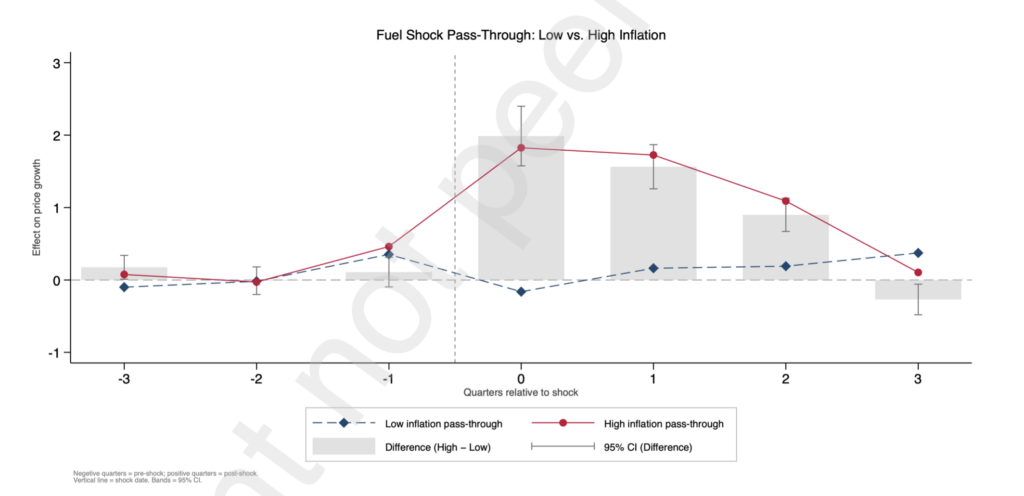
Using data from the Department of Transportation’s DB1B Ticket and Coupon files from 2015 to 2024, they find that a one percent increase in fuel costs raises fares by 0.26 percent in low-inflation periods but by 0.50 percent in high-inflation periods (when inflation exceeds three percent). The study also finds that pass-through is greater on concentrated routes; pass-through was 0.31 on low-HHI routes and 0.42 on high-HHI routes (when HHI exceeds 2,500). The authors conclude that such evidence “support[] the argument that general inflation can increase cost pass-through by firms in noncompetitive markets.”
Beyond airlines
Economists at the Kansas City Fed found that corporate profits drove a large share of price increases in 2021, but argued that profit’s contribution faded in 2022 as costs caught up, much like it does in most recoveries. Their colleagues at the San Francisco Fed disagreed, concluding that rising markups “have not been a main driver” of inflation at all. Yet the San Francisco-based economists found markups increased by more than ten percent in autos, petroleum, and general merchandise, increases that disappear once they’re averaged in with the rest of the economy.
We wanted to ask a more targeted series of question: When inflation took off, did companies raise prices faster than their own costs (or what we will call “profiteering”)? And what happened once inflation cooled? Using Census data on the income statements of American corporations, we find that in fact companies engaged in profiteering. In places like grocery stores, the extra profit went away only once costs (including wages) finally caught up.
Every quarter, the Census Bureau’s Quarterly Financial Report collects income statements from U.S. corporations and adds them up by industry. We used it to follow 26 manufacturing and trade industries, from food processing to grocery stores, covering about $13 trillion in annual sales, from 2000 to mid-2026. We left out oil, mining and other commodity producers, whose profits swing with world prices.
To study whether firms have been profiteering, we use operating margin. Economists have used such margins to study pricing power for decades. Operating margin is how many cents of profit a firm keeps from each dollar of sales after paying its operating costs. If a company raises prices only as much as their costs went up, its operating margin should stay flat. If it raises prices by more, operating margin should go up.
Before the pandemic, the 26 industries in our data kept about 6.2 cents of operating profit on every dollar of sales. During the inflation of 2021 to 2023, however, that share rose to 6.9 cents. Margins went up in 21 of the 26 industries, from food processing and machinery to wholesalers and grocery stores.
That may sound small, but on $13 trillion of sales it adds up to roughly $100 billion a year in extra operating profit. Put another way, for every extra dollar that companies paid out in expenses, they took in about $1.12 in sales (equal to increase in sales divided by increase in costs). Had margins remained flat, companies would have taken only about $1.07 (equal to 1 divided by (1 − pre-pandemic margin)).
Compare that profiteering with 2008, when inflation hit 5.6 percent, the biggest spike before the pandemic. Yet margins declined in 18 of the 26 industries in 2008. And when inflation briefly topped three percent again in 2011, margins barely moved. In 2021, with inflation on its way to nine percent, companies didn’t just pass on their higher costs but instead used them as cover to charge more. The shaded areas in the figure capture times where CPI inflation exceeded three percent.
Operating margins rose during the latest bout of inflation, and stayed up
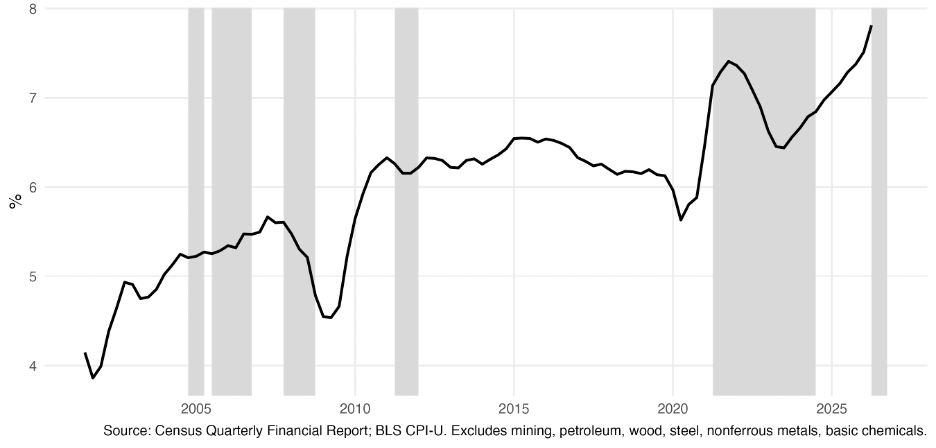
What’s even more striking is that the margins stuck around after the inflation faded in 2024. Between mid-2024 and early 2026, inflation hovered between 2.5 and 3 percent, and yet two-thirds of these industries were still earning more on every dollar of sales than they did before the pandemic. Part of that is the AI boom, which has been a boon to the companies making chips and servers. But even excluding those industries, the rest were still keeping 6.6 cents of every dollar in sales in 2025, compared with 6.0 cents before COVID.
Grocery gouging
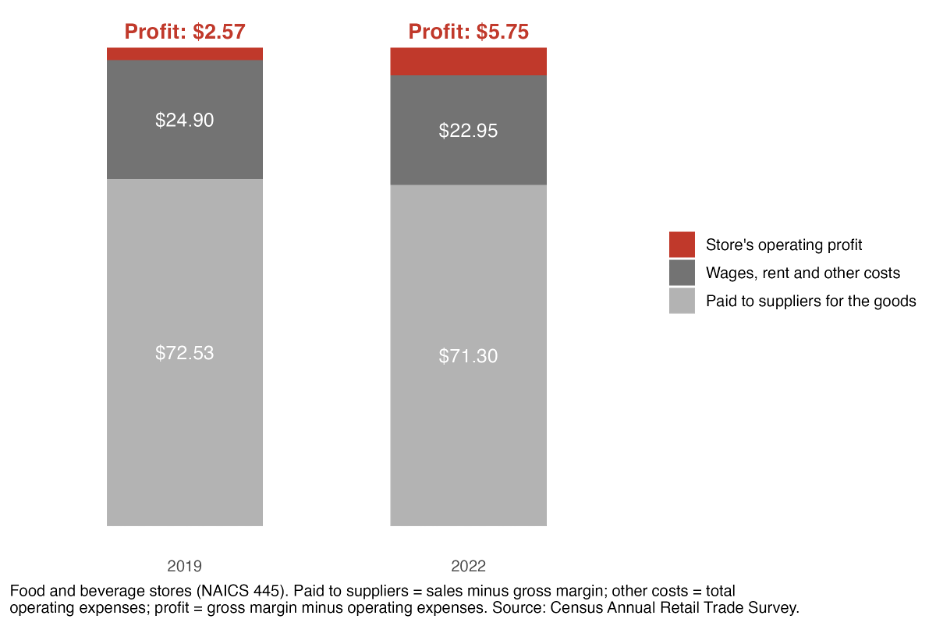
If you want to see how this dynamic affected families, look at grocery stores. The Census Bureau’s Annual Retail Trade Survey (ARTS) tracks where each dollar spent at food and beverage stores ends up, and the change between 2019 and 2022 is hard to miss. Before the pandemic, a grocery store allocated $72.53 of every $100 spent by customers to its suppliers, with $24.90 going towards wages, rent, and other expenses, retaining just $2.57 as profit. By 2022, a grocery store’s profit on $100 of sales increased to $5.75, more than doubling its previous profit margin.
Where $100 spent at food and beverage stores went
What happened after 2022 is even more fascinating. To see it, we go back to the Quarterly Financial Report, which covers only larger grocery chains, so its margins run a bit lower than the ARTS above, but it tracks them through 2025. Grocery margins, meaning profit as a share of sales, peaked at around 4.2 to 4.3 percent in 2022 and 2023, and by 2025 they had slid back to their pre-pandemic level of about 2.7 percent. That wasn’t due to grocers’ benevolence. Their sales kept growing every year, but what changed was that their costs, including the wages that had trailed prices for two years; those costs started growing faster than sales from 2023 and squeezed the margin back down. Put simply, grocery stores increased prices more rapidly than their costs rose, but eventually, those costs did catch up. During the interim, however, the additional profits had already been realized.
Grocery margins rose during the inflation and fell back as costs caught up
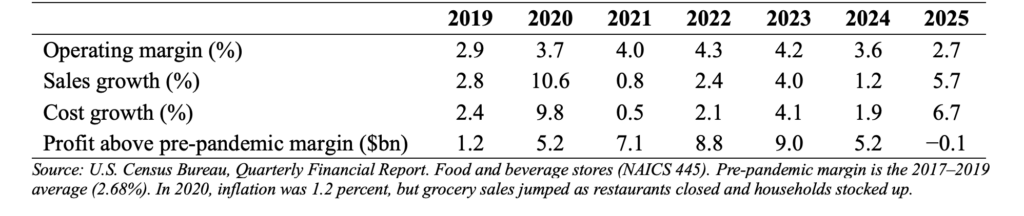
In 2020 alone, grocers made $5.2 billion more than their usual margins would have earned them. Even with profits that high, they kept pushing margins up in 2021 and 2022 as inflation took off. By the time costs caught up, grocers had banked about $30 billion more in profits over 2021 to 2024 than their normal margins would have brought in.
As with anything, it was the consumers and workers who paid for these profits. A margin drifting back to normal doesn’t mean prices came back down; it means a store’s costs eventually rose to meet prices that had already gone up. The grocery bills people pay today are built on the prices set during the inflation.
Workers lost out too. In 2021 and 2022, the two years grocery margins climbed, the people stocking shelves and working registers saw their pay fall behind prices both years. Because hourly pay rose 6.5 percent in 2022, but prices rose eight percent, grocery workers took a real pay cut in the same year their employers posted their highest margins since at least 2000.
Grocery margins started coming down only once wages began rising faster than prices. That is the cycle in a nutshell: when inflation hits, prices move first and pay follows later, and the gap between the two ends up as profit.
The usual suspects
The standard industry defense, often peddled by industrial organization economists, is that widening margins reflects a hot economy. Stimulus checks were in people’s pockets, demand for goods was through the roof, and firms with more customers than they could serve naturally earned more. Demand clearly played a part, as the industries that grew their output the most also tended to see the biggest jumps in margins. But that story can’t explain what happened in the industries that made fewer things. Of the 21 manufacturing industries we could match to the Federal Reserve’s industrial production data, 14 produced less output in 2021 to 2023 than before the pandemic, yet margins went up in ten of them anyway.
Paper mills produced about ten percent less output yet still widened their margins (by more than a cent on the dollar). Similarly, machinery makers produced about five percent less output yet widened their margins (by nearly two cents on the dollar). And our estimates imply that even an industry whose output didn’t grow at all would have widened its margins (by about 1.3 cents on the dollar).
The new Democratic-controlled Congress will be looking for ideas on how to tame inflation. The first lesson from our analysis is that inflation stokes even more inflation, by permitting companies to raise prices in excess of any legitimate cost increase. Congress should break this vicious cycle by adopting a national ban on price gouging during a crisis (think oil shock or COVID). Companies would be free to raise prices to cover any cost increase, but by no more.
There are many other anti-inflationary tools that we would recommend, including (1) banning the use of common pricing algorithms, (2) banning surveillance pricing, (3) expanding the FTC’s unique authority to police invitations to collude to private enforcers and states, (4) tasking and funding the Department of Justice to automatically investigate any industry experiencing above-average inflation, (5) preventing investors and private equity in particular from converting residential apartments into short-term rentals, (6) flooding the housing market with publicly owned units, and if needed (7) implementing targeted price controls in critical industries such as healthcare and food.
Rioters ransacked the streets of France because prices were growing in excess of wages. Real wages are also falling in America, but Americans thankfully expressed their frustrations peacefully at the voting booths. Democrats will receive the same treatment as Republicans in 2028 if they can’t get a grip on what’s squeezing households. Now is the time to act.