
Delta president Glen Hauenstein told investors in July that AI-based pricing is currently used on about 3 percent of its domestic network, and that the company aimed to expand AI pricing to 20 percent of its network by the end of the year. This is bad news for flyers, and given the particular way Delta is accessing the technology, is particularly bad for competition.
Airlines have been using “dynamic pricing” for decades, which entails setting fares based on common (as opposed to individualized) factors like demand, timing, real-time supply, and pricing by competitors. A spokesperson for Delta insists the new technology is merely “streamlining” its dynamic pricing model.
Personalized pricing, made possible via surveillance and AI, is distinct from dynamic pricing, in that the former allows a firm to condition pricing on the circumstances of the customer. Hence, two people shopping for airfares at the same time might see different prices based on things like travel purpose (business or leisure), income estimates, browsing behavior, ticket purchase history, website used, or type of device used.
To implement the new technology, Delta is working with Fetcherr, an Israeli-based GenAI pricing startup whose clients include other airlines like Virgin Atlantic and WestJet, to power the pricing changes. Alas, the three carriers share overlapping routes. From London, Virgin Atlantic flies to several U.S. destinations, including Atlanta, Boston, Miami, Las Vegas, Los Angeles, New York, Orlando, and Washington D.C. Delta also operates flights from London to many of those same U.S. cities, including Atlanta, Boston, Los Angeles, and New York. WestJet has expanded its network into the United States, including to such destinations as Anchorage, Atlanta Minneapolis, Raleigh, and Salt Lake City. (Some of these routes are in partnership with Delta.) Economists and antitrust authorities recognize that there could be anticompetitive effects if common pricing algorithms lead to collusion. Check out the DOJ’s antitrust case against RealPage, in which landlords are alleged to have to turned over their pricing decisions to a common algorithm (RealPage).
During the company’s second-quarter earnings, Delta CEO Ed Bastian noted “While we’re still in the test phase, results are encouraging.” Hauenstein called the AI a “super analyst” and results have been “amazingly favorable unit revenues.” These boasts, aimed at investors as opposed to consumers, mean that AI-based pricing is raising profits—else the results would be ambiguous or discouraging. And those extra profits are likely coming off the backs of consumers. And as we will soon see, rising unit revenues means that AI-based pricing is not leading to price reductions on average, contra the predictions of price-discrimination defenders.
Price Discrimination Is Bad for Consumers, Even When Implemented Unilaterally
Economic textbooks are filled with passages claiming that the welfare effects of price discrimination are ambiguous. It’s worth revisiting the key assumption that permits such an innocuous characterization—namely, an increase in output. As we will see shortly, this assumption isn’t easily satisfied in the airline industry.
Consumer welfare or “surplus” is recognized as the area underneath the demand curve bounded from below by the price. For a particular customer, surplus is the difference between her willingness to pay (WTP) and the price. Importantly, when it comes to first-degree price discrimination—charging each consumer her WTP—all consumer surplus is transferred to the producer, meaning consumers receive no benefit from the transaction beyond the good itself.
Let’s start with the basics. The figure below shows what happens when a firm facing a downward-sloping demand—an indicator of market power—is constrained to charging a single, uniform price to all comers. The profit-maximizing uniform price, P*, is found at the intersection of the marginal revenue and marginal cost curve, and then looking up to the demand curve to find the corresponding price.
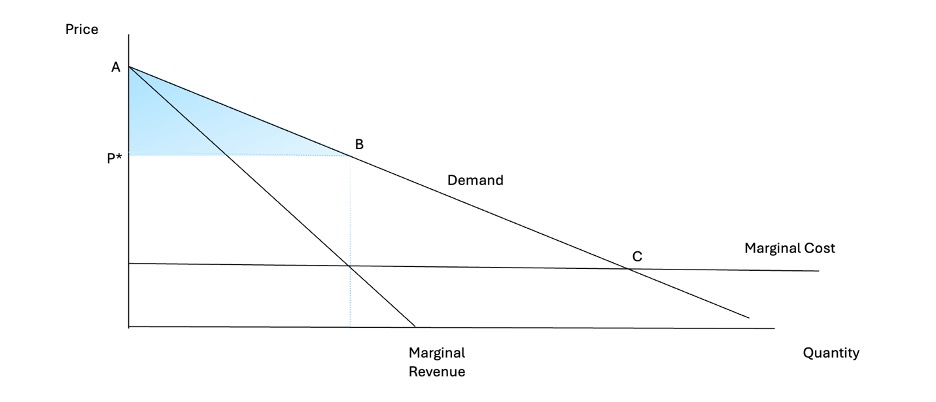
Even at the profit-maximizing uniform price, P*, the firm with market power leaves some consumer surplus on the table, equal to the area of the triangle, ABP*. This failure to extract all consumer surplus motivates many anticompetitive restraints that we observe in the real world, such as bundled loyalty discounts. Another way to extract that surplus is, if possible, to charge each consumer along the demand curve between A and B her WTP. And that’s where AI-based personalized pricing comes in. Consumers along that portion of the demand curve are clearly worse off relative to a uniform pricing standard. The only consumer who is indifferent between the two regimes is the one whose WTP is just equal to P*, situated at point B of the demand curve.
Defenders of price discrimination are quick to point out that the price-discriminating firm can reduce its price, relative to P*, to customers on the demand curve from B to C, bringing fresh consumers into the market (who were previously priced out at P*) and expanding output. After all, they claim, there is incremental profit to be had there, equal to the difference between the WTP (of admittedly low-value consumers) and the firm’s marginal cost. There are at least two practical problems, however, with this theoretical argument as applied to airlines.
First, this argument presumes that airline capacity can be easily expanded. But an airline can only enhance output in a handful of costly ways. An airline can add more planes, which are not cheap, or more seats per plane, decreasing the quality of the experience for all passengers. An airline could also add more flights per day, but this too is costly because the airline must secure permissions from the airport at the gates.
Second, as noted above, the customers between B and C along the demand curve are the low-valuation types, who are not coveted by legacy carriers like Delta or United. These low-valuation and budget-conscious customers tend to fly (if at all) on the low-cost carriers and ultra-low-cost carriers like Southwest and Spirit, respectively. Serving these customers, as opposed to extracting greater surplus from high-valuation customers, is likely less attractive to Delta, especially if doing so would compromise the quality of existing customers (through, for example, cramming more seats on a plane), or would put downward pressure on prices of other items that are sold on a uniform basis (e.g., in-flight WiFi or alcoholic drinks).
Even if you don’t accept these practical arguments, it bears repeating once more that under first-degree price discrimination, there is no consumer surplus, even at the expanded output. So expanded output here is nothing to cheer about, unless you are an investor in the airlines or work as an airline lobbyist or consultant. And if there’s any doubt on the price effects from AI-based pricing, recall the boast from Delta’s executive—unit revenues are rising, which can’t happen if Delta is using the technology to drop prices on average to customers.
Price Discrimination Is Even Worse for Consumers When Implemented Jointly with Rivals
If this weren’t bad enough, there’s a knock-on effect from AI-based personalized pricing, especially if the technology vendor is also supplying the same pricing assistance to Delta’s rivals. Recall that Delta uses a pricing consultant that is also advising airlines with overlapping routes with Delta. In that case, the common pricing algorithm can facilitate collusion that would other not be possible. We can return to our figure to see how collusion can make consumers even worse off relative to discriminatory pricing.
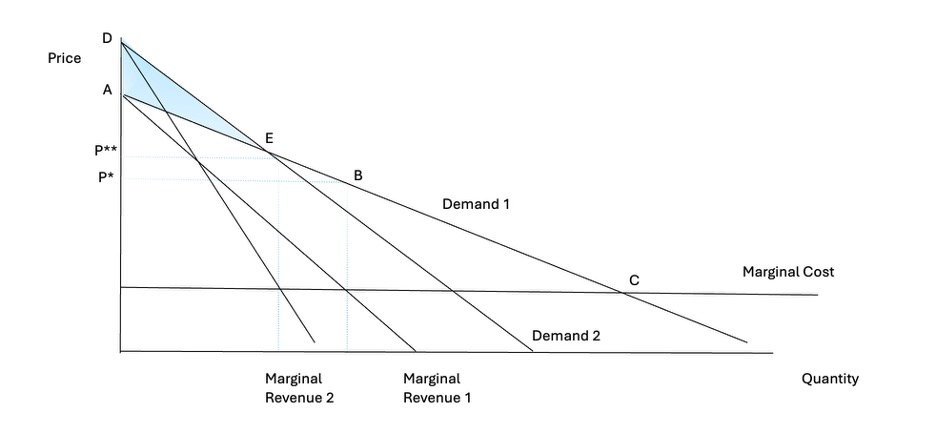
Relative the original demand curve (Demand 1), the demand when prices are set via a common pricing algorithm (Demand 2) is less elastic, meaning that an increase in price does not generate as large a reduction in quantity. In lay terms, the demand is steeper. This rotation of the demand curve, made possible by weakening an outside substitute via collusion, causes the uniform profit maximizing price to rise above P* to P**. And this higher price opens the possibility of additional surplus extraction via price discrimination, equal to the area DAE, for the highest-value customers.
Where We Do Go from Here?
At this point, we have two different policy choices. The first is to pursue an antitrust case against Delta and Fetcherr. The problem with antitrust—and I make this argument against my own economic interests as an antitrust economist—is that such a case against Delta would not be resolved for years. The DOJ’s case against RealPage was filed nearly a year ago (August 2024), and we’ve seen little progress. In complex litigation, the defendants need time to produce voluminous data and records in response to subpoenas, the plaintiffs’ economists will have to understand those data and build econometric models that will be subjected to massive scrutiny by even more economists, there will be hearings, motions for summary judgment and to exclude testimony, and then a trial.
The second intervention is to ban, via regulation at either the city or federal level, the use of common pricing algorithms for airlines or more broadly. Similar bans have been imposed by cities against RealPage and Airbnb, which also has been accused of employing a common algorithm (and the subject of a forthcoming piece). Senators Ruben Gallego of Arizona, Mark Warner of Virginia, and Richard Blumenthal of Connecticut sent a letter to Delta on July 22 correctly asserting the harms from Delta’s AI-based pricing, which will “likely mean fare price increases up to each individual consumer’s personal ‘pain point’ at a time when American families are already struggling with rising costs.” A senate hearing could be in order. But Delta won’t back off from this approach unless and until it perceives the threat of regulation to be credible.
Of the two options, I prefer the latter. With luck, Congress will too!
Since the launch of ChatGPT back in November of 2022, what was once a concept confined to Sci-Fi novels has now certifiably hit the mainstream. The highly visible advances in artificial intelligence (AI) over the past few years have either been awe-inspiring or dread-inducing depending on your perspective, your occupation, and maybe how much Nvidia stock you owned before 2023. Many white-collar workers now fear that they may face the same job-displacing effects of automation that has plagued their blue-collar peers over the past several decades.
Nevertheless, at least one powerful constituency is absolutely thrilled with the rise of AI and is betting big on its success: Big Tech. Microsoft, currently the second most valuable company in the world with a mind-boggling $3.7 trillion market cap, is a leading AI zealot. This fiscal year alone, Microsoft plans to invest over $80 billion in AI-related projects.
As one of its big selling pitches to investors and consumers, Microsoft argues that AI has prompted massive efficiency gains internally, including eliminating a staggering 36,000 workers since 2023. Microsoft CEO Satya Nadella estimated that as much as 30 percent of the company’s code is now written by AI. Mr. Nadella, of course, has a lot riding on convincing shareholders and consumers that AI is a big deal. So, to what extent this claim is legitimate, or pure marketing fantasy, is uncertain. A recent working paper authored by Microsoft researchers and academics analyzes the productivity increases in (non-terminated) software developers who use AI tools. The authors find that developers using AI tools saw an average 26 percent increase in their productivity. If such experimental results generalize to the broader labor market, AI will certainly have a dramatic impact. Despite evident benefits towards companies from this productivity boon whether workers themselves stand to gain remains uncertain.
A Look into Software Developers’ Compensation
AI models capable of assisting with writing and coding tasks have existed for a couple of years now. Taking Mr. Nadella’s statements at face value, such models enjoy widespread utilization by developers and coders working for Big Tech. As such, if workers—and not just their employers—stand to benefit from AI, then worker compensation should reflect at least some evidence of these productivity gains.
Simple economic models of the labor market suggest that a technology that boosts the marginal productivity of labor will cause a concomitant increase in worker pay. After all, in competitive labor markets, workers should capture 100 percent of their marginal revenue product (MRP), which increases with productivity, though such an outcome rests upon a strong and often-violated assumption that the relevant labor market is perfectly competitive. When an employer has buying power, it can drive a wedge between the worker’s MRP and her wage. In lay terms, this means the employer can appropriate value created by the worker without sharing in the gains, the Pigouvian definition of exploitation. Thus, the extent to which workers benefit from this AI-induced productivity remains unclear. (In addition, a monopsony reduces employment relative to a competitive labor market; Microsoft’s mass firings since its acquisition of Activision in 2023 is also consistent with the exercise of monopsony power.)
While a recent article in The Economist highlights how the AI boom has led to some “superstar coders” seeing their “pay [] going ballistic,” this subset of workers represents a tiny sliver of the total labor market of developers. In that same article, The Economist also produced a graph showing a dramatic slowdown in hiring—job postings for software developers have dropped by more than two-thirds since the beginning of 2022. To understand how AI is affecting workers, we need to look at the labor market at large. Unfortunately, our analysis suggests that software developers have not yet benefited (and may never fully benefit) from their increase in productivity.
Figure 1 below takes the broadest look at how all software developers and computer programmers in the United States have (or have not) benefited from the rise in AI. The results are not pretty: While 2022 inflation has hit all workers hard, eroding much of their nominal wage increases, both computer programmers and software developers are faring much worse than the average worker. Per the BLS, the median wage of computer programmers decreased by 5.89 percent between 2022 and 2024.
Figure 1: Real Wages Are Flat for Most Workers, But Have Declined for Programmers and Developers
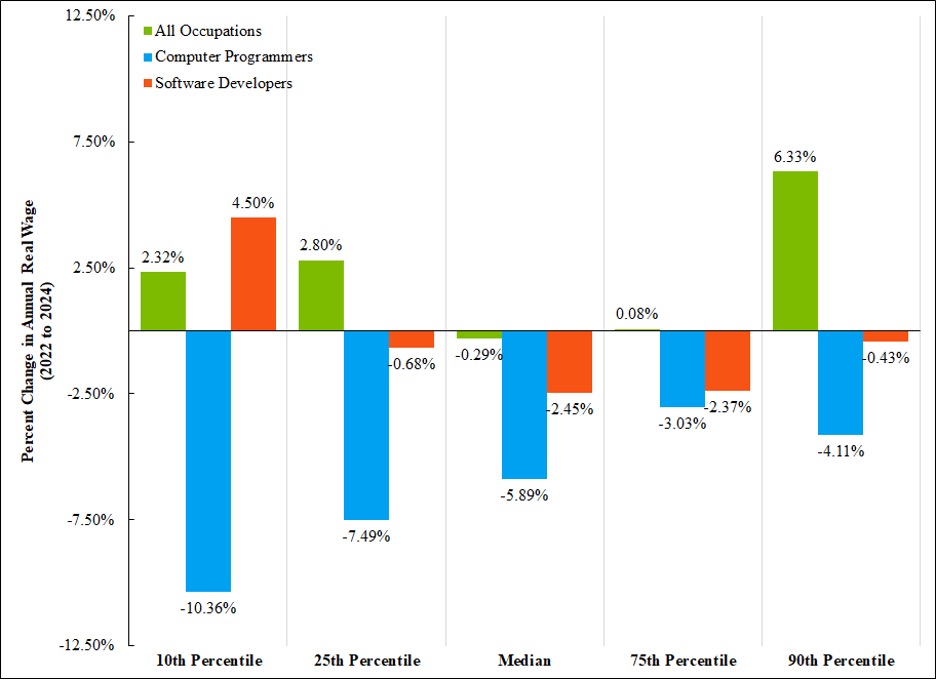
Source: Bureau of Labor Statistics’ Occupational Employment and Wage Statistics Annual Report; CPI sourced from FRED. Notes: We transformed this nominal data using CPI to be in 2024 dollars. Hence, this chart shows the real change in wages between 2022 to 2024 (i.e., accounting for inflation). 2024 is the most recent data release, and the 2024 data are not inclusive of data from Colorado.
Not even the top ten percent of software developers, including the “superstar coders” as dubbed by The Economist, appear to be thriving. Figure 1 also shows that the highest paid computer programmers (90th percentile) saw their real wages fall by 4.11 percent.
Workers for Big Tech fared no better. Indeed, the percentage change in the median compensation for software engineers employed by Big Tech effectively mirrors that reported in Figure 1—the median software engineer saw a 2.22 percent decrease in their real wages from 2022 to 2024 per data from Levels.fyi.
Figure 2: Software Engineers Working Big Tech Also Have Not Seen a Dramatic Rise in Wages
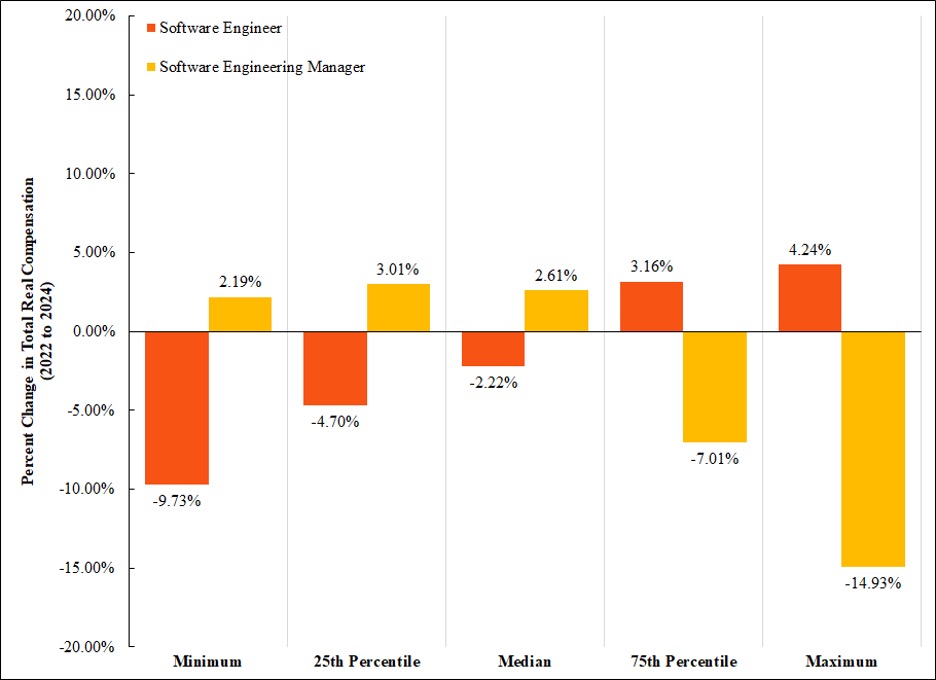
Source: Levels.fyi 2024 and 2023 year-end reports; CPI sourced from FRED. Notes: Levels.fyi collects self-reported data “for the top paying tech companies and locations.” Total compensation is inclusive of base salaries, stock grants, and bonuses. Note that Levels.fyi’s trend table has slightly different median compensation estimates than the box charts that we source our data from. It is unclear what causes this discrepancy. We transformed this nominal data using CPI to be in 2024 dollars. Hence, this chart shows the real change in total compensation between 2022 to 2024 (i.e., accounting for inflation).
At the very least, we see evidence that software engineering managers (depicted in yellow) have seen their compensation rise (by 2.61 percent), though nowhere near their supposed AI-powered productivity increase.
Microsoft-specific wage data were not easily accessible. The Economist reported that the median pay for software developers at “tech giants including Alphabet, Microsoft and, until recently, Meta” was close to $300,000. Lucky for us, however, Microsoft sponsors thousands of H-1B visas, which provides a source of publicly available salary data. Using these data, we can get a sense of the trend in how Microsoft software engineer compensation has evolved over time. Because they are beholden to their American employer, H-1B visa-holders likely earn wages below their American counterparts. Nevertheless, the trajectory of wages of H-1B workers should roughly track the trajectory of wages of their American peers.
Figure 3: H-1B Data Suggest That Microsoft Software Engineers’ Real Wage Stagnated in the 2020s
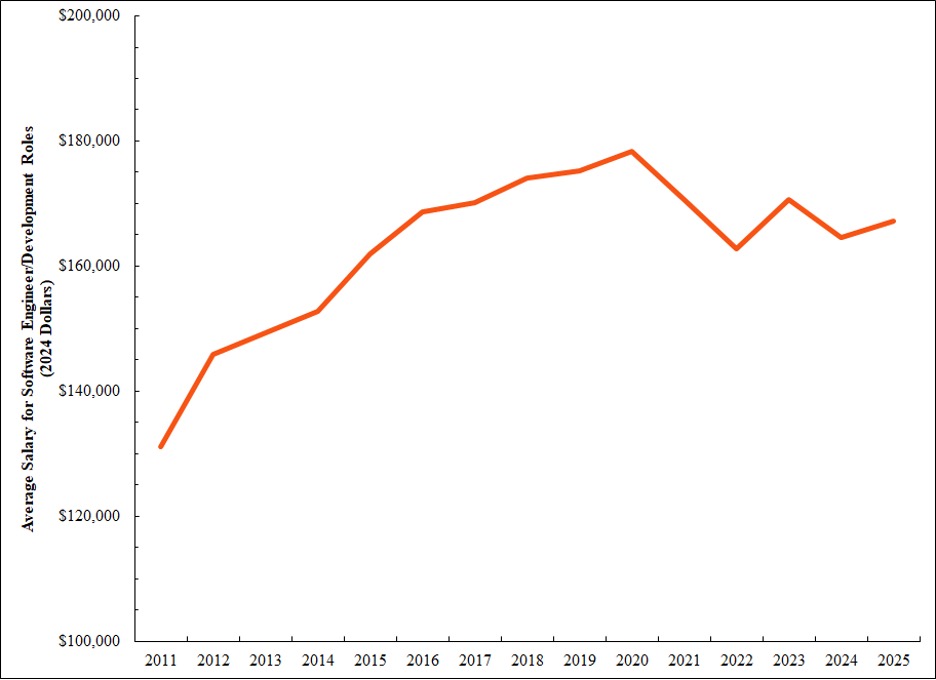
Source: Data is from H1B Grader.com which states that “salaries data is extracted from the H1B Labor Condition Applications (LCAs) filed with the US Department of Labor by [the] Microsoft Corporation.”Notes: We combined various positions’ pay information to produce this average salary measure. Positions that were consolidated had titles that indicated they were roles in software engineering or development. We explicitly excluded IT-specific roles.
While H-1B software engineers working at Microsoft saw real wage increases during the 2010s, by the 2020s, real wages appear to have stagnated. This trajectory likely reflects the trend for all Microsoft developers, including domestic workers.
While these figures are by no means perfect, if workers truly reaped benefits from their AI-boosted productivity in a significant way, the above charts should have reflected such an outcome. Unfortunately, from what we can see, wages have not captured much of AI’s productivity impact. This lends credence to the hypothesis of monopsony exploitation restraining wage growth—in other words, Microsoft (the employer) is appropriating the productivity gains of its workers, presumably because the workers do not have credible outside employment options to which they could turn easily in response to a wage cut.
Software Developers Face an Uncertain Future
Unfortunately, not only do software developers not receive boosts in their compensation commensurate with their productivity increases, but many also now risk losing their jobs. As noted above, Microsoft has shed 36,000 jobs since 2023.
The cause of these mass layoffs does not appear to lie with any underperformance on Microsoft’s part. On the contrary, Microsoft’s gross profits have continued to rise over the past few years, as seen in Figure 4 below.
Figure 4: Microsoft Has Seen Significant Profit Growth in the Past Five Years
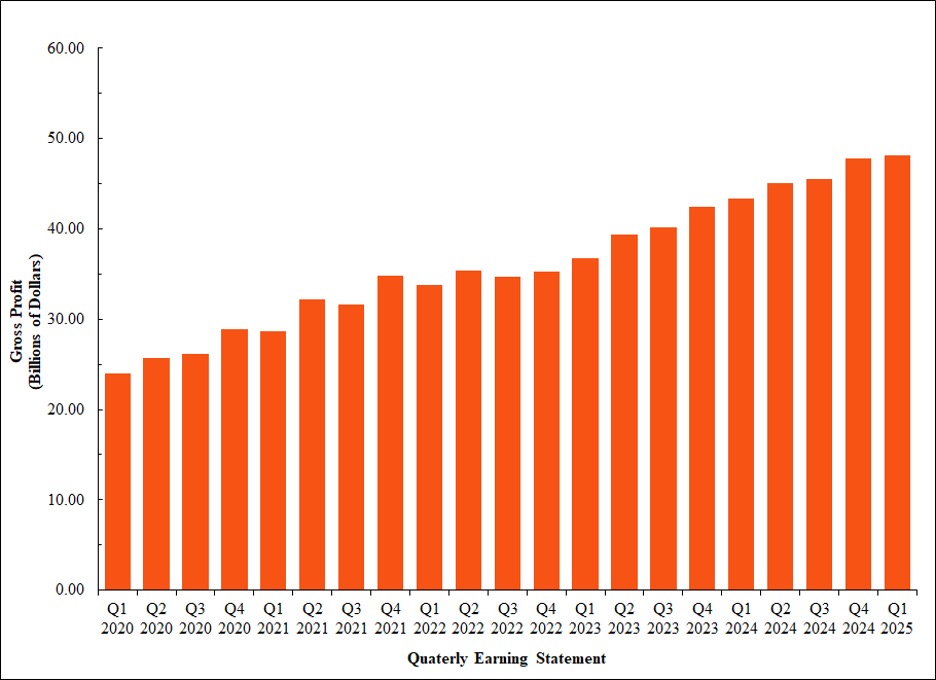
Source: MacroTrends.net.
Microsoft stock has also performed tremendously since the release of ChatGPT. If anyone is benefiting from the increased productivity of its workers, it appears it is Microsoft itself. (To be fair, given that Big Tech workers’ compensation packages often include stock, they too benefit from the AI rally even if the compensation figures reviewed above may not reflect such increases.) The combination of layoffs and no real impact on pay appears to at least suggest that AI will function as a substitute, rather than a complement, to human labor.
Figure 5: Microsoft Stock Has Performed Well in the Age of AI
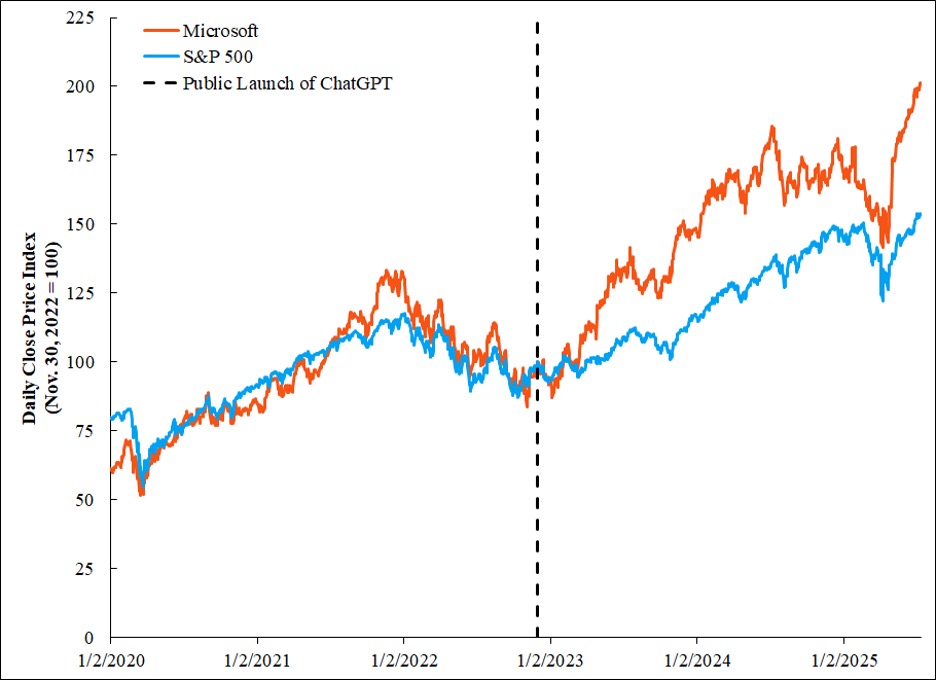
Source: Data retrieved using getsymbols package in Stata, sourced from Yahoo! Finance. Notes: As is standard, we used the adjusted closing stock price. Data is from Jan. 2, 2020 to July 11, 2025. Closing price indexed such that November 30, 2022 equals 100 (notable for being the date OpenAI first publicly released a demo of ChatGPT, which would go on to reach a million users in less than a week).
AI Fits a Trend of Growing Productivity and Wage Stagnation
Whether AI will truly revolutionize the workplace and make many human workers “go the way of the horses” remains to be seen. From what we have analyzed, however, even if AI does not replace human labor, workers should not put too much hope that they will reap the rewards of their increased productivity. AI continues a trend that started back in the 1980s: the divergence between worker’s productivity growth and their wages. Without a significant policy intervention in labor markets, such as a federal job guarantee or unionization to countervail monopsony power, AI may be a technology that continues to exacerbate the inequality of the 21st century.
In May, Heatmap’s Robinson Meyer and Matthew Zeitlin wrote an article about House Republicans’ plan to weaken environmental review to accelerate the construction of new infrastructure. The subject line of the email promoting the piece read, “Permitting Reform Is Back, Baby,” a rather nonchalant way to describe the latest legislative plan to gut the National Environmental Policy Act (NEPA). The proposal, part of the GOP’s budget reconciliation package, seeks to allow developers to pay a fee in exchange for an expedited environmental assessment or impact study that would be exempt from judicial review. Other provisions in the budget reconciliation bill would enable oil and gas companies building pipelines and export terminals to pay for favorable national interest determinations from the Department of Energy and expedited permitting from the Federal Energy Regulatory Commission.
On May 21, Meyer and Thomas Hochman of the Foundation for American Innovation—a right-wing mouthpiece for the “abundance agenda”—discussed in a webinar the legislation’s pay-to-play NEPA provisions. Yet both commentators failed to acknowledge the context in which debates and developments related to “permitting reform” are taking place. To properly understand what’s happening, one must consider how tech- and petro-capitalists are now invoking society’s “need” for data centers to rationalize an irrational increase in fossil energy production.
According to proponents of the so-called abundance agenda, regulations are a major obstacle to building all sorts of infrastructure, including socially beneficial goods like affordable housing, mass transit, and clean energy. Meanwhile, NEPA has long been villainized by the fossil fuel industry and its allies, who lament how environmental review processes can delay, and occasionally thwart, dirty energy production. Abundance advocates misleadingly cast NEPA as the main barrier to the growth of renewables, even though an interconnection backlog at regional power grids dominated by private, profit-maximizing utilities is a far greater problem.
A shared disdain for NEPA goes a long way toward explaining why some conservative commentators have been so complimentary of nominally liberal abundance advocates. American Enterprise Institute senior fellow James Pethokoukis, for example, recently urged “pro-growth conservatives and supply-side liberals” (e.g., Abundance co-authors Ezra Klein and Derek Thompson) to team up. He sees, correctly, that the corporate-backed abundance agenda’s deregulatory impulse dovetails with many of the right’s (often corporate-backed) goals.
The admiration is mutual, as evidenced by neoliberal Democrat and prominent abundance champion Matt Yglesias’s early praise for Interior Secretary Doug Burgum, who proceeded to derail offshore wind projects and embrace coal. What’s more, when Open Philanthropy, a Democratic-leaning “effective altruism” organization founded by Facebook billionaire Dustin Moskovitz, announced its $120 million Abundance and Growth Fund, it cited three Republicans—Burgum, Energy Secretary Chris Wright, and President Donald Trump—as positive embodiments of abundance-enhancing deregulation. This announcement, two months into Trump’s second term, ignored the Trump administration’s extreme actions to benefit oil, gas, and coal interests.
During the Biden administration, the United States became the world’s largest producer of oil and exporter of liquefied methane gas. Despite this development, Trump has made clear that one of his main objectives is to further increase hydrocarbon production, expand liquified methane gas exports, and revive the moribund coal sector. Echoing rhetoric used by Klein and Thompson, the Energy Secretary said in April that the Trump administration “will replace energy scarcity with energy abundance” by “prioritizing infrastructure development and cutting regulatory red tape.”
Yet abundant renewable energy does not appear to be a priority. A recent analysis found that more than $14 billion in clean energy projects have been canceled or delayed in the United States so far this year, with more investments in jeopardy due to the GOP’s proposed rollback of the Inflation Reduction Act.
But when it comes to fossil fuels,Trump officials are barreling full speed ahead—reversing regulations, further opening industry access to public lands, and criminalizing dissident activism. Ironically, Trump’s “drill, baby, drill” edict and incoherent tariffs have earned the ire of oil executives, who typically prefer to strategically limit supply to boost prices and profits. More importantly, accelerating the construction of even more fossil fuel infrastructure is completely at odds with the scientific and moral imperative to decarbonize society as quickly as possible.
Why would Trump, who received nearly $100 million from fossil fuel interests during the 2024 election cycle, encourage unlimited dirty energy production even though it could hurt the oil industry’s bottom line, and will surely exacerbate the deadly impacts of the climate crisis? One key factor to consider is the nascent surge in the construction of energy-hungry data centers, the infrastructural backbone of both artificial intelligence (AI) and cryptocurrency.
In short, the heavily subsidized AI boom, and the concomitant buildout of land-, water-, and electricity-intensive data centers, is creating the impression that the United States “needs” to significantly increase energy supply (clean and dirty alike) to satisfy an unprecedented surge in demand. This narrative persists even though the DeepSeek model developed by Chinese graduate students proved that even if one values AI highly, it does not necessarily require a massive increase in energy use.
Hours after he was inaugurated, Trump declared a “national energy emergency,” implying in Abundance-like fashion that overregulation is creating energy “scarcity.” Three days later, Trump issued an executive order to remove “barriers to American AI innovation.” This order rescinded a Biden-era directive aimed at the “safe, secure, and trustworthy” development and use of AI. It bears noting, however, that Trump has built on Biden’s eleventh-hour executive order to fast-track the construction of AI data centers on federal land.
In addition to AI, cryptocurrency mining is also a major source of rising electricity demand, and Trump has gone to great lengths to boost that industry as well. He claims that digital assets will “unleash an explosion of economic growth.” For himself, maybe; the Trump family has already reaped billions through memecoin corruption.
Trump’s unbridling of AI, crypto, and dirty energy supply must be understood as a singular, inseparable process. In effect, Big Tech has thrown Big Oil & Gas a lifeline by fabricating speculative justifications for fossil fuel expansion.
In April, during a House committee hearing on AI’s energy and transmission “needs,” former Google CEO Eric Schmidt claimed that “demand for our industry will go from 3% to 99% of total generation.” He told lawmakers that “we need the energy in all forms, renewable, non-renewable, whatever. It needs to be there, and it needs to be there quickly.”
And if it isn’t? The implicit message is that humanity will be deprived of ostensibly life-enhancing technological advancements. The United States managed to expand average life expectancy by ten years (from 69 to 79 years) without this technology since the 1960s. There is, evidently, no appreciation of the fact that if fossil fuel combustion isn’t curtailed, humanity will be deprived of life-sustaining ecological conditions.
The explicit warning is that if the United States doesn’t win the “AI race,” then China will, and that would be bad. Here’s Alexandr Wang, founder and CEO of Scale AI, during the same hearing: “If we fall behind the Chinese Communist Party, this technology will enable the CCP as well as other authoritarian regimes to utilize the technology to, over time, effectively take over the world.” But if the energy required to win the “AI race” ensures the degradation of life on earth, what would China be taking over?
Remarkably, Scale AI’s CEO failed to apply the logic of his cautionary tale about authoritarian abuses of AI to Trump’s fascist government and its corporate allies. Sinophobia, now en vogue across much of the political spectrum, appears to have prevented greater recognition of the dangers of entrusting AI policy to Silicon Valley’s far-right billionaires, the members of Congress they’ve bought, and the Trump administration.
For his part, Interior Secretary Burgum describes the stakes this way: “The U.S. is in an AI arms race with China. The only way we win is with more electricity.” Meanwhile, upon announcing a May 8 Senate committee hearing, Sen. Ted Cruz (R-TX) said that “the way to beat China in the AI race is to outrace them in innovation, not saddle AI developers with European-style regulations.”
In the wake of that hearing, the Koch-affiliated Abundance Institute reiterated its demands for federal lawmakers to preempt state-level regulation of the AI industry and accelerate energy permitting. (The GOP’s budget reconciliation bill would do both.) In so doing, the institute simultaneously confirmed two things about the abundance movement: (1) its anti-democratic nature; and (2) the centrality of expanding gas-powered data centers. The term “supply-side liberals” is an oxymoron.
Notwithstanding oil producers’ complaints about Trump’s maximalist approach, other fossil fuel players who bankrolled Trump’s campaign, especially those in the fracked gas industry, are poised to capitalize on the AI- and crypto-fueled growth in energy-hungry data centers. For example, Energy Transfer—the company behind the Dakota Access Pipeline—has already received requests to supply 70 new data centers with methane gas, according to a recent investigation. That represents a 75 percent increase since Trump took office, a big return on Energy Transfer’s $5 million investment in Trump’s Make America Great Again Super PAC. Moreover, Trump recently signed executive orders to expand the use of coal, which he has characterized as a good option for off-grid backup power.
The rapid growth of data centers is deepening reliance on fossil fuels and jeopardizing our already-delinquent transition to renewables (not to mention stressing water supplies in drought-stricken areas and harming ecosystems). Existing energy injustices are being intensified, and we are likely to see a further increase in electric bills, as utilities pass costs onto ratepayers. Ultimately, the data center boom threatens to make life more expensive for working people in general given that AI-induced mass unemployment could suppress wages and because any increase in greenhouse gas pollution means more frequent and severe extreme weather, and those shocks devastate communities and disrupt supply chains.
While the left has long been adamant about the need to discipline (fossil) capital, self-described “supply-side liberals” have contended that streamlining environmental review would automatically lead to better outcomes because it would enable cheaper renewables to outcompete fossil fuels. Amid Trump’s coal, oil, and gas-friendly deregulatory blitz, however, it’s clearer than ever that if clean energy is to replace dirty energy, and not just complement it, we must take steps to eliminate polluter handouts and phase out fossil fuel production.
If that means Big Tech’s data centers can’t be built and powered as quickly as Big Tech and its abundance-aligned lobbyists would like, so be it. We must put our energy resources to good use, including the electrification of our built environment and transportation systems. We are not obligated to destroy our one livable planet just so that a few eugenicist tech billionaires can force-feed us alienating and dehumanizing AI garbage designed to further exploit us and enrich themselves and their shareholders.
Kenny Stancil is a senior researcher at the Revolving Door Project.