
The Law and Economics (L&E) movement is coming under critical scrutiny these days. And deservedly so. It has spawned opposition schools of thought, including the emerging Law and Polical Economy (LPE) movement. In a recent post on LPE Blog, Madison Condon and Luke Herrine suggest that L&E approaches “mostly derive from the neoclassical tradition.” We write only as a caution to not throw out all of mainstream economics, as not all of mainstream economics supports L&E policies.
As a friendly modification, we suggest as a finer point: Neoclassical economics consists of both a scientific aspect and an ideological aspect, and it is only the latter from which L&E derives its foundations.
By ideology, we mean mainstream theories that are known to be inconsistent, based on unrealistic assumptions, or empirically false, but that remain a prominent part of economic textbooks and economic education. They are what Paul Krugman refers to a “zombie economics” in his book “Arguing with Zombies: Economics, Politics, and the Fight for a Better Future.” Zombie economic theories survive despite their known deficiencies in the profession.
While consistent evidence-based economic theories can have political implications, it is noteworthy that all of the neoclassical zombie economic theories justify policy that benefit the powerful groups in our society. Krugman mentions, for example, austerity theories (advocating cutting spending in a recession), “free trade benefits all,” and “tax cuts increase growth” as examples of widely held economic views reflected in most textbooks that do not survive serious scrutiny.
What is the ideology that undergirds L&E? Professors teaching L&E to students often begin by explaining that the core themes of the movement are that (1) the common law is efficient, and (2) the proper goal of the law is efficiency. But what is efficiency? This is the heart of L&E ideology. To begin with, it may come as a surprise given its rhetoric that no economist has ever proven that a real-world market economy is efficient. Typically, economists cite to the proof by Arrow and Debreu for this proposition. What Arrow and Debreu actually proved was that under extreme assumptions—firms acting as if they were infinitely small, all agents having perfect information including about the future (or perfect information about the probabilities), costless entry, and all goods being homogeneous (meaning no brands or special features), an equilibrium point will exist where supply equals demand.
Many such points can exist, however, and there is no proof that an economy would ever reach such a point even given the extreme assumptions. As Joeseph Stiglitz explains in his recent book “The Road to Freedom: Economics and the Good Society,” Arrow and his colleagues believed that they had proven that a market economy is not necessarily efficient because of the strong assumptions necessary to get the existence result. But later economists came to use the result as ideology, as support for the efficiency of markets.
A problematic efficiency standard
The first theorem of welfare economics establishes that the equilibrium points of an Arrow-Debreu economy are Pareto Efficient. This means that at that point no one could be made better off without making someone else worse off. Essentially, a policy move is Pareto efficient only if everyone impacted agrees; that is, the policy gets unanimous consent. But in any real economy, economic theory can say almost nothing about the benefits or costs of a market economy. Nonetheless, there is no shortage of economists that claim that a market economy leads to efficiency.
Graduate students in economics learn that “efficiency” means Pareto Efficiency. But this is not the definition of efficiency used by L&E. If we consistently adopt this definition, then economists have nothing to offer regarding legal policy. If no one is harmed, and at least one person claims he/she is better off, this allocation must be an improvement in welfare. Few policy decisions let alone litigation outcomes ever involve zero losers.
The definition of efficiency behind L&E is not Pareto Efficiency. It is the Kaldor-Hicks measure of efficiency, also called the Potential Pareto Efficiency standard. The idea is that a policy is an improvement or an increase in efficiency if all the losers could potentially be compensated, even if they are not compensated. For example, if output is higher, then there is a Potential Pareto improvement, irrespective of the impact on distribution. As we show in our paper, every L&E textbook has adopted this definition of efficiency. This is another Zombie ideological economic concept. We say this because the entire economic subfield of welfare economics (those economists that study welfare and measures of efficiency) have rejected Potential Pareto efficiency as hopelessly flawed and ethically untenable.
Among other problems, welfare economists showed that output or value can be measured by willingness to pay or willingness to accept. Both are equivalently valid measures. These two measures can differ, however, leading to serious inconsistencies. In 1950, Gorman showed that the assumption needed to prevent these inconsistencies (many but not all of them) is that people buy the same products, in the same amounts, when their income changes. For example, if you eat one pizza a week when you make $10,000, if you make $100,000, you must still eat one pizza a week. A completely absurd assumption. Economists rarely discuss these assumptions, even though they are made explicit in graduate textbooks where they are buried in difficult mathematics.
A second serious problem is that to treat everyone’s willingness to pay as equal amounts of welfare, we have to assume that society should consider that an additional dollar has the same value for a rich person as a poor person. Otherwise welfare depends on distribution and Potential Pareto is not a valid measure of welfare, and therefore can’t be a useful measure of efficiency. The vast majority of people would hold this assumption (this value judgment) to be false. Nonetheless, L&E is premised on Kaldor-Hicks efficiency, an approach rejected by welfare economists, but kept alive as ideology in economics.
The equity-efficiency “tradeoff”
In our paper “The Core Value of Public Policy Should be Equality,” we show that numerous social scientists (includingeconomists) have demonstrated that equality, i.e. equity in distribution, has an enormous positive impact on human well-being. So how can L&E use a theory that by definition eliminates distribution from the discussion of efficiency? They must employ a third economic ideological myth: the equity-efficiency “tradeoff.” That notion is that there is a social tradeoff between how equal income is an economy and the economy’s rate of growth. Equality is supposed to dilute incentives for work and hence to slow down growth. One can find this idea of a tradeoff in many basic economic textbooks. But again, this idea is a zombie, it has no basis, it survives because of the ideological power of the idea. To see this, take, for example, the experience of the United States. The graph below is from Piketty’s work on economic equality.
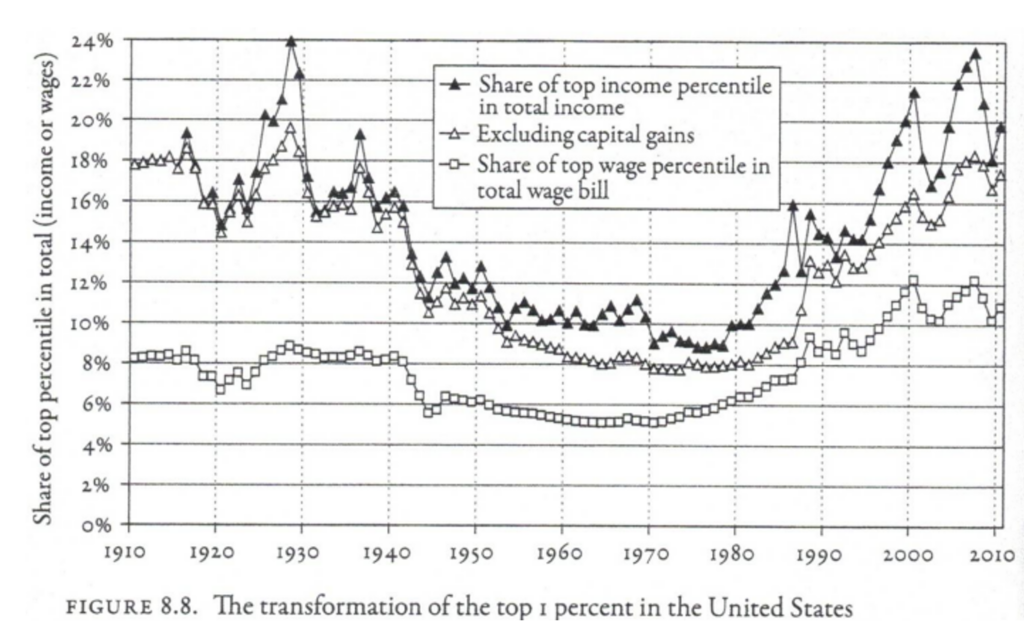
As the above figure shows, the period of the 1950s through the1970s is far more equal than the period from the 1990s to the present. So what are the growth rates? Turns out that the average growth rate of the first period was 3.9% and the second period was 2.6%
To further test the underlying premise for the notion that there is an equity-efficiency tradeoff, here is a simple scatter plot of data taken in three-year non-overlapping periods beginning with 1947–1949 and ending with 2022–2024 (which is the most recent data available) for “annual growth rate of real disposable income per capita” in the United States, versus the average U.S. Gini coefficient for income.
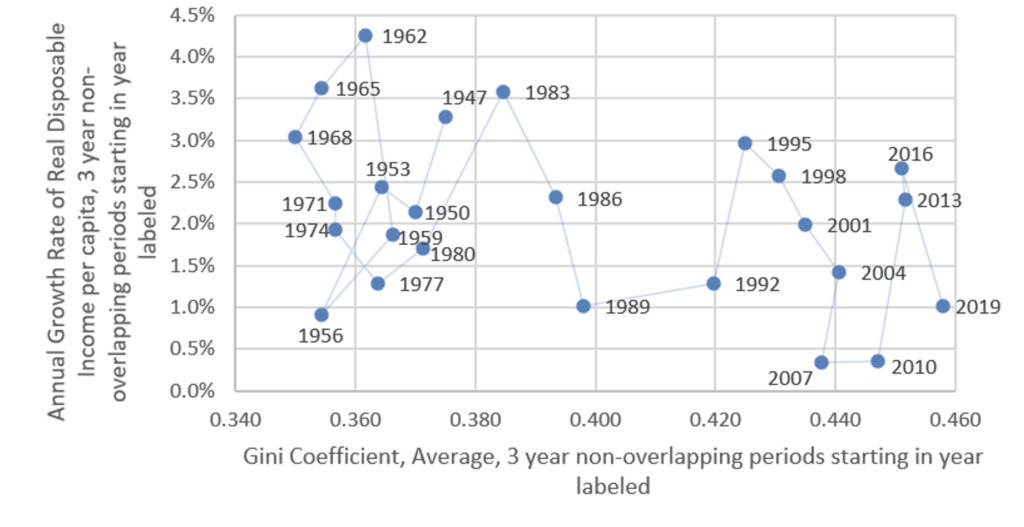
Figure 1: Gini Coefficient source is: https://www.census.gov/data/tables/time-series/demo/income-poverty/historical-income-families.html. Economic data from U.S. Bureau of Economic Analysis, Real Disposable Personal Income: Per Capita [A229RX0A048NBEA], retrieved from FRED, Federal Reserve Bank of St. Louis; https://fred.stlouisfed.org/series/A229RX0A048NBEA, January 28, 2026
Even without doing any statistical analysis, it is plain to see that the purported tradeoff between equality and efficiency is unsupported. Greater inequality (i.e., higher Gini coefficients as one moves to the right) has been associated with a lower growth rate. The data are clearly divided into two eras, an earlier one with low inequality and high growth (the top-left quadrant), and a more recent one with high inequality and low growth (the bottom-right quadrant), with 1986–1991, the end of the Reagan Administration and most of the George H.W. Bush Administration, being the transition period. The same is true across countries. As we show in our paper on equality, virtually all the economic studies show that more equal countries grow faster than unequal countries. Our conclusion is that the equity-efficiency tradeoff is another example of mainstream economic ideology.
The potential role for LPE legal scholars in understanding contemporary social problems is enormous, while the assumptions of L&E limits its ability to understand these issues. The great increase in economic inequality, which is a critical factor in human welfare, is not explained by market forces, but instead by changes in the legal framework in which the economy operates. As the legal realists demonstrated long ago, there is no such thing as a “free” market. All markets are embedded in legal structures that influence their outcomes. For example, few contracts would ever be signed if the state took no role in contract enforcement.
For another example, where output is produced by corporations, the legal relationships between the shareholders, managers, and other stakeholders influence potential and actual corporate decisions, and these stakeholder relationships are governed by corporate law. The role of finance is determined by securities law and financial regulations. The influence of workers is affected in important ways by labor law. In addition, the market is embedded in an entire superstructure that is strongly influenced by numerous other laws, regulations, and norms. These conditions are instrumental to how income is distributed. Bernard Harcourt adopts a similar point of view in his book “The Illusion of Free Markets: Punishment and the Myth of Natural Order,” although he does not address the period we are analyzing here.
Mark Glick is Professor of Public Policy and Adjunct Professor of Law at the University of Utah; Gabriel Lozada is Professor of Economics at the University of Utah; Darren Bush is the Leonard B. Rosenberg Professor of Law at the University of Houston.