

It is the dream of many law professors to be cited in a judicial decision. It is not my dream to be cited, however, when the decision misunderstands the subject of my work, ignores other work, and ultimately comes to the wrong conclusion. That is what I’m reading in the court’s HPE-Juniper decision.
On August 12, Judge Pitts entered the proposed final judgment—the consent decree settlement between HPE-Juniper and the Department of Justice (DOJ)—finding the proposed final judgment to be in the public interest under the Tunney Act.
The court errs, in my opinion, in three fundamental ways: (1) It misunderstands what ought to be considered in the realm of public interest and what is not; (2) It misunderstands the role that evidence of corruption plays in terms of the “public interest;” and (3) It misunderstands that the whole point of the Tunney Act is that process matters.
As a brief backgrounder, the settlement occurred over the objections of Antitrust Division lawyers, including Roger Alford and William Rinner. Both were fired. A lobbyist for HPE, Mike Davis, reportedly threatened the head of the division, Abigail Slater: “If you don’t approve this settlement, I will destroy you. I will destroy your job at the DOJ.” Slater was forced out in February 2026. The concern among those in law enforcement and anti-monopoly community is that well-connected and powerful firms should not be able to buy their way around antitrust law, via patronage to the administration. This concern is particularly acute if the settlement permits an anticompetitive merger to be consummated.
On page 2 of the decision, the court explained the alleged infirmity in the states’ case to unwind the consent decree: “While the states have performed an invaluable public service in bringing to light additional details about the machinations at the DOJ that led to the settlement, they have not shown that entry of the amended proposed final judgment would not be in the public interest.” The court displays an interesting use of a double negative to avoid asking the more fundamental question: Is a consent decree in the public interest when it arose out of inappropriate contacts and political influence? The court answers yes, but only by committing two errors.
First, the court assumes that sunlight is the best disinfectant, and by bringing the information to light, the states have cured the harm. The notion that “sunlight is the best disinfectant” is embedded in notions of administrative law since Judge Louis Brandeis coined the term. But Brandeis’s full quote is “Sunlight is said to be the best of disinfectants; electric light the most efficient policeman.” That the states discovered the inappropriate contacts does not imply that those contacts carry no meaning in a public interest inquiry. That would be akin to saying that, although family of a defendant slipped the prosecutor a $100 bill, the plea bargain is still in the public interest. Process matters, and the process here, by the court’s own record, was badly flawed.
Moreover, given the way this administration has operated, it’s hard to claim that sunlight disinfects anything. Brandeis’s notion was that people would be outraged by misconduct. It is hard to muster sufficient sunlight to disinfect the firehose of corruption we current face.
Second, the court overlooked how procedural defects incentivize strategic dealmaking when crafting a settlement, pushing the needle towards the outer bounds of what is “the public interest.” The court states on page 28 that its “review of the amended proposed final judgment will therefore focus on whether the proposal is within the reaches of the public interest.” “Within the reaches of the public interest” suggests, however, that the proposed final judgement can be at the outer boundaries of the public interest, not squarely in it, and the court would accept the final judgment. Corruption, among other things, moves enforcement from what is squarely within the public interest to the outer territories.
And the reason that this settlement was on the outer boundaries of the public interest is because it was moved there by a tainted process. The court fails to recognize this problem, and instead doubles down by giving the DOJ deference:
The United States and HPE argue that the Court should grant significant deference to the United States’s decision to settle its lawsuit and its view of the public interest….The Executive Branch certainly has the prerogative to choose whether and how to prosecute any particular case. But the Executive does not have the authority under the Tunney Act to enter judicial orders with the binding force of law. Instead, both the Tunney Act and the nature of the parties’ request that the Court to exercise its own powers require that the Court exercise independent judgment about whether to do so. The Court will accordingly give the United States’s view of the public interest the deference appropriate to an experienced agency and to a party’s view of what actions best advance its interests.
I am not following this argument. It suggests that the DOJ gets deference even when there is a level of inappropriate contacts that raise questions.
Yet there is no requirement for judicial deference to an agency’s determination of the public interest in the Tunney Act. Indeed, the Tunney Act seeks to remove deference by elimination of judicial rubber stamping of consent decrees (the ultimate level of deference). It is striking indeed at a time when SCOTUS has eliminated levels of deference to administrative agencies (see Loper Bright) and has all but destroyed independent agencies (see Slaughter) that the court would come to the conclusion that an agency’s tainted, procedurally defective settlement deserves deference. Other commentators have noted the oddity of giving agency deference in the entry of a judicial decree: “a court’s entry of a consent decree is a judicial act which is both constitutional and statutory in nature. Thus, an intensive review of a consent decree by a district court may be supported apart from the Tunney Act.”
A missing citation
While I’m pleased that my Tunney Act article (one of them—more on this later) and others are mentioned in footnote 4 of the court’s decision, the court fails to note one important critic of deference—Congress. Per the Congressional Record, “As originally written, the Tunney Act serves two goals deterrence and mediation. The prospect of judicial scrutiny deters the Justice Department from heeding political pressure to enter a ‘sweetheart’ settlement.” And the legislative history of the Tunney Act amendment in 2004 also noted the possibility of moving the needle from the boundaries of public interest to something squarely within it:
And real Tunney Act review also provides an opportunity for a judge to act as a mediator, obtaining modifications to deficient settlements. As Professor Anderson points out, “[i]f the government and antitrust defendants come to perceive that meaningful [judicial] scrutiny is not a real threat, the door will be wide open for attempts to swing sweetheart deals and for the public to lose confidence in antitrust enforcement by the government.” 65 Antitrust Law Journal at 38.
The court failed to consider the larger ramifications of its entry of this decree, and the world is worse off for it.
Next, the court makes the remarkable conclusion that “The parties’ failure to comply with certain procedural requirements does not require rejection of the settlement.” The court notes that the parties failed to address the procedural requirements of the Tunney Act and then decides it is within the scope of its authority to enter the judgment anyway because the states discovered the omissions. And the omissions are troubling. First, “defendants failed to disclose, however, that Arthur Schwartz [a close confidante of Vice President JD Vance] had spoken on their behalf with DOJ officials Mizelle and Woodward, that Schwartz and Schultz [HPE’s Chief Operating and Legal Officer] had met with CIA Deputy Director Michael Ellis and Defense Under Secretary of Defense for Policy Elbridge Colby, and that Schultz had talked to the CIO of the National Security Agency and to individuals connected to the National Security Council.” Second, “although the Tunney Act required the United States to provide the public with a competitive impact statement that includes “a description and evaluation of alternatives to such proposal actually considered by the United States,” Id. § 16(b)(6), it did not disclose a complete list of alternative remedies it actually considered.”
The court puzzles as to what the remedy ought to be for such procedural defects but points out that because the states brought them to light, there is no harm. Under this standard, I look forward to robbing a department store while a sales rep discovers me so I might claim that, since the witness caught me, there is no injury. Such reasoning ignores the very real concern that this will be a signal that sweetheart deals are welcome, even if they are negotiated under questionable circumstances. This is not what the Tunny Act seeks as meaningful judicial review. The correct answer is the consent decree should have been rejected.
The wrong counterfactual
The court compares the outcome of the consent decree to a world in which the DOJ folds its tent upon failing to secure this settlement:
Given the risks that the United States would have faced at trial due to the relatively low market shares of HPE and Juniper, the fact that the proposed consent decree requires HPE to divest assets that others may be able to use to compete with HPE in the enterprise-grade WLAN solutions market, and the possibility that the United States could choose to walk away entirely from its challenge to the proposed acquisition if the settlement is not approved, entry of the proposed settlement serves the public interest.
Something isn’t better than nothing, and the Court mistakenly thinks its role is to compare the world in which DOJ abandons its challenge with the world in which it settles on the cheap. With that logic, even the most miniscule of consent decree would be considered in the public interest. That isn’t what the Tunney Act contemplates.
My coauthor on my first article on the Tunney Act, John J. Flynn, who was special counsel to the Senate Antitrust Subcommittee during the period when the Tunney Act was drafted and adopted and had a lot to do with drafting it, noted that the delineation of powers is clear. Prosecutorial discretion ends at the doors of judicial powers:
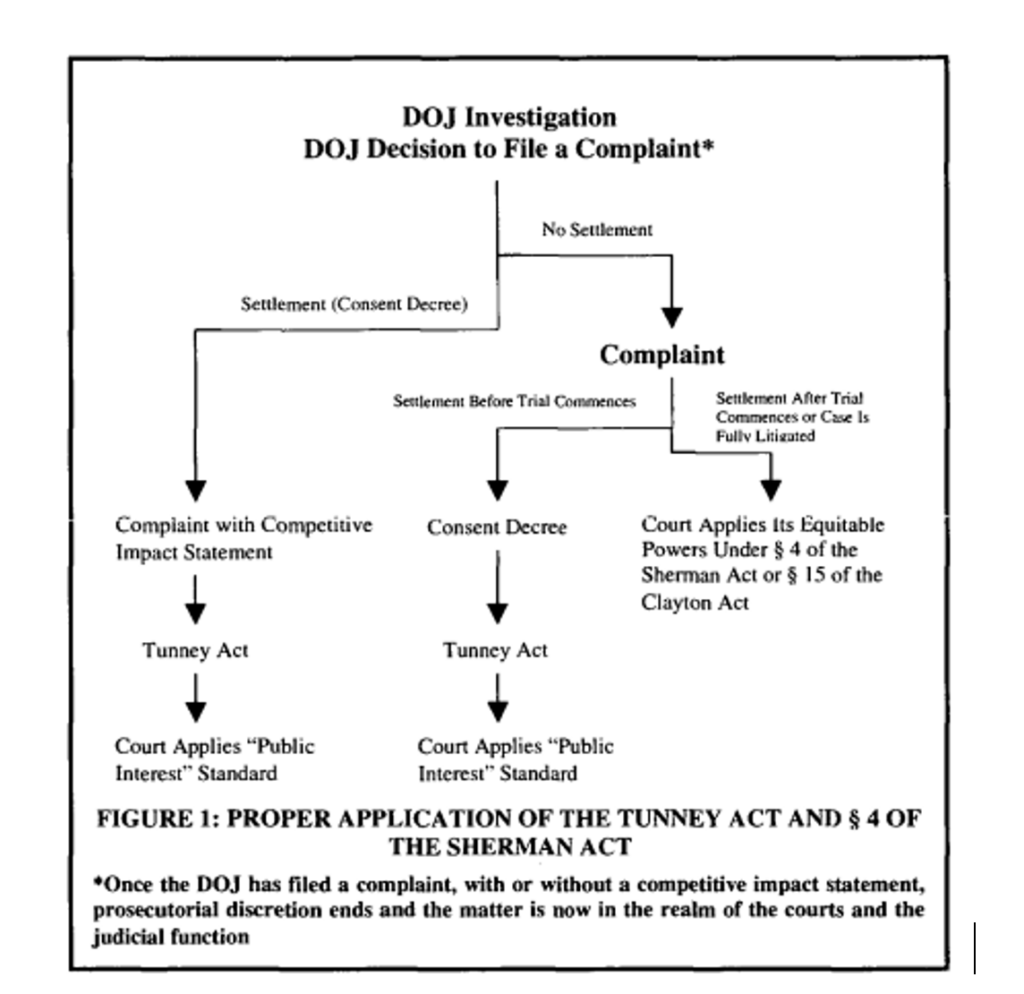
A court should not consider the DOJ’s prosecutorial discretion in its consideration of the public interest; to do so encroaches on judicial powers. It would be akin to a court accepting a plea bargain for the lightest sentence ever in a murder case because the prosecution could drop the case. The abdication of responsibility of the DOJ, in other words, is not one of the public interest considerations the court must ponder.
But it’s worse than that. As Lee Hepner points out (as does the Court):
HPE’s Schultz sent Woodward a draft competitive impact statement, writing, “We recognize that this document is typically prepared by the DOJ but thought we would share this draft in case it was at [all] useful to you.” … According to Rinner, aside from removing HPE’s commitment to maintain current prices, DOJ did not make any significant changes to the draft competitive impact statement HPE had provided. (citations omitted)
The court therefore implicitly gives DOJ deference for a proposal drafted by defendants and then claims that the settlement achieved by the DOJ is better than nothing.
It is not up to the states to fix DOJ’s errors, nor is it reasonable to expect them to continue to do so when the court uses it as a signal the proposed final judgment is in the public interest. Why waste time and resources in that manner?
The Tunney Act won’t save democracy
By focusing on the end result and overlooking the process, the court’s error is akin to watching a teenage driver run over multiple people and curbs but applauding the fact the car ultimately ended up in the driveway.
The court offers some consolation: “Even short of such an independent challenge, the states’ efforts may help inform the political process and future engagement with the Executive Branch in matters relating to antitrust enforcement.” How so? Congress spoke on the Tunney Act in 2004 and the Judiciary and the DOJ flat out ignored it. Also, the court must understand how fundamentally broken Congress is, so its platitude is somewhat baffling here.
I sadly predicted this outcome, when I wrote in August 2025 that the Tunney Act won’t save democracy:
The HPE-Juniper deal also raises serious questions related to the role of lobbying and whether the DOJ’s acquiescence has precious little to do with separation of powers and prosecutorial discretion and more to do with gangster antitrust. As the Wall Street Journal reported, “Hewlett Packard Enterprise made commitments, not disclosed in court papers, that called for the company to create new jobs at a facility in the U.S., according to people familiar with the matter.” This, if true, ought to be sufficient to reject the consent decree. But I doubt it. While SCOTUS is hard-core killing Chevron and administrative law, it seems totally fine with the extreme level of deference the DOJ gets under the bastardized interpretation of the Tunney Act.
There is potential to rehabilitate the Tunney Act. But not any time soon. And, as I’ve written before, while bills like the one Senator Klobuchar introduced as helpful, they are far from perfect. At the very least, Congress needs to define what is out of bounds for public interest determination (and what is within it). Prosecutorial abdication should not be one of the considerations. And there needs to be automatic rejection of consent decrees that are procedural defective.Finally, to Judge Pitts, many thanks for the citations! This is the article that, in my judgment, would have helped you the most. Alas, it was one you didn’t cite.