
In the past seven months, Judge Amit Mehta of the U.S. District Court for the District of Columbia has dismissed three antitrust lawsuits against Google over its uncompensated use of publisher content for AI training. In March, he dismissed a lawsuit brought by two newspaper publishers, Helena World Chronicle and Emmerich Newspapers. In September, he dismissed similar lawsuits brought by Chegg, an education technology company, and Penske Media, the owner of Rolling Stone and Variety.
All three challenged Google’s use of publisher content without compensation and Google’s growing competition with publishers through AI-generated answers. These dismissals are a setback for publishers, but they do not settle whether Google’s conduct violates the Sherman Act. Importantly, the court rejected the particular theories the plaintiffs advanced, not every possible theory of harm. Courts require plaintiffs to identify a precise theory of liability, even where the conduct arises in rapidly evolving markets and the legal framework is still developing. A different framework grounded in Google’s monopsony power over publisher content, spelled out below, avoids many of the doctrinal obstacles that defeated Helena, Chegg, and Penske.
A fraught relationship
Google once acted as an intermediary for publishers. Publishers allowed Google to crawl their websites and index their content. In return, Google directed users to those websites, allowing publishers to earn advertising and subscription revenue. As Google’s market power and publishers’ dependence on Google for traffic increased, that relationship became increasingly skewed. Google began answering users’ queries directly through new search features such as “Featured Snippets,” “Knowledge Panels,” and “People Also Ask,” reducing the need for users to click through to publisher websites. Rather than directing users to publisher content, Google used publisher data as excerpts in all these features without their consent or any additional compensation.
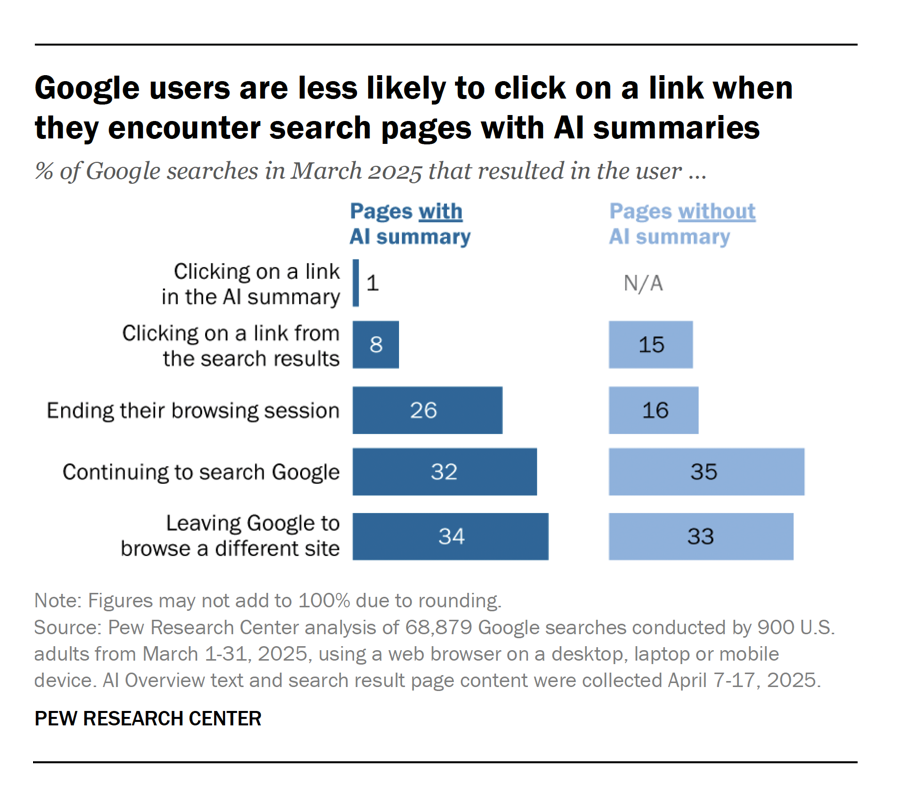
The introduction of AI Overviews marked a fundamental shift in Google’s relationship with publishers. For years, Google acted as an intermediary, directing users to publisher websites. AI Overviews transformed Google into a competitor. Instead of merely helping users find information, Google now uses publisher content to generate answers that increasingly satisfy users without requiring them to visit the original source. As AI Overviews have expanded in both frequency and prominence, publishers have experienced a sharp decline in referral traffic. Some studies estimate declines of around 25%, while others report a decline of around 50% for certain publishers or certain categories of searches. A Pew Research study found that users who encounter an AI Overview are less likely to click through to any external website than users who do not see one; only 1 in 100 users clicked on a link within the AI summary.
Publishers are now squeezed even more than they were before and from both ends. On the one hand, Google uses their content to train and ground its AI models without consent or compensation. Simultaneously, those same AI models integrated into search results divert users away from the publishers whose content made them possible. Google’s position is also different from that of other AI developers, many of which have negotiated licensing agreements with publishers. Publishers can block the crawlers of other AI labs without their discovery or traffic being affected. Not so with Google, which uses the same crawlers for search indexing and for training its AI models. Any publisher that wants to appear in Google’s search index—and few can afford not to, given its dominant position in general search (89.2% of the market by query volume)—must also permit Google to use its content for AI training and grounding. It is a Hobson’s choice: a slow death, as AI Overviews steadily erode publisher traffic and revenue, or a quick one, through exclusion from Google’s search index.
Why the publisher cases failed
Chegg and Penske alleged that Google engaged in unlawful reciprocal dealing by conditioning search referral traffic on publishers allowing Google to use their content for AI training and grounding. Judge Mehta rejected that theory because reciprocal dealing requires an agreement between two parties to buy from one another. He ruled that the complaints did not plausibly allege that Google agreed to provide publishers with search traffic in exchange for their content. Publishers may have expected traffic as a consequence of participating in Search, Mehta asserted, but that expectation did not amount to an “agreement.” Accordingly, the reciprocal dealing claims failed.
The plaintiffs’ tying claims presented a different question. Unlike reciprocal dealing, tying does not turn on whether the parties agreed to exchange products. It asks whether access to one product is conditioned on accepting another. The difficulty in these cases, however, is identifying the right products that are being tied together.
The three complaints each characterized the tie differently. Chegg and Penske alleged that Google conditioned search referral traffic (the “tying product”) on publishers allowing Google to use their content for AI training and grounding (the “tied product”). Penske also alleged that Google unlawfully tied AI Overviews to Search. Judge Mehta rejected those theories. Publishers may expect traffic from appearing in Google’s search results, but Google does not promise or “condition” publishers any particular amount of traffic in exchange for their content. Whether a publisher receives substantial traffic, little traffic, or none at all depends on a number of factors. Similarly, Search and AI Overviews were not plausibly alleged to be separate products. Instead, the court viewed search and its AI features as one integrated product rather than distinct ones.
Helena framed the tie differently. It alleged that Google conditioned search traffic on the supply of publisher content (the “tied product”). Judge Mehta rejected that theory for a different reason. He observed that “if anything, it is Google who is ‘buying’ the purported tied product.” Because Google was the purchaser of the allegedly tied product, the complaint did not describe a conventional tying arrangement, but instead what the complaint described was reciprocal dealing.
Yet there is another way to characterize the tie. Google acquires publisher content for two distinct purposes: (1) search indexing and (2) AI training and grounding. Search indexing and AI training are distinct uses of publisher content. Publishers routinely license AI training rights separately, demonstrating that the market recognizes them as separate products with independent economic value. Google uses the same crawling infrastructure to index publisher content for Search and to acquire that content for AI training and grounding. Publishers therefore have no meaningful way to permit one use while refusing the other. Any publisher that wants its content indexed by Google must also allow Google to use that content for AI training and grounding. The tie is therefore not between Search and AI Overviews, or between search traffic and publisher content. It is between two distinct uses of publisher content. Google conditions one purchase—the right to index publisher content—on another—the right to use that content for AI training and grounding. That theory more closely matches the economic relationship between Google and publishers and avoids many of the doctrinal problems that defeated the tying claims in Helena, Chegg, and Penske.
Why the government should bring the next case
The monopolization claims in Chegg and Penske also failed because the publishers lacked antitrust standing. Judge Mehta held that their alleged injuries, from lost traffic to lost advertising revenue to and uncompensated use of their content, were suffered in markets other than the downstream search market in which Google allegedly possessed monopoly power. That problem stems from the theory pleaded. Framed as a search monopolization or search monopoly maintenance case, the relevant market is general search, where publishers are neither competitors nor consumers. But a monopsonization claim belongs in the upstream market for publisher content. The way Google’s monopoly in Search is relevant is that its monopsony power over publishers (the input market) arises due to its monopoly power in search (the output market). Google uses that power in the output market to acquire publisher content for AI training and grounding on anticompetitive terms. Framed this way, publishers are no longer asserting injury in the downstream search market. They are suppliers in the very market in which Google allegedly exercises monopsony power. Indeed, Helena recognizes that suppliers suffer antitrust injury when buyers restrain competition in the market in which they purchase inputs. The same principle applies here.
The publisher cases may have failed, but the underlying antitrust question remains unresolved. The opinions reject particular theories of harm but not the possibility that Google’s conduct violates the Sherman Act. Judge Mehta repeatedly acknowledged the harm alleged by publishers. The opinions simply concluded that the theories before the court did not fit that harm. Applying a century-old statute to a new technology is rarely straightforward. Technology markets might require courts and enforcers to adapt existing doctrines before they identify the theory that best captures the competitive harm. Technological change might require courts and enforcers to determine how established antitrust principles apply to new contexts. Questions such as competitive harm in zero-price markets and network or lock-in effects in digital platforms required doctrinal and economic theorization before courts settled on the analytical frameworks that govern them today. That iterative process is precisely why government enforcement matters. In addition to avoiding the standing issue raised above, public enforcers have the resources and institutional capacity to test theories in new contexts that individual publishers do not.
The next case should be brought by federal or state antitrust enforcers. This would not be a follow-on to the Google Search litigation. It would be a different monopolization case involving different exclusionary conduct in a different market. The Google Search judgment provides an important starting point by establishing Google’s monopoly power in Search. A new case would build on that finding to establish Google’s monopsony power in the upstream market for publisher content and show that Google used its dominance in Search to acquire AI training and grounding rights on anticompetitive terms. A government victory could also facilitate follow-on private damages actions under Section 5(a) of the Clayton Act.
Regulators rather than private plaintiffs are better positioned to bring a novel monopolization claim of this scale, which will require extensive economic analysis, access to Google’s internal documents, and years of investigation. The platform era has also taught us an important lesson: late enforcement is often ineffective. As time passes, markets become more entrenched, making courts increasingly reluctant to impose remedies that meaningfully restore competition, even where liability has been established and antitrust law requires remedies not merely terminate unlawful conduct but also restore competitive conditions. AI presents another inflection point. If antitrust law is to preserve competition in AI, enforcement must come before markets become entrenched. The relationship between Google and publishers presents one of the earliest opportunities for timely antitrust enforcement in AI.
Madhavi Singh is the Deputy Director of the Thurman Arnold Project and a Resident Fellow at the Information Society Project at Yale Law School.