
This week, to much fanfare, Google introduced its new Universal Commerce Protocol (UCP). UCP was developed in collaboration with multiple retail partners, including Target and Walmart.. UCP involves artificial intelligence (AI) agents (i.e., programs that can perform some tasks autonomously) in the shopping process (aka, agentic commerce). Simply put, instead of searching for a specific product on the web, finding your preferred location, then going there to perhaps purchase it, you can perform the entire transaction within Google’s AI Mode through UCP.
Google’s announcement was met with immediate (and frankly, warranted) skepticism and concern, particularly given recent court decisions finding Google has engaged in anticompetitive conduct in both search and display advertising. Lindsay Owens, Executive Director of The Groundwork Collaborative (whose recent research on price discrimination by Instacart’s shopping algorithms prompted congressional calls for an investigation) raised concerns regarding the potential for UCP to result in supracompetitive consumer prices. Her two-part viral tweet appears below.

The concern here is less with upselling, which occurs ubiquitously, but rather more with the potential for data collected from consumers’ AI prompts to motivate price discrimination by creating or amplifying existing market power.
Google’s Defense Made Matters Worse
Google immediately denied such claims in an attempt to mollify any concerns that UCP would lead to consumer harm. But, in doing so, Google did the exact opposite. Look carefully at the highlighted text.
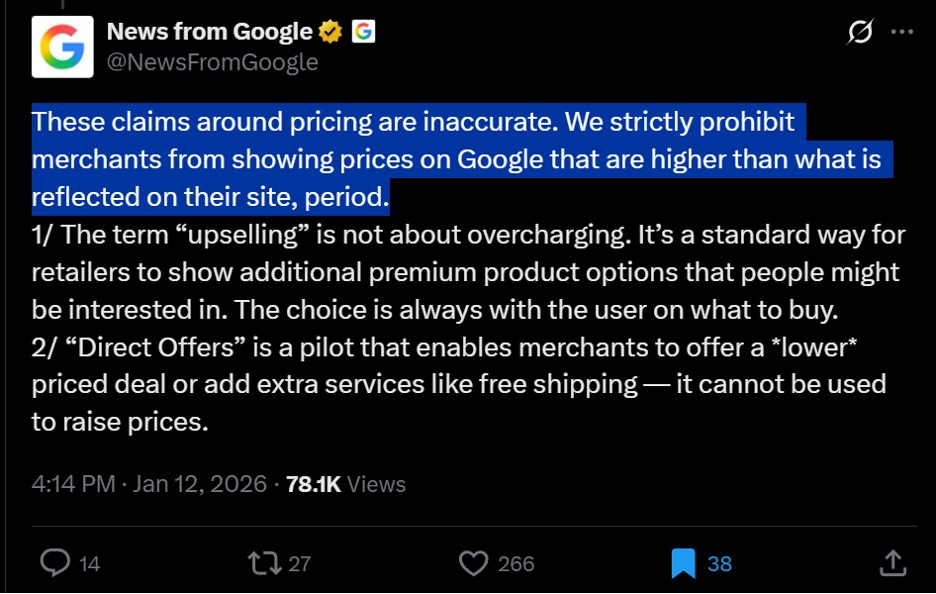
If you’re familiar with the ongoing Ad Tech litigation against Google, as well as the pricing parity cases against Amazon, you might have reacted with more than just a little surprise. This looks A LOT like the very same conduct for which both Google and Amazon have been accused of violating the antitrust laws. Simply put, the highlighted text reflects a most-favored nations agreement: merchants cannot sell the same product at a lower price elsewhere than the price at which they sell on Google. This reflects a reduction in choice.
Notably, in NCAA v. Board of Regents, the Supreme Court noted that widening choice reflects a procompetitive outcome. Consistent with this view, courts adjudicating the ad tech antitrust matters have recently found a similar policy that Google implemented with respect to display advertising to constitute anticompetitive conduct. The specific Google practice there is called Unified Pricing Rules (UPR). In the district court’s August 5, 2024 Memorandum Opinion, Judge Brinkema described UPR as “a policy that prohibited publishers using DFP [DoubleClick for Publishers] from setting higher price floors for AdX [Google’s ad exchange] than for other exchanges…Unified Pricing Rules also prohibited DFP publishers from setting higher price floors for Google AdWords demand than for demand from other ad networks or demand-side platforms.”
Google’s own description indicates that it implements a similar policy with respect to Google Shopping—namely that merchants cannot advertise lower prices on other platforms (including their own sites) than on Google. But in the ad tech case, publishers indicated that they had good reason to reject such a policy. In finding that UPC constituted anticompetitive conduct, the court explained,
But in implementing Unified Pricing Rules, Google simultaneously took away publishers’ ability to set higher price floors on AdX than on third-party exchanges, which was a primary tool that publishers had used to maintain revenue diversity and to mitigate Google’s dominance of the ad exchange market. Publishers viewed Unified Pricing Rules as not in their best interests, but felt stuck using DFP given its tie to AdX. Unified Pricing Rules is another example of Google exploiting its monopoly power and tying arrangement to restrict its customers’ ability to deal with its rivals, thereby reducing its rivals’ scale, limiting their ability to compete, and further compounding the harm to customers. Under these circumstances, Unified Pricing Rules constituted anticompetitive conduct because it involved Google using its coercive monopoly power to deprive its publisher customers of a choice that they had previously exercised to promote competition.
In the ad tech case, Google could have chosen to compete on the merits rather than imposing UPR. It could have reduced its AdX take rate to motivate publishers to choose its exchange. Instead, it chose an anticompetitive course of action (UPR).
The same concept applies here. A seller’s ability to set different prices across sales channels can benefit consumers. For example, suppose one shopping platform offers lower fees to sellers, just as some ad exchanges offered lower take rates than AdX. Sellers can take advantage of those lower fees and pass on the benefits to consumers in the form of lower prices. In turn, this places pressure on rival platforms to lower their own fees and offer consumers the same benefits. Similarly, if sellers can avoid such costs, they can offer lower prices on their own sites. This is how competition works. Imposing price parity requirements as Google indicates it that it does, avoids such competition, to the detriment of consumers.
This article focuses on Google, but Amazon has also previously implemented a price parity policy. Amazon dropped this policy in Europe in 2013, after facing multiple investigations from European competition authorities. (See FTC 2nd Amended Complaint ¶275.) Though it also abandoned the policy in the United States in 2019 after facing legislative pressure, particularly from Sen. Richard Blumenthal (D-CT), Amazon continues to face antitrust suits based on implicit enforcement of such policies. The FTC has alleged that Amazon implicitly enforced this policy “through an internal mechanism called Select Competitor – Featured Offer Disqualification” (See FTC 2nd Amended Complaint ¶277.). In other words, sellers who did not abide by the price parity policy could lose their Buy Box eligibility. For more information on how the Buy Box works and its role in algorithmic pricing, you can see my recent piece on The Sling on this topic.
Google’s public acknowledgment that it imposes a price parity policy seems at best an unforced error, thought it may also signal its confidence that its conduct can escape the “anticompetitive” label in this case. Google might argue that it does not have monopoly power in shopping, particularly given Amazon’s presence. But Google does have monopoly power in search advertising. UCP will integrate with AI Mode in Google Search, where Google continues to test ads. Google has also added Direct Offers, a new Google Ads pilot that “allows advertisers to present exclusive offers for shoppers who are ready to buy — like a special 20% off discount — directly in AI Mode.”
Leveraging Its Search Monopoly into Online Shopping
Google already serves ads in its other AI-powered search product, AI Overviews (the AI-generated summaries that appear above search results) as well as AI Max for Search. The competitive concern here are twofold: (1) that Google will leverage its market power in search to the online shopping industry and (2) the remedies contemplated in the Google search case, specifically the expectation that AI would begin to dilute Google’s market power in search, may prove less effective than anticipated, if at all.
Specifically, the competitive concern would arise because, as mentioned, Google is the dominant search engine, and it now offers AI Mode in Search, which uses Google’s family of Gemini LLMs. AI Mode allows a more in-depth, “conversational” interaction between an individual and the AI-powered Gemini-3 model. It is worth noting that Google already knows a lot about individual users from products other than search: Chrome, Gmail, Google Fiber, and so on. As Google itself has acknowledged, it “draws insights from across your Google apps to provide customized responses from Gemini.”
The information people feed into Gemini, ChatGPT, and other LLMs provide more information about that user, valuable data that allows platforms to monetize their user base. Take, for example, the OpenAI commercials of the sort (“let ChatGPT plan your vacation”, or “use ChatGPT to schedule your day”). The intent here is to integrate AI into every facet of life, maximizing a platform’s opportunities for commercial extraction. OpenAI’s Sam Altman provided perhaps the emblematic example of this goal when he told Jimmy Fallon “I cannot imagine figuring out how to raise a newborn without ChatGPT,” as though humans have not been doing this very same thing for millennia.
Suppose you type in your agentic commerce-empowered AI chatbot that “I’m looking for lightweight running shoes with a carbon plate and support for pronation” instead of “I’m looking for running shoes.” An LLM can glean more important information from the former than the latter, which in turn informs that back-end machine learning algorithms. (For more about how such algorithms can result in tacit algorithmic collusion, you can check out my new paper on this topic here.) The former description suggests you’re a serious runner, likely a racer, who is familiar with various purpose-designed shoe features. It can then “upsell” you on other products that similar individuals have purchased. You can see Google acknowledging this below.
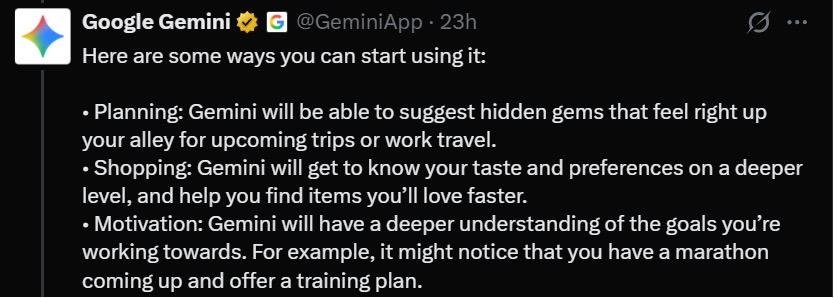
Learning individual preferences “on a deeper level” from user interactions allows Google to build out your consumer profile more accurately. This practice also preys on information asymmetries. While some may regard LLM outputs as ground truth (note the tendency of Twitter posters to ask “hey grok is this true), platforms such as Google can exploit that misunderstanding. After all, consumers acting more financially responsible and making better decisions doesn’t keep the lights on in the data center, nor does it pay for those new NVIDIA Blackwell chips. It’s worth remembering Google’s own warning: “Generative AI is a type of machine learning model. Generative AI is not a human being. It can’t think for itself or feel emotions. It’s just great at finding patterns.”
Amazon’s AI Shopping Tool Also Inflicts Harms
Of course, agentic commerce has some ostensible appeal. Cross-platform checkout can potentially save time or otherwise improve comparison shopping (absent the price parity restraint that Google imposes). But such attempts by Amazon have met with mixed results. Businesses reprimanded Amazon for using its AI shopping tool through its Shop Direct program to list products on its site without their permission. Shop Direct allows potential customers to browse offerings from brands sites directly on Amazon. The individual can then complete the purchase by clicking the “Buy for Me” button, which prompts the AI agent to purchase product on the shopper’s behalf.
The problem arose when the AI agent attempted to purchase items that the shop does not even sell or when the seller does not even participate in the Amazon program. Hitchcock Paper, a stationary company in Virginia explained in an Instagram post,
I fiercely believe this is why we shouldn’t let AI control things with no human backup or accounting. Amazon should not be beta testing faulty programs on small businesses without ANY way for us to seek help when it inevitably goes wrong. @sellonamazon, unknowingly involving my business in this program – then requiring me to pay to get help – is deceptive and wrong.
Other sellers noted that Amazon’s AI agent attempted to buy discontinued products from third party sellers though Shop Direct, indicating that this was not an isolated incident but a program that affected sellers more broadly. Such practices point to another source of consumer and seller harm: platforms’ misuse of agentic commerce can impose transaction costs on sellers, which eventually translate into higher prices for consumers.
Amazon itself is not immune to the vagaries of agentic commerce. In November 2025, Amazon sued Perplexity, an AI-powered answer engine that operates the Comet web browser application. Comet AI incorporates agentic AI functionality, enabling it to take actions on users’ behalf, including placing orders on Amazon’s store. Amazon alleges that Perplexity did not identify its AI agents as such, and that Perplexity set up Amazon Prime accounts, enabling users to make purchases on Amazon and take advantage of Prime features without paying for them.
Agentic commerce makes many promises. Whether these actually manifest themselves remains to be seen. The outcome will depend, at least in part, on whether platforms engage in good-faith efforts to improve consumer experiences, or instead turn to exploitative practices that mirror those already challenged under antitrust statutes. If anything, consumers and sellers have cause for concern.