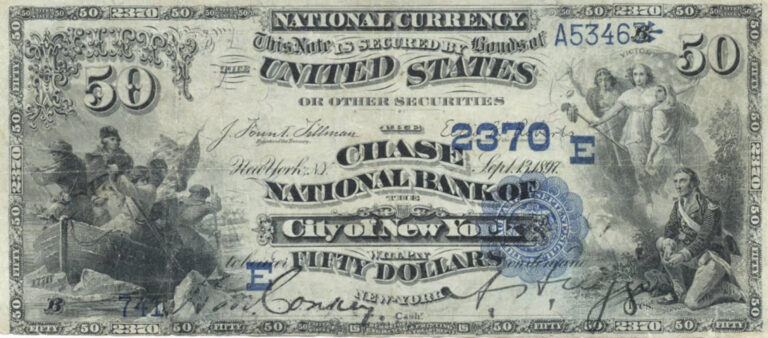
There was a time in American history, after the Civil War, when politicians of many stripes raged at “national banks.” They had something specific in mind—namely, the big financial institutions, concentrated in the eastern United States, and their obscure regulator with the ungainly name, the Office of the Comptroller of the Currency (OCC). These banks formed, in the phrase of the day, “the money monopoly.”
The label, uttered with a contempt rooted in a century of antimonopoly activism, spoke to exclusive right of those banks to issue banknotes—the “currency” in the OCC’s name—secured by holdings of Treasury securities deposited with the government. A small number of banks seated in Boston, Philadelphia, and New York dominated finance, and the Comptroller defended national bank privileges, all under laws signed by President Lincoln.
Historical analogies, to riff on a common saying, seldom repeat but can rhyme, and this story seems impossibly familiar. So, pretty please, with sugar on top, bear with me as I explain the outrage, to anyone who values competition, through the prism of the OCC’s capricious attempt to destroy a law—in Illinois, the Land of Lincoln, no less!—banning transaction fees on taxes and tips collected via credit cards.
A step back in time
If it was the money monopoly in the 19th century, it is the payment monopoly today. And money is no good if you can’t use it as payment for what’s essential or fun in life. Control of money’s usage isn’t that different than control of its creation.
Today the credit card business is dominated by an oligopoly of the megabanks: JPMorgan Chase, Bank of America, Citigroup, American Express, and Capital One, which account for 70 percent of all credit card spending. The debit cards, based on where people have checking accounts, are less concentrated. But both business lines rely on Visa and Mastercard, which dominate card payment processing.
Cards dominate the business of making payments, and it’s not even close by number of transactions. By volume the biggest player is the Automated Clearing House (ACH), thanks to mortgages and business-to-business payments, which is also dominated by the largest banks. Other payment methods are either used at homeopathic levels (cryptocurrency, FedNow) or simply piggyback on the existing payment rails (ApplePay, Venmo). There’s simply no way around the card-based and ACH systems in the modern economy, with former essential for daily transactions.
The system of fee-setting that determines what merchants pay for card transactions only makes sense as a price-fixing conspiracy. Visa and Mastercard, the dominant networks, determine the fees they deduct from merchant sales, and share the money with credit card-issuing banks. The Federal Reserve, under to the 2010 Durbin Amendment, capped debit card fees albeit at a bank-friendly rate. Credit card swipe fees, as they are typically known, are unregulated in the United States.
Banking and monetary policy
The nexus between money and payments is as old as the republic. Until the creation of the Federal Reserve in 1913, banking policy was overwhelmingly about currency, the medium of exchange on which the American economy ran, and control thereof. The OCC and national banks, so called because banks were previously state-chartered entities alone, emerged from the cauldron of Civil War policymaking as a solution to increasingly desperate efforts to finance Union forces that put down the slaveholder rebellion.
Lincoln signed the first of a series of laws in early 1863 that created federally chartered banks required to invest their reserves in U.S. government securities and allowed them to issue banknotes backed by those bonds, and at a stroke, created a massive new revenue source. The laws also sought to tax banknotes issued by state-chartered banks, which had been the antebellum currency of choice, out of existence. In the coming years, comptrollers would forcefully defend the money-issuance monopoly of national banks. Remember that part.
Federal bank chartering was anathema to the many Americans who cheered President Andrew Jackson’s destruction of the Second Bank of the United States in the early 1830s. But southern antimonopolists had chosen the wrong side of history by supporting slavery, and their absence from Congress enabled passage of the national bank laws amid the exigencies of war. Still, approval was a hard-fought effort that required Lincoln’s personal lobbying to overcome popular skepticism of any marriage between financial and political power.
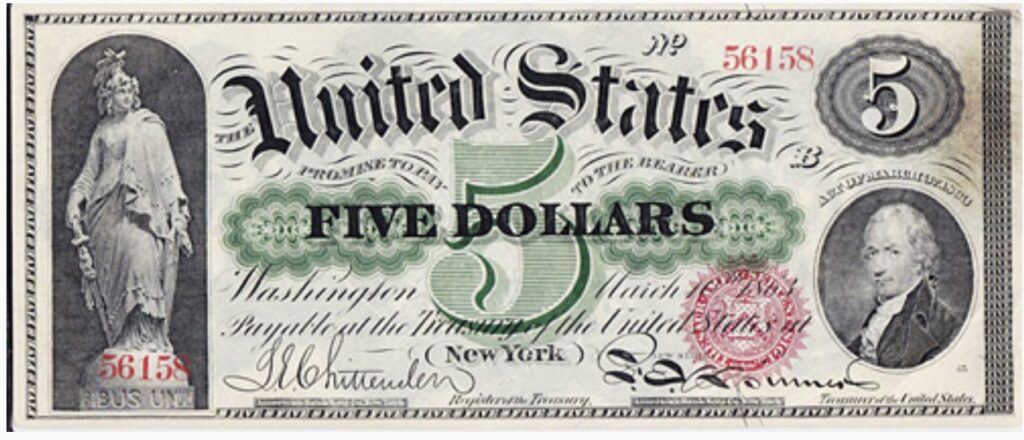
The move made national banknotes as reliable a currency one could have during the most turbulent period in American history. The United States abandoned the gold standard in deed, though not word, in the desperate early phase of the war, so that banknotes could not be redeemed for precious metal. The government issued a new fiat currency whose appearance gave us the term “greenbacks.” Only the promise that they would eventually be withdrawn from circulation made them politically tenable.
From greenbacks to the gold standard
The subsequent 30 years witnessed the victory of what the political scientist Gretchen Ritter, in her study of postwar money politics, Goldbugs and Greenbacks, calls the “financial conservatives” over the antimonopolists, as the country cemented the dominance of national banknotes as the country’s gold-backed currency. Greenbacks were withdrawn from circulation. The gold standard was restored. Silver was “demonetized.” These financial measures shrank the money supply in a way that would be unthinkable today and was outright cruel to the yeoman farmers who needed credit to avoid collapsing into debt peonage.
The country discarded various proposals to break the money monopoly, but not without a fight. The Americans who experienced the rise of 19th century industrial capitalism saw more than the great trusts and the need for what became the Sherman and Clayton Acts. The antimonopolists, who formed clusters in the two major parties and sometimes parties of their own, proposed more greenbacks, “free silver,” and, for you nerds out there, interconvertible bonds.
A standout critic of the currency system dominated by national banks after the Civil War was Wendell Phillips, a famous abolitionist who turned to economic issues after Reconstruction as he grappled with how liberation meant more than ending slavery. It was the heyday of grievances against privileged New York types who decisively influenced national economic development through credit allocation, but the Phillips critique of the “money monopoly” embodied hope as well. A man who’d seen the abolition of slavery could believe that the democratic process would free money from the grip of private avarice.
A native son of Illinois, Alexander Campbell, published a pamphlet, The True American System of Finance, that made similar arguments. Campbell was no pitchfork populist; he was well-off from his time in mining and steelmaking and eventually went to Congress as a leading figure in the Illinois Greenback Party, which also sent a U.S. Senator to Washington. He laid out a cogent critique of the national bank system which “places the whole moneyed interest of this great nation in the hands of a few selfish, scheming financiers.” (He also sometimes referred to lenders as “shylocks,” a reminder how critical rhetoric of finance can slide into casual antisemitism.)
Antimonopolists and their antagonists
On the other side stood people like Hugh McCulloch, the first comptroller. The most generous interpretation of his views is that the national bank system was not a monopoly because there was no single institution, as the Bank of the United States had been, in his own living memory, having been born in 1808. The system, he said upon becoming comptroller, “will concentrate in the hands of no privileged persons a monopoly of banking.”
It says something about the power of national banks that being the first comptroller was McCulloch’s steppingstone to Treasury Secretary. They were no low-profile bureaucrats executing policy either; they actively fought the democratization of money and increasing the supply. Comptroller John Jay Knox authored the “Crime of 1873,” as his detractors described the law that effectively locked in the gold standard by banning the silver dollar. Comptroller James Eckels raged against populist calls for fiat money as the Panic of 1893 laid commerce low. Both left office to become … national bank presidents.
With their ideas for alternatives, the antimonopolists were posing simple questions: Should large financial institutions control an instrument so fundamental to our economic life? Should they be allowed extract rents from it? And should the government help them? In the late 19th century, the antimonopolists answered with a resounding “no.”
So did Illinois, though more quietly, just two years ago.
The latest money monopoly
Aiming at one of the softer spots in the argument for swipe fees, Illinois lawmakers banned the fees on taxes and tips associated with transactions at a store or restaurant. If the fees are what merchants pay for the service of card networks, went the logic, then why impose them on taxes and tips, which merchants simply pass on to the government or employees?
The bill won enactment in 2024 despite furious lobbying from banks and payment networks and was then delayed pending a court challenge. And in the advocates’ arguments and even in the judicial response to the legislation, one hears echoes of antimonopoly thought. The merchants, supporters noted, pay swipe fees on money they don’t even get to keep, a straightforward synthesis of why control of the payment system amounts to control of our money.
Predictably, the big banks and payment processors sued to overturn the Illinois law, and they turned to the national banking laws of 1860s vintage, arguing that the Illinois law impinges on the rights of national banks to profit from swipe fees. Judge Virginia Kendall of the Northern District of Illinois (a George W. Bush appointee) flatly disagreed, pointing out who calls the shots: “That is hard to square with a system where Visa and Mastercard do the actual work of fee-setting all for the banks to collect a check. It is even harder to say that type of fee-setting is such a cornerstone of national banking power as to preempt all state intervention.”
In other words, how do the national banking laws preempt entities that are not even banks? Judge Kendall struck at the heart of the price-fixing scheme and how today’s payment monopoly works. For the banks to all set swipe fees openly in concert would draw the attention of even the dumbest antitrust enforcer, so having payment processors do it and then share the cash works out nicely. (A recent Sling essay just explained how involving an intermediary in a price-fixing conspiracy raises the evidentiary burden for plaintiffs.) But if those entities don’t enjoy federal preemption, then states can eat away at this cartel, however incrementally.
The OCC to the rescue
You can read panic in the words of former Comptrollers—having served Republicans and Democrats—who filed an amicus brief in the appeal of the bankers’ loss. “It does not matter which party ‘sets’ the default interchange fees at issue,” the former Comptrollers write, dismissing the notion of price-fixing in 13 words and some scare quotes. They go on to assert that the fees “are indisputably charged and received by national banks as compensation for their lending and deposit services.” It’s about the money, period. Just like the national banknotes of yore.
To the banks’ rescue came Comptroller Jonathan Gould, a former OCC staffer and bank lobbyist with a law firm closely associated with the first Trump administration, Jones Day. Gould has proposed a new regulation clarifying that laws like the Illinois measure are preempted by federal law and to boot issued an order explicitly invalidating what the state had just done. These measures appear to pave the way for anticompetitive practices under the umbrella of the OCC that would go far beyond swipe fees.
The OCC is wasting no time. It issued an interim final rule, rather than slogging through the usual notice-and-comment period for a proposal. (Want to give them a piece of your mind? You have until April 29 to file comments here. It takes effect on June 30.) And the order approves of collective price-fixing of bank fees: It says national banks can receive “charges” that are “set by or in consultation with third parties.” It defines “charge” very broadly: “directly or indirectly, through intermediaries, partners, payment networks, interchanges, or other third parties, assess, collect, impose, levy, receive, reserve, take, or otherwise obtain, including through a fee sharing or similar economic relationship.”
In for a penny, in for a national banknote
On its face, the OCC is paving the way for new versions of Visa and Mastercard, or even RealPage, the much-loathed software that lets landlords share information and fix—that is, jack up—rents. How about a third party that sets and collects late fees, over-limit fees, annual fees, ATM fees, and any other fee banks can lard on and then forwards a portion of the cash to the banks? It’s a realistic scenario. And if the OCC tries to narrow the scope of its rule, how, exactly, will they draw the line between swipe fees and other charges?
Five years ago, I wrote a lengthy piece arguing for the agency’s abolition: “The OCC is less a regulator than a big-bank trade association embedded in the federal government—a lobby with the power to write its own rules.” It was true in the 19th century. It’s true in the 21st century. But for now, let’s leave the Land of Lincoln to its birthright—fighting the money and payment monopoly.
Carter Dougherty is Senior Fellow for Antimonopoly and Finance at Demand Progress. He also writes the occasional newsletter at The Money Trust.