
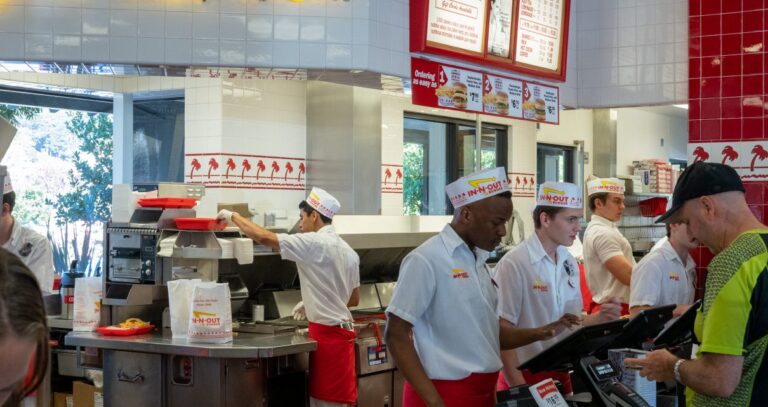
Over the weekend, someone forwarded me a tweet by George Mason economist Alex Tabarrok, who claimed that not one but two new studies provide conclusive evidence that higher minimum wages are a bad thing. Although this tribe shows little sympathy for the plight of workers and despises unions in particular, I thought it was worth digging into the evidence in support of their positions.
Tabarrok’s tweet pointed to his post in Marginal Revolution, which cited two NBER working paper studies, with Jeffrey Clemens, an economist at UC San Diego affiliated with the Hoover Institute, serving as the lead author for both. The first study, from July 2025, purports to show that California’s increased minimum wage for certain workers in the fast-food industry (AB 1228) caused employment in California’s fast-food industry to decline by 2.7 percent. The second study, from March 2026, purports to show that AB 1228 caused food-away-from-home (FAFH) prices in California’s to increase by 3.3 percent. Based on these findings, Tabarrok concluded: “So the policy effectively taxes low-income consumers generally to raise wages for a subset of low-income workers, while eliminating jobs for another subset. Your mileage may vary but I don’t see this as a big win for workers.”
I respectfully disagree. That a higher minimum barely decreased jobs is not dispositive of the policy’s welfare effects on workers. Accepting the findings of the first study, 97.3 percent of California workers affected by AB 1228 benefited from the intervention via higher wages. We balance harms and benefits all the time—think cost-benefit ratios. That’s how policymakers make decisions. We know vaccines have some side effects, but we take them anyway because the benefits outweigh the risks. If a higher minimum wage improves the welfare of workers on net, then the policy should be embraced as a big win for workers.
Clemens et al. (2025) find that employment in California’s fast-food sector declined by a scant 2.7 percent relative to employment in the fast-food sector elsewhere in the United States from September 2023 (when the AB 1228 was enacted, but not yet effective) through September 2024. The wage increase did not actually go into effect until April 2024, just a few months before the end of their study window. The authors would have you believe that California fast-food employers stopped hiring in anticipation of a future wage increase.
Setting this issue to the side, and accepting their estimated effects, out of every 1,000 workers affected by the minimum wage increase, 973 workers earned more per hour and kept their jobs. The authors estimate on page eleven that fast-food pay increased in California by roughly $4 per hour, from $16 to $20. Such an hourly increase would translate into $7,200 more per year for every worker who kept their job (at 1,800 hours per year) after AB 1228 came into effect. Before addressing the welfare losses incurred by the disemployed, that’s a welfare gain of roughly $7 million per every 1,000 workers affected by the policy (equal to 973 workers x $7,200 per year).
On the other side of the ledger, 27 workers per 1,000 affected lost their fast-food job because of the intervention. In a potential Pareto sense, so long as the roughly 973 “winners” from the policy (per every 1,000 affected) could compensate the 27 disemployed with (say) $100,000 annual awards and still be better off—with awards totaling $2.7 million—there is no doubt that the policy was welfare-improving for workers on net (a surplus of $4.3 million to the winners after compensation). With the benefit of hindsight, fast-food workers would have overwhelmingly voted for the wage increase. In Tabarrok’s words, this was a “big win for workers.”
It’s hard to put a figure on the losses, and losing a job is absolutely horrible. But the 27 workers (per every 1,000 affected) who are priced out of the market by the minimum wage increase might find work at the formerly prevailing wages in unaffected industries—recall the law affects only fast-food establishments. Or they might collect welfare payments for a stint. In a world with a better safety net, their welfare would be ensured. So their harms might be mitigated. But even with our intolerably weak safety net, workers collectively are better off by an overwhelming margin, even if the results of the Clements et al. study withstand scrutiny.
Moreover, Clemens and his co-authors acknowledge at page two that two prior studies found little-to-no employment effects from AB 1228:
Because of its relative novelty, this policy has already attracted some analysis. Reich and Sosinskiy (2024) assess AB 1228’s effects on fast-food wages and prices, and use preliminary CES data to examine employment, finding no adverse impact. … Sovich and Hamdi (2025) analyze the effects of AB 1228 using anonamyzed [sic] payroll data from Equifax, which covers 5,000 large employers across the United States. Their analysis focuses on relatively large establishments and finds evidence of offsetting declines in turnover and hiring that net to modest if any impact on employment. (emphasis added)
So now we have three studies on point. Averaging across the three implies a de minimis employment effect from AB 1228 (equal to 2.7 percent divided by three or less than one percent on average). But if you go by Tabarrok’s tweet, it seems that Clemens et al. are the only folks who have weighed in here, they are channeling God, and God tells us that a minimum wage increase is bad for workers.
Balancing worker gains against consumer losses
It’s possible that even if workers benefited on net from AB 1228, consumer welfare losses owing to purportedly higher FAFH prices could swamp the net gains to workers. Before examining the evidence in the companion study, my inclination is to resist such a balancing, as there is no objective way to weight gains to one group (workers) against losses to another (consumers). (Outside of two-sided platforms, antitrust law disallows such balancing for the same reason.) The purpose of raising the minimum wage is to level the playing field for workers in their dealings with dominant employers—that is, it is a pro-worker tool. That some of the worker gains from higher wages come via the employers (via reduced profits) while the residual comes via consumers (via pass-through of a higher wage bill) is to be expected. To wit, Reich and Sosinskiy (2025) estimate that roughly two-thirds of the wage increase from AB 1228 was passed through to consumers in the form of higher prices, meaning that employers absorbed the remainder via lower profits—consistent with the monopsony employer model.
Notwithstanding my views on balancing, the companion price study potentially overstates the impact of AB 1228 on FAFH prices at fast-food restaurants. Here, the treated group are four metropolitan statistical areas (MSAs) in California and the control group consists of 17 MSAs outside California; the BLS only tracks 21 MSAs nationwide for this index. The authors note at page five that “Limited-service and full-service meals together account for over 93 percent of the FAFH basket, with limited-service restaurants comprising approximately 50 percent of the index.” (emphasis added). To the extent that limited-service restaurants serve as a proxy for fast-food, this implies that nearly half of their treated group were not directly affected by AB 1228. If prices increased among full-service restaurants around the implementation of AB 1228 for reasons unrelated to the treatment, their model would attribute that price effect to AB 1228. Anticipating this critique, the authors are quick to credit full-service price effects as “spillovers” from the limited-services segment. The FAFH index also includes deliveries like DoorDash; its drivers sometimes do not even make minimum wage, as they get paid by the order.
Among Tabarrok’s evidence that a minimum wage hike increases prices—or what he calls a “new consensus on the minimum wage”—is a 2020 paper by Renkin, Montialoux, and Siegenthaler, which finds that a ten percent minimum wage increase results in a 0.36 percent increase in food prices. Thus, increasing the minimum wage from $7.25 to almost $8.00 would raise a $100 grocery bill to a whopping $100.36. That negligible increase in the bill is about half of the worker benefit for a single hour of work. Tabarrok is cherry-picking the literature that just barely suggests some negative effects from minimum wage increases. It bears noting that the federal minimum wage has not been raised in almost 17 years. Imagine the outcry among libertarians if the federal government actually made an effort to address income inequality.
Finally, Clemens et al (2026) argue at page three that “an implication of price pass-through is that minimum wage increases function in part as a regressive consumption tax, with costs borne disproportionately by lower-income consumers who spend a greater share of income on affected goods.” But the minimum wage increase is exactly aimed at benefiting those lower-income consumers in the first place. And why exactly are they looking only at the distributional effects on minimum wage rates? Why do they never look at the distributional effects of stock buybacks or executive pay?
An anti-worker bias?
Clemens is a small-government conservative. He has been affiliated with the Hoover Institute since 2021. He contributes to CATO books, co-authors essays about the minimum wage with Michael Strain of the American Enterprise Institute. He’s also the director of the Center for Economic Policy Analysis within the UC San Diego economics department, where in his mission statement, he discusses “how the role of housing supply (or lack thereof) in driving the housing affordability crisis” aka corporatist abundance propaganda. Now there’s nothing wrong with a conservative weighing in on the minimum wage debate. But we should understand where he is coming from, and we should be particularly curious as to whether any of his funders benefit from this research. After all, less pay for workers means greater profits for employers!
Labor economists recognize that in the presence of monopsony power, the imposition of a minimum wage can actually increase employment. When the wage is set moderately above the monopsony price, the intervention is a pure win for workers; there are no losers, only winners. In these cases, the minimum wage serves as a countervailing force against the employer’s buying power, compelling the employer to share more of the marginal revenue product and employ more workers. Even under the monopsony model, a sufficiently large increase in the minimum wage above the monopsony wage might cause the employer to reduce work opportunities, creating winners and losers. Based on the three studies on point, AB 1228 likely did not disemploy any workers, consistent with the monopsony model.
In any event, to assess the net welfare effect on workers, one must weigh the losses of the disemployed against the significant gains to the workers who kept their jobs but now earn $4 more per hour. Using the 2.7 percent employment effect estimated by Clemens et al., AB 1228 appears to be a big win for workers. Let’s celebrate it!