

It is a strange and exciting thing to see any legislative effort to bolster antitrust enforcement. But Senator Klobuchar’s bill to bolster the Tunney Act is special. Congress enacted the Tunney Act in 1974 to prevent the Department of Justice (DOJ) from resolving antitrust cases through consent decrees that inadequately protected competition or the public interest.
My coauthor and friend, John J. Flynn, was special counsel and Consultant for the Senate Antitrust Subcommittee of the Senate Judiciary Committee at the time the Tunney Act was drafted. In light of the DOJ’s prosecution of Microsoft in the late 1990s and early aughts (and its less than stellar settlement with Microsoft), John and I wrote about the problems in judicial interpretation of the Tunney Act, something I again did after John’s passing and after the 2004 amendment to the Tunney Act. That’s 23 years of watching my friend’s work be corrupted, misinterpreted, and rendered almost meaningless. When courts ignore the will of Congress, change ought to come faster than that.
Thus, I strongly endorse this bill. I write to explain why. I also write to emphasize that this bill is not a perfect bill. Yet I feel with greater time and deliberation, it could yield something that vastly improves the Tunney Act. Because I am not constrained by the legislative process, my viewpoint represents a best-of-worlds scenario, and not necessarily the most pragmatic of worlds.
Nonetheless, in my opinion, this bill remedies some long-standing issues.
What the Bill Does Well
To begin, the bill more clearly delineates the powers of the courts versus the powers of the executive branch. The statute was intended to ensure independent judicial review of proposed settlements once the executive branch invoked the jurisdiction of the federal courts. Over time, the courts—particularly within the District of Columbia Circuit—have developed a body of common law that treats Tunney Act public interest review as meaningless and highly deferential to the executive branch. These decisions have relied heavily on theories of prosecutorial discretion even after the filing of a civil complaint. This interpretation misconstrues the separation of powers—perhaps purposefully. Prosecutorial discretion governs whether to investigate or file suit; it does not govern the judicial act of entering a decree that carries the force of law. Despite Congress’s attempt to correct the D.C. Circuit’s line of cases via the 2004 amendment to the Tunney Act, courts continue to rely on D.C. Circuit precedent to aggrandize the executive branch at the expense of Article III of the Constitution.
Second, to the extent that agencies have engaged in sycophantic surrender of their independence to the president, and seek to serve as executive branch agencies, it makes sense that the FTC be subjected to the same requirements as the DOJ. I have explained how the establishment of “sister agencies” is a gross misreading of the FTC Act, and the structure we currently have would have been better served with a true independent and expert agency. Notwithstanding that concern, harmonization of consent judgment standards brings administrative parity. Moreover, the lack of independence proclaimed by the current FTC Chair suggests the potential for greater executive branch influence, perhaps at the behest of parties.
Third, the bill is motivated in part by increasing reports of White House involvement in the negotiation of antitrust settlements. Without disclosure, courts and the public cannot assess whether consent decrees reflect independent legal judgment or political influence. This is not singularly a President Trump concern (see examples under Democratic governance in the airlines) although it is more frequently a concern with this administration.
Finally, current practice often allows merging firms to close transactions before judicial review is complete, effectively mooting Tunney Act scrutiny and limiting a court’s remedial options. The bill addresses this problem directly, by requiring the parties to hold assets separate pending Tunney Act review. One of my long-time complaints has been parties (perhaps rightly) assuming entry of the decree and merging, with the blessing of the DOJ.
Where the Bill Could Be Improved
This does not mean this bill is perfect. There is much work that can and should be done to improve this bill.
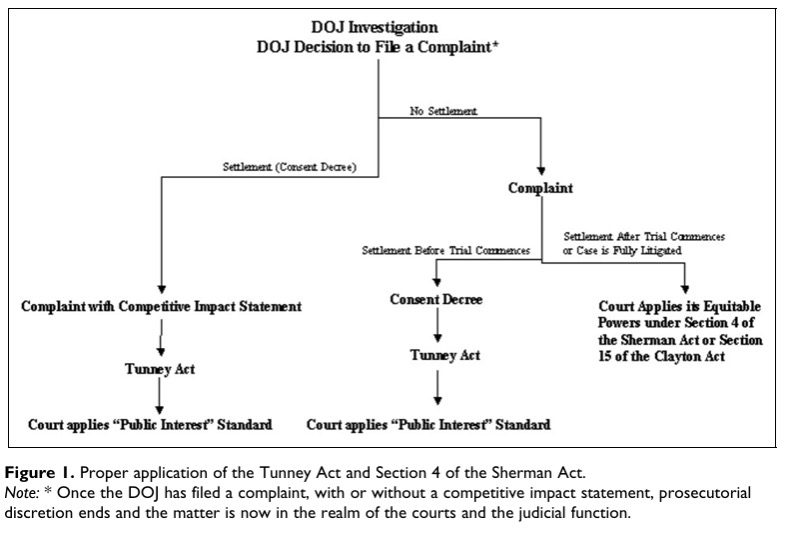
For starters, the bill could stand an even clearer articulation of the powers of the courts versus the powers of the executive branch. Antitrust enforcement includes the investigation, decision to file a complaint, or closing the investigation. In contrast, the decision whether to enter a consent decree, reject a consent decree, or entry of a decree after litigation of a case to final judgment using the equitable powers of the court are judicial functions.
This is the separation of powers that typically occurs with judicial decrees. For example, my second Tunney Act article described how courts have the power to reject plea bargains. There is no reason for the Tunney Act to allow for greater executive encroachment on the judiciary (apart from perhaps the wealth of the parties, which is not a good reason).
The figure below further delineates the difference between application of a court’s equitable powers and Tunney Act review, as it would appear in a Section 2 case, for example.
Moreover, this bill does not address the “fix it first” issue. A “Fix it first” typically involves merging parties identifying an anticompetitive risk and proposing to remedy the issue prior to an antitrust investigation. However, another potential method is for the DOJ to negotiate a “fix it first” in problematic avoidance of Tunney Act proceedings. That would be a deliberate circumventing of the Tunney Act process, and this bill does not cure that concern. I have other reservations about this practice beyond the scope of the Tunney Act.
There is still a question of what happens if the D.C. Circuit courts continue to ignore Congress. While this bill makes it harder for them to use Constitutional Avoidance to suggest Congress really didn’t mean what it says, this bill is sufficiently clear that if the courts wish to continue down this path, they raise the risk of asserting courts rejecting any type of settlement—including plea bargains—is unconstitutional.
There is still a question of what happens when a remedy is proposed to a broadly worded complaint, as happened in the American Airlines merger. There, a broadly worded complaint was filed, then the case settled with minimal remedies that did not cover the scope of the complaint. Ultimately, the court could reject the decree on that basis. That may lead to very narrowly written complaints in litigation when the complaint is not written alongside the proposed final judgment (i.e., in anticipation of litigation).
Finally, there needs to be a clearer delineation of when a court exercises its equitable powers versus when it is engaged in Tunney Act review. As in the case against Microsoft, the court erroneously limited the scope of its powers despite the case having already been litigated to final judgment. The Tunney Act does not apply to fully litigated cases, and attempting to shoehorn fully litigated cases into the Tunney Act limits the equitable powers of the court.
In sum, I hope this bill passes, with improvements. Although it won’t save democracy, the bill can restore some meaningful judicial review to an increasingly politicized area of law and perhaps foreclose some windows of corruption.
My works on the Tunney Act:
Darren Bush, The Abdication of Judicial Responsibility and Authority in Consent Decrees and the Dismissal of Congressional Intent by the Judiciary: The Implications of the Misuse of the Tunney Act in the D.C. Circuit, 63 Antitrust Bull. 113 (2018).
John J. Flynn & Darren Bush, The Misuse and Abuse of The Tunney Act in the Microsoft Cases: The Adverse Consequences of The “Microsoft Fallacies,” 34 Loy. U. Chi. L. J. 749 (2003).
Darren Bush, No, The Tunney Act Won’t Save Democracy, The Sling (August 13, 2025).