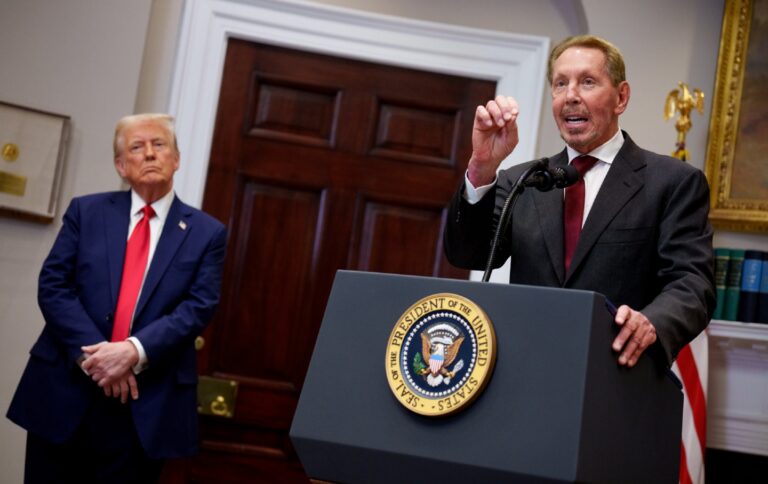
We are witnessing the collapse of antitrust enforcement at the federal level under the second Trump administration. State enforcers have attempted to fill the void. But absent a muscular federal cop on the beat, state efforts will often be in vain. The exceedingly weak settlement between Paramount and the states, announced on Monday by the attorney general of California, illustrates this dynamic. In return for dropping their merger challenge, the states secured the creation of an editorial board, appointed by Paramount CEO David Ellison, to monitor the content of CBS and CNN. In other words, the states got nothing.
Why fold when you’re holding a strong hand? The post-merger concentration levels in wide theatrical film releases satisfied the requirements under the Merger Guidelines to create a presumption of anticompetitive effects. Despite these findings, the Department of Justice (DOJ) Antitrust Division officially closed its investigation into Paramount’s acquisition of Warner Bros. Discovery in June. According to The Wall Street Journal, the career staff were “leaning moving toward recommending a challenge” but were overturned by senior DOJ officials. A shareholder lawsuit alleged that Trump interfered on behalf of the Ellison family, which has contributed significantly to Trump’s campaigns over the years.
Not only did the DOJ refrain from pursuing the merger, the agency actively worked in support of the merger, filing motions against the states, including one seeking that the states “post a proper bond covering the costs of any delay” in completing the deal. From a judge’s perspective, DOJ’s active support of a merger could cast doubt on the merits of the states’ claims. How could an expert federal antitrust agency see things so differently?
The payoff for Trump for intervening in these affairs potentially extends beyond campaign contributions. Last year, concurrent with its attempt to receive clearance of its acquisition of Skydance, Paramount reportedly agreed to pay Trump $16 million as part of a settlement of Trump’s lawsuit concerning “60 Minutes.” The acquisition was later approved by Trump’s Federal Communications Commission (FCC). Some have speculated that another payoff is that Paramount will remake CNN, which is hardly progressive in its current state, into the image of Fox News.
Trump’s interference in the DOJ’s investigation likely led to this week’s dreadful outcome with Paramount. Alas, the administration’s deal with the Hollywood giant is only one example.
Across multiple industries, in exchange for regulatory favor, companies have purchased Trump’s cryptocurrency, contributed to his inaugural fund, silenced a late-night talk show host, or simply paid cash for his various vanity projects. A July piece in The Wall Street Journal spelled out the precise channel by which Trump could be compensated for a deregulatory intervention: “Trump has been demanding large checks from companies for a range of political and legacy projects—telling executives and lobbyists that their companies should give $25 million or $50 million.” The story, which was hardly news in our corruption-laden era, did not make the connection to Trump’s interference in antitrust matters before the DOJ. But it provided a related episode of a tobacco giant, Reynolds American, explicitly buying off regulatory scrutiny from a different regulator:
At a meeting with tobacco executives in May at Trump’s golf club in Jupiter, Fla., the president promised to do much of what executives wanted on policy related to vaping and the Food and Drug Administration. He also took in millions of dollars in contributions for his political committees. O’Rourke [Trump’s chief fundraiser] sat in on the meeting. Shortly after the meeting, the FDA lifted restrictions on some flavored vaping products, and the FDA’s chief was gone.
There is no reason to think that special favors in the antitrust realm would work any differently.
Other recent DOJ settlements reviewed below reveal that companies are hiring Trump allies and using various indirect mechanisms to influence antitrust outcomes. Those efforts may fall short of direct monetary payoffs to Trump. But corruption is not a binary variable. What we are observing today can easily progress towards direct payments of cold hard cash tomorrow, if that’s not happening already.
A Quick Review of Recent DOJ Settlements
In several high-profile cases, the DOJ’s Antitrust Division has pulled back from enforcing antitrust laws at the behest of Trump (and whatever lobbyist caught his ear that day) after initially filing lawsuits or opening investigations. It bears repeating that there is zero evidence, at least not yet, of money having passed to Trump; the evidence instead shows money passing to a Trump ally who brokered a back-door deal.
- Live Nation: In May 2024, the DOJ, along with 29 states plus the District of Columbia, filed a complaint against Live Nation, alleging monopolization of various concert and event-related services. After a reported personal intervention by Trump, the DOJ unexpectedly reversed course and settled in the middle of a jury trial. The states, now acting alone, persisted and secured a jury finding of antitrust liability in April 2026, suggesting the merits of the DOJ’s original case were sound.
- HPE-Juniper: In late January 2025, ten days after Trump’s second inauguration, the DOJ filed a complaint to stop the merger of two large enterprise tech companies, Hewlett Packard Enterprise (HPE) and Juniper Networks. HPE hired lobbyists, such as Mike Davis, a staunch Trump ally, who negotiated directly with aides to then-Attorney General Pam Bondi, bypassing the DOJ’s career antitrust lawyers. It was money well-spent, as the DOJ ultimately reversed course and settled the case in June 2025. In Tunney Act hearings on the settlement, the district court found the proposed settlement to be in the public interest, despite the evidence of corruption. (Read Darren Bush’s excellent Sling piece for a review of how the court erred.)
- Compass-Anywhere Real Estate: In October 2025, the DOJ was investigating Compass’s proposed acquisition of Anywhere Real Estate, first- and second-biggest U.S. brokerages, respectively, by volume. Compass hired Davis, on the acquisition, who reportedly appealed to then-Deputy Attorney General Todd Blanche’s office that the merger did not warrant a second request for information, over the objections of Assistant Attorney General Gail Slater, head of the antitrust division at the time. The deal closed at the beginning of this year without a second request.
In each of these instances, career staff, tasked with enforcing the antitrust laws and often with decades of experience of doing just that, have been sidelined by their politically appointed bosses. Indeed, reporting in The Wall Street Journal suggests that Trump has directly entangled himself in these matters. For instance, the CEO of Live Nation CEO, Michael Rapino, reportedly visited the White House twice (once with Trump himself) in the lead up to the DOJ’s course reversal. Given Trump’s transactional nature, it is reasonable to infer that he only does something if he stands to benefit. So what explains his personal involvement in any antitrust matter?
If Trump and his DOJ appointees, like AAG Slater, were libertarian, as some prior Republican administrations, then the DOJ’s unwillingness to enforce the antitrust laws could be chalked up to ideology rather than corruption. But Trump’s crowd is decidedly interventionist—and not just when it comes to tariffs or government equity in companies. They even campaigned on populist ideas that at least suggested some promise to enforce the antitrust laws. A president cannot extract a payment from a corporate giant unless and until he feigns interest in enforcing the antitrust laws; the credible threat of enforcement serves as leverage. In sum, Trump created the perfect fact pattern for a quid pro quo.
Non-cash payments can also complete a quid pro quo. The Nexstar-Tegna merger, which the DOJ did not even bother to challenge, would allow the combined entity to reach approximately 80 percent of U.S. television households; such levels vastly exceed the long-lived 39-percent cap set by the FCC. (In August 2026, the FCC’s broadcast ownership rules were relaxed on a 2-1 vote.) Some reporters have speculated that Trump’s payoff there, in return for permitting Nexstar to flout the cap, was Nexstar’s silencing Jimmy Kimmel on its affiliated networks. Eight states sued to block the Nexstar-Tegna merger, and a federal judge halted the deal in April, indicating the merits of such a challenge were sound. A trial date on the matter is set for July of next year.
Comfortably Numb
Consistent with Steve Bannon’s theory of flooding the zone, the unending stream of this administration’s corruption has caused previously presidency-ending activities to seem hardly worthy of a footnote. Trump’s repeated market-moving announcements of the start (or end) of the Iran War—a conflict that has killed as many as 22 American service members and over a 3,000 Iranian civilians—have provided myriad opportunities for insiders to cash in, as the price of oil (and the stock market generally) have predictively moved in response to Trump’s manufactured events.
If that weren’t bad enough, Trump now offers a premium version of Truth Social that allows early access to his market-moving announcements. Trump is seeking to monetize the office of the presidency in broad daylight.
In the face of such blatant corruption, it is natural for us all to go numb. Even if a reporter were to identify an explicit payment to Trump in return for an antitrust waiver, it is not clear whether that act would spur Democrats into action, as many corporatist Democrats enjoy the same patronage as Republicans.
So who cares about corruption? Well, if you don’t believe in antitrust enforcement (think Matt Yglesias and his ilk), and you learn that the president (hypothetically) has been monetizing his powers to terminate antitrust investigations, then you likely will not be moved by news of the monetization. This is just the price of getting deals done. Who cares if the president gets to wet his beak?
If, on the other hand, you believe in antitrust enforcement, and you learn that the president (hypothetically) has been monetizing his powers to terminate antitrust investigations, then you also likely will not be moved. What upsets you is the lack of enforcement; that Trump may have personally benefited from the decision to settle a case is of secondary importance. Absent the executive meddling, however, enforcement would have continued; in this case, the purported monetization was pivotal to the outcome. Moreover, to the extent that career officials at DOJ or FTC perceive that any meritorious case can be reversed at the eleventh hour (via a Trump intervention, compensated or not), fewer cases might be developed. Why invest the energies and resources if the process is ultimately rigged?
It’s possible that those who hold no views on antitrust enforcement—potentially a large swath of Americans—upon learning that the president (hypothetically) has been monetizing his powers to neuter antitrust investigations or active cases, would be freshly upset by news. It might seem unjust that only the largest (and unscrupulous) companies can purchase their way around law enforcement. As affordability becomes a central political issue, voters might connect consolidation and exploitation (in the case of Live Nation) with higher prices.
But would enough people care about the news to demand Congressional inquiries and passage of legislation that would prevent future presidents from monetizing their powers? There are some indications that blatant corruption could move voters. A milder form of corruption occurs via campaign contributions, by which large corporations made contributions in exchange for an implicit promise for hands-off treatment. At least three Senate candidates — Abdul El-Sayed (Michigan), James Talarico (Texas), and Jon Ossoff (Georgia) — have campaigned on a pledge to eradicate this form of corruption. One could imagine explicit corruption easily being folded into their campaigns.
The Key to Meaningful Reform
As an alternative strategy to acquiescence, we can try to restore the democratic principle that antitrust law applies equally to all firms, regardless of political influence. How can we do that? One can look at attempts at political reform to curb executive overreach in the post-Nixon era, including how they fell short. In 1974, Congress passed the Election Campaign Act Amendments, which overhauled campaign financing by setting strict limits on political contributions and expenditures.
In the same year, Congress passed the Tunney Act, in response to perceived meddling by the Nixon administration into the DOJ’s investigation of ITT’s acquisition of the Hartford Fire Insurance Company. As Darren Bush recounts in The Sling, ITT “offered to help finance the 1972 Republican National Convention. While no quid pro quo was proven, the appearance of impropriety sparked significant debate.” In 2004, Congress revised the Tunney Act to compel a public interest determination. But we’ve already seen in HPE-Juniper why the Tunney Act is insufficient, at least in its current form, to protect against presidential meddling. Courts have shown uniform reluctance to question proposed final judgments, or engage in anything more than performative questions before using the rubber stamp.
None of these Nixon-inspired safeguards, to the extent they even resemble what Congress intended, prevent Trump’s effort to sell regulatory waivers to the highest bidder. Trump’s abuses make Nixon’s appear quaint by comparison. The rationale for making the FTC an independent agency, as opposed to an executive one, was to insulate career officials from executive interference. There is little wonder why Trump is trying to convert the FTC into an executive agency, by firing its two Democratic commissioners. Alas, the Supreme Court seems pliant to this usurpation of power, making a special exemption for the Federal Reserve to remain independent but not the FTC.
Despite his timid approach to price gouging and other corporate abuses, President Joe Biden never sought to unwind an FTC or DOJ antitrust investigation. We can either hope to elect presidents who respect the independence of antitrust agencies, or we can build in certain protections against future abuses. In an ideal world, we can make the FTC independent again, with full authority and resources to prosecute antitrust cases ignored by the DOJ. And even within the DOJ, we should have a law ensuring that once a political appointee such as Abigail Slater or Jonathan Kanter decides to open an antitrust inquiry, those leaders and supporting career officials are shielded from executive interference.
Finally, we need to stop the revolving door from agency to lobbyist. Some of the worst abuses here occurred under the Obama administration. After “investigating” Big Tech, many of Obama’s FTC appointees landed jobs in Big Tech. Working for the DOJ or FTC should be career paths with much higher compensation. They cannot be stepping stones into cushy jobs defending the same conduct they were previously tasked with policing.
There are ways to prevent future presidents from monetizing the White House. The meager settlement between the states and Paramount is the latest consequence of the Trump administration’s evisceration of antitrust enforcement. If we fail, we will continue to experience the concentration of power in the hands of a shrinking set of oligarchs.