Anger. That’s been the most frequent and obvious reaction to the Justice Department’s baffling and embarrassing decision this week to settle its monopoly lawsuit against Live Nation. After years of evidence that Live Nation, the largest artist manager and concert promoter in America, in coordination with its in-house event-ticketing monopoly Ticketmaster, consistently ripped off fans and bullied venues and artists, the government’s case had finally made it to trial—only to end a week after it began. How could a company that has so blatantly abused its outright power in the live music industry for so many years, earning scorn from artists, independent venues owners, and consumer advocates, get off with the most cursory slap on the wrist?
The settlement has been messy at the least. The Department of Justice (DOJ) settled the lawsuit without informing either the judge or its lead litigator on the case—a decision Judge Arun Subramanian said showed “absolute disrespect for the court.” The settlement came just weeks after Trump-affiliated lobbyists forced the former head of the DOJ’s Antitrust Division, Gail Slater, out of her job, and after those same lobbyists spent many months working to convince top Department officials to settle the Live Nation lawsuit before a jury could decide the company’s fate. It was easy to predict how this lawsuit would turn out.
But amid the Trump administration’s observable corruption and Keystone-cops level of stumbling over itself to get this settlement done, it’s worth thinking about why this particular kind of settlement rarely works, and why breaking up monopolies like Live Nation is the better, and often only, solution to the core problems of monopoly power.
Under the settlement, Ticketmaster will cap some of its notoriously high fees at amphitheaters and open its platform to third-party ticket resellers like Stubhub and SeatGeek. Live Nation, meanwhile, will allow venues that contract with the company to use ticketing services other than Ticketmaster for a percentage of their events, and will limit exclusive contracts between venues and Live Nation to four years. Live Nation will also sell off around a dozen of the 400-plus venues it owns, and pay $280 million to the Plaintiff States.
The settlement is getting poor reviews
Those with a dog in the fight against Live Nation and Ticketmaster aren’t happy with the deal. Stephen Parker, head of the National Independent Venue Association, rightly points out that the reported $280 million Live Nation will pay out to the States is a fraction of what the live music monopoly rakes in from concert goers and venues over a year. The payout, Parker says, “is the equivalent of 4 days of their 2025 revenue, which means they could potentially make it back by this Friday.” Meanwhile, the settlement’s requirement that Ticketmaster host rival platforms could empower scalpers and secondary ticketing sites, “which would likely exacerbate the price gouging potential for predatory resellers and the platforms that serve them,” Parker says.
United Musicians and Allied Workers and The National Consumers League also objected to the deal. “Allowing Live Nation to keep Ticketmaster without meaningful structural remedies would squander a rare opportunity to restore competition to the live entertainment marketplace,” National Consumers League executive John Breyault says in a statement.
The settlement likely won’t work, not just because it’s barely a slap on the wrist for the most powerful company in live music history. It won’t work because settlements like this almost never work — and the government surely knows it.
A history of failed behavioral remedies
There’s maybe no better example of a failed conduct remedy than what the government required in the original Live Nation/Ticketmaster merger 15 years ago. In 2010, antitrust enforcers from the Obama administration ignored the chorus of music industry and consumer critics warning about the unchecked power of a merged Ticketmaster and Live Nation. They approved the deal over these objections, subject to some promises that the combined company wouldn’t force venues to use Ticketmaster in order to host Live Nation artists and tours (or what antitrust recognizes as a “tie-in”). Eight years later, Live Nation was found to have violated that remedy so flagrantly that even the first Trump administration was forced to take action. But rather than sue the company to break it up, they made Live Nation double-promise that it wouldn’t abuse its monopoly again.
Nothing changed. According to sworn testimony at trial, Live Nation in 2021 threatened the Barclays Center, a major live event venue opened in 2012 and home to the NBA’s Brooklyn Nets, with withholding major concerts and tours after the venue ditched Ticketmaster for a different ticketing platform. The testimony, from former Barclays Center head John Abbamondi, described exactly the kind of monopoly conduct critics feared when the companies merged, and that the DOJ banned for a second time just one year before Abbamondi got his first “offer you can’t refuse” call from Live Nation. The conduct remedy failed, and then failed again. A few years later, Jonathan Kanter and the Biden DOJ had seen enough, and sued to break up the company.
This settlement appears destined to fail as well, for the reasons conduct remedies often do. The proposed behavioral fixes to Live Nation’s monopoly power do nothing to address the structure of the company, which is the thing that gives it the power and motivation to dominate every corner of the live music industry. So long as Live Nation controls Ticketmaster, it will want to compel the many hundreds of major artists it manages and the tours it organizes to use Ticketmaster. The milquetoast guardrails the settlement creates around venue and artist choice in ticketing platforms do nothing to change the interrelated nature of Live Nation’s business.
That’s why conduct remedies in monopoly cases are exceedingly difficult to enforce. Stopping a monopoly from doing monopoly things is expensive and time-consuming for everyone involved — enforcers, the courts, and the company itself. There’s the inherent information asymmetry between the monopoly and the government, forcing the government to assign a team of people to monitor the company, and use subpoena power when necessary, to essentially litigate the remedy for years until the settlement’s rules expire, after which the company can again abuse its monopoly and wait for enforcers to catch on.
As antitrust scholars John Kwoka and Spencer Weber-Waller point out, conduct remedies directly conflict with a monopoly’s very nature. If abusing power benefits a company’s bottom line, as it does Live Nation’s, the company is going to do whatever it can to work around the settlement’s rules to continue that abuse, either in full or some reduced version of it. Conduct remedies force the government to fight against nature itself.
Breakups strike directly at the heart of monopoly power. If Live Nation no longer owns Ticketmaster, it has no ability or reason to force venues and artists to use it. Its ability to tie a ticketing platform to popular artists and tours ends then and there. There’s no court-appointed monitor necessary, no compliance program needed. Breakups are effective, direct, and permanent.
The government’s failure to end Live Nation’s monopoly structure has animated critics of the settlement, and forced states to continue to litigate. “We will keep fighting this case without the federal government so that we can secure justice for all those harmed by Live Nation’s monopoly,” New York Attorney General Letitia James said in the wake of the settlement news.
DOJ’s settlement with Live Nation, presumably at the behest of White House operatives, is more like a presidential pardon than something that will make live music competitive again. The government is asking a serial monopolist to play nice when it has never played nice before, then assigning a monitor, perpetually in the dark about what Live Nation is actually doing, to enforce the deal. Even if Live Nation fully abides by the settlement’s rules, in eight years everything goes back to the way it was. The settlement offers no solution and no relief.
Now, it will be up to state enforcers to demand a breakup, which is the only remedy that can, once and for all, end Live Nation’s monopoly abuse. Artists and venues are counting on the states’ success.
You don’t have to be an economist to recognize that we are living through an era of diminished competition. You simply must open your eyes and ears. And wallet. Whether paying for airline tickets, groceries, health insurance, concert tickets, ski passes, or video streaming services, consumers have experienced a consistent rise in prices, making things less affordable.
In most facets of our lives, we are confronted by a dominant firm (or two if we’re lucky) plus a fringe set of competitors. Airline passengers typically face two alternatives per route—as of 2018, the average HHI on a route before considering common ownership was just below 5,000, implying two equal-sized carriers. Amazon accounts for over 40 percent of all online retail sales revenue in the United States. Two federal district courts found that Google monopolizes both the search and ad-tech industry, respectively. Social media users congregate on a handful of platforms like Facebook/Instagram or TikTok. Four hotel conglomerates (Marriott, Hilton, Hyatt, and IHG) have acquired formerly independent resorts. Ridesharing is provided by just two companies. Visa, Mastercard, and American Express account for nearly all credit cards issued in the United States. The pattern is hard to miss. Even in markets that are not concentrated, the use of common pricing algorithms can effectuate monopoly outcomes.
So it was striking to see a new paper in the Journal of Political Economy by economists Carl Shapiro and Ali Yurukoglu contending that the current record does not show a weakening of competition—and that many troubling trends are best understood as competition at work. As explained more fully below, their methodology for assessing the evidence would never yield to a finding of increasing concentration in the economy, either because there will never be enough data, or because they can invent just-so stories that are consistent with the evidence. In other words, their methodology seems very rigorous and impressive but cannot detect economy-wide changes in concentration or price/cost markups. It would be akin to assessing climate change by insisting on measuring every millimeter of the earth; because you never have the requisite data, you can never say anything.
For context, Shapiro was the Deputy Assistant Attorney General for Economics of the Antitrust Division of the Justice Department under Obama. Shapiro famously told Congress in 2017 that the reason there was little-to-no enforcement against monopolists during his tenure was that there were “precious few” meritorious cases to bring. Like many others who “served” as regulators and later found comfortable landing spots at expert services firms that defend mergers, Shapiro has since consulted to Amazon, Apple and Google—each of whom has been a defendant in a monopolization case brought the antitrust agencies after Shapiro left. Shapiro also terminated an engagement with the FTC (in a monopolization case against Facebook) under Lina Khan’s leadership.
It is thus not entirely surprising that Shapiro would publish a paper purporting to find no “widespread decline in competition” in the United States. Shapiro’s position in this paper is entirely consistent with his laissez-faire approach as an antitrust “enforcer.”
Shapiro’s co-author, Yurukoglu, made a name for himself by publishing a paper in the prestigious American Economic Review in 2012 that purports to show that bundling of cable networks is economically efficient. The paper finds that average consumer surplus from a forced movement from bundling to a-la-carte pricing would decline. An earlier version of the paper released in 2008, however, came to a different conclusion, more attuned to the concerns of the anti-monopoly movement: “Mean consumer surplus [from a-la-carte pricing] increases by an estimated 36.5% and cable industry profits decrease by an estimated 30.6% as households still receive the networks they value highly, but pay a lower monthly bill.” (emphasis added). Defending exclusionary conduct by dominant firms is helpful in getting published in top-tier economics journals.
Rejecting the Growing Body of Evidence on Concentration
In one swoop, Shapiro and Yurukoglu (hereafter “S&Y”) dismiss the growing body of empirical literature, but also the tangible, lived experience of market consolidation. They claim:
The research underlying these claims [of declining competition] has not generally followed the approach usually taken in the field of industrial organization to evaluating market power, which involves looking at individual firms, markets, or industries in some detail to understand the forces driving change and to detect any anticompetitive conduct or mergers. Instead, these claims are about the US economy overall on the basis of evidence at scale, by which we mean aggregated data available across many industries. (emphasis in original)
Per S&Y, heterodox economists who write in support of the declining competition hypothesis are not following the exacting rules developed by certain members of the industrial organization (IO) community, consisting mostly of professors at elite universities. These particular experts, whose pro-monopoly positions are amplified in The Economist and other defenders of neoliberalism, have conveniently designed a research heuristic that precludes using industry structure as a means to predict prices (or price/cost markups), under the rationale that industry structure is “endogenous” to the price-generating system. Indeed, the structure-conduct-performance paradigm reigned supreme for decades until the new empirical IO framework took over and banished all such studies from publications. Now an economist gets published by writing things like “Within the field of industrial organization, the structure-conduct-performance approach has been discredited for a long time.”
What S&Y seem to be complaining about here is that economists who write in support of the declining competition hypothesis rely on industry-level aggregated data, as opposed to transaction-level data for a given defendant in an antitrust case. But use of industry-level data occurs in academic research for good reason—researchers can’t subpoena transaction-level data from a company, as can a private or public antitrust enforcer. S&Y insist that concentration metrics are not informative unless they are applied to a relevant antitrust market, or a collection of goods that are close economic substitutes. In any event, the examples of declining competition in tech industries provided above, including the two federal court decisions finding monopolies in search and ad-tech are sector-specific; we don’t need an independent concentration study to confirm what has already been found. Moreover, because antitrust markets are generally narrower than industry-wide metrics—a relevant antitrust market is defined by the smallest set of services over which a hypothetical monopolist could exercise power—it follows that these papers likely understate the level of concentration in the relevant antitrust market.
Celebrating Concentration
S&Y turn the mounting evidence of concentration on its head, suggesting that winner-take-all markets actually benefit consumers through vigorous competition on the merits:
As we assess the empirical evidence and identify key areas for future research, we find it useful to contrast the decline-in-competition hypothesis with the much cheerier view that many of the changes we have seen in the structure and performance of US industries represent healthy competition that has delivered benefits to the public. We call this the “competition-in-action” hypothesis. For example, if a few “superstar” firms in an industry grow by delivering greater value to customers on the basis of their superior ability to adopt and use new technologies that involve higher fixed costs and lower marginal costs, we would expect both concentration and price/cost markups to rise, along the lines developed brilliantly by Sutton (1991, 1997).
Notwithstanding that Shapiro consults to many of these “superstar firms,” the authors are reducing structural transformation to a purely technological and cost-based story. Omitted in this vigorous defense of corporate behemoths like Apple, Amazon and Google are network effects, intellectual property regimes, tax arbitrage, labor suppression, financializaton, regulatory choices, and political lobbying—as if none of these things play any part in shaping market outcomes and enabling durable market power. For example, Uber seized the ridesharing market in large part by engaging in regulatory arbitrage, misclassification its drivers as independent contractors and evading requirements to buy taxi licenses.
Sticking with ridesharing, S&Y oddly cite to a recent paper by Castillo (2025) as evidence that “sophisticated pricing algorithms serve to increase consumer and total surplus.” Castillo’s findings relate to Uber’s practice of surge pricing. Of course, S&Y make no mention of the various ongoing litigation against firms that use a common algorithm to fix prices, including the RealPage and Yardi litigation. A closer look at Castillo’s findings reveals that the findings are not as glowing as S&Y indicate:
Welfare effects differ substantially across sides of the market: rider surplus increases by 3.57% of gross revenue, whereas driver surplus and the platform’s current profits decrease by 0.98% and 0.50% of gross revenue, respectively. Riders at all income levels benefit. Among drivers, those who work long hours are hurt the most, especially women. (emphasis added)
In other words, any benefits to riders come at the expense of drivers, particularly women. To S&Y, this outcome provides some societal benefits. Apparently, harm to workers, in their view, justifies some modicum of cost savings to Uber riders. One might remember that the NCAA recently tried this same economically bankrupt “consumer benefit” argument to justify its “amateurism” restraint in Alston, which resulted in losses at the District Court, Ninth Circuit, followed by a 9-0 thrashing from the Supreme Court.
S&Y assert that rising concentration at the industry level is just as consistent with their “competition-in-action” hypothesis as with the decline-in-competition hypothesis. But how can these IO economists confidently assess that dominant firms are “delivering greater value to customers on the basis of their superior ability to adopt and use new technologies,” rather than obtaining their dominance by exploiting loopholes, leveraging political influence, or engaging in exclusionary conduct? Indeed, many of these corporate leviathans acquired their way into power. Google’s acquisition of DoubleClick made Google dominant in the ad stack. Facebook acquired Instagram to maintain its hold over social media. Amazon has made 117 acquisitions since 1998, including Alexa Internet, Audible, Zappos, Quidsi, Whole Foods, and Ring. As demonstrated by Kwoka (2017), since the 1990s, U.S. companies have been free to pursue most horizontal mergers and can only expect real scrutiny, let alone a challenge, from the agencies at very high levels of concentration. Bogus (2025) explained, via a case study of General Electric, how firms and an economy centered on M&A and financial engineering tend to neglect welfare-increasing, long-term undertakings like investment and R&D.
Put differently, S&Y claim that concentration evinces competition on the merits, ignoring all of the non-meritorious–and often anticompetitive–ways many firms have achieved dominance. We should reject their premise because winning does not prove the game was fair.
And regardless of how markets became so concentrated—competing on the merits or via anticompetitive conduct—employers in concentrated markets can exercise power over both consumers and workers. A new study in the Journal of Economic Perspectives shows that in concentrated markets, workers receive lower pay that is equal to a roughly eight percent decrease in their lifetime consumption. More on this in the section (below) on the declining labor share.
Rejecting Evidence of Growing Price/Cost Markups
After dispensing with the evidence on growing concentration, S&Y turn to inventing alternative stories to explain the evidence on growing markups. “Our reservations are based on problems with both measuring and interpreting trends in price/cost markups.” As I write this essay, the amount of pre-tax profit generated per every dollar of operational expense has increased from around five cents per dollar for much of the 20th century to over 20 cents per dollar in recent years. As S&Y even acknowledge, “a widespread increase in markups would warrant further examination as to its underlying causes, especially if observed in conjunction with a widespread rise in profits.”
S&Y state that “Simply observing that price/cost markups rose as revenue was reallocated to firms with higher markups does not help us distinguish between the decline-in-competition hypothesis and the competition-in-action hypothesis.” Yet when making inferences about market power, the means by which (historically) high markups were secured doesn’t matter. As Shapiro appreciates, having worked in antitrust matters, market power is defined as the ability to raise prices over competitive levels, often proxied by marginal costs. So if marginal costs fall, as S&Y speculate, but prices don’t fall to those lower cost levels as a result of competition, that too is an indication of market power.
S&Y try to debunk the findings of De Loecker, Eeckhout, and Unger (2020), which used Compustat data to estimate price/cost markups for publicly traded firms. De Loecker et al. found that revenue-weighted average markups have risen from around 1.21 in 1980 to 1.61 in 2018—consistent with the declining competition hypothesis. S&Y assert that the fancy econometric modeling in the paper provides “essentially the same” result as using the weighted average ratio of revenue to cost of goods sold (COGS), and that COGS might include many costs that economists consider fixed costs. They conclude that what De Loecker et al. are “actually measuring is something more like a scaled version of the firm’s operating profitability than its price/cost markup.”
So what? To assert that this related measure of markups is economically meaningless, one would have to demonstrate that the way publicly traded companies record COGS has changed dramatically over time, by for example, increasingly moving fixed costs outside of COGS and into other categories, thereby artificially inflating the observed markup. But S&Y never even assert this tendency; if firms’ tendencies to treat certain fixed costs as COGS has remained roughly constant over time, this critique is irrelevant. Finally, to cast further doubt on the findings in De Loecker et al., S&Y cite Conlon et al. (2023), who claim that De Loecker’s markups at the sector-level do not correlate with sector-level price indexes as measured by the Bureau of Labor Statistics. Again, what is this testing? The lack of correlation could occur for myriad reasons, including having too few observations within a sector to study or failing to control for other variables that might affect both series. For example, Table 1 of Conlon et al. show that in five of twelve sectors studied, the number of observations in the univariate regression of PPI growth on the markup growth was below 100; in three other sectors, the number of observations was below 200. As Conlon et al. acknowledge, “This [lack of correlation] does not necessarily imply that no such correlation exists because our analysis is subject to many caveats.”
Spinning Evidence of the Declining Labor Share
S&Y also casually dismiss the notion that a declining labor share indicates declining competition, “given that there are many competing explanations for the decline of the labor share (Grossman and Oberfield 2022), that the pattern seems to be global (Karabarbounis and Neiman 2014), and that many of the same measurement issues that exist with markups and concentration apply to the labor share.” S&Y neglect mentioning any contrary findings, such as Wilmers (2019), who used panel data on publicly traded companies to show that dependence on large buyers lowers suppliers’ wages and accounts for ten percent of wage stagnation in nonfinancial firms since the 1970s.
An economist can easily construct a different story to fit a fact pattern, especially when he can assume the equivalent of no gravity. For example, MIT economist Autor has argued that superstar firms just happen not to utilize (or pay) labor as extensively as the firms they displaced; hence, when superstars take over an industry, the labor share falls. S&Y seize on this explanation, as if they were channeling the gospel. One might wonder, then, why the largest tech firms engaged in a no-poach agreement to suppress competition for worker and thus reduce their pay, as evidenced in the In Re High Tech Antitrust Litigation. And if Autor’s speculation had merit, then why do the largest tech firms now engage in the practice of acquihiring, a de facto acknowledgment of the importance of labor?
There are other reasons to be skeptical of the “superstar” theory for a declining labor share. Consider a not-so-hypothetical fact pattern: Workers at Promoter A (the largest promoter) capture 30 percent of event revenues, workers at Promoter B capture 40 percent of event revenues, and workers at Promoter C capture 50 percent of event revenues. Platform A acquires Platform B outright, and then forecloses Platform C from hiring its workers via non-compete agreements. Platform A reduces its wage share to 20 percent and industry-wide wage share falls to (say) 25 percent. When the industry was less concentrated, Platform A’s workers enjoyed the option of taking their talents elsewhere, which forced Platform A to pay 30 percent. When that outside option was extinguished via acquisition and exclusionary conduct, however, workers were forced to work at a single platform, which allowed Platform A to push down its wage share. Autor (and presumably S&Y) could argue that “superstar” Platform A just happens to pay its workers a low wage share. But the reason why Platform A can pay a lower share is precisely due to the lack of competition. Put differently, employers aren’t assigned a wage share by some exogenous force. The wage share they pay is a function of the labor market in which they compete for talent.
Moreover, that the pattern of a declining labor share “seems to be global” does not undermine the declining competition hypothesis. One would suspect that similar patterns of consolidation or exclusionary conduct by dominant firms (or both) are happening around the world. It reminds one of a standard efficiency defense put forward by dominant firms in antitrust litigation: “My smaller competitors are doing it too. Ergo, it must be competitive!”
Policy Implications
As MIT economist Nancy Rose elegantly explained in Senate testimony in 2021, the debate over what to make of rising markups and concentration misses the point:
There is ongoing and robust debate over the measurement and implications of both aggregate trends and the “winner-take-most” economics of many digital markets. Empirical economists have jumped enthusiastically into this fray, and I discuss the strengths and limitations of this work in my 2019 paper, “Concerns About Competition.” But it would be a mistake to think that the evidence of a competition or competition policy—problem rests solely or even primarily on how these debates are resolved. … But aggregate concentration and mark-up trends or empirical industry studies are far from the only source of evidence on our growing competition problem.
As centrists focus on social conflicts like “wokeism” to divert attention away from our widening inequality problem, IO economists like S&Y have fabricated a distraction to deflect attention away from the obvious failures of competition.
Despite rejecting the decline-in-competition hypothesis, S&Y still purport to “favor strong antitrust enforcement,” though it’s not clear why antitrust would be needed if we are living in a competitive world as they claim—without market power, a single firm cannot effectuate anticompetitive outcomes.
S&Y oddly reject the notion that antitrust can curb a dominant firm’s ability to influence our politics: “Furthermore, very different policies [from antitrust] are used to directly control the political power of large companies, notably the rules regarding campaign finance, lobbying, and media ownership.” By preventing firms from rolling up entire industries via merger enforcement, or by compelling conglomerates to divest key assets previously acquired during the remedies phase of a monopolization trial, antitrust can precisely limit a firm’s political power. Again, one doesn’t have to be an IO economist to observe the CEOs of Amazon, Apple, Google, Meta, and Microsoft seated behind President Trump at his inauguration.
In summary, S&Y make bold claims at the outset of their paper, such as “We explain that the empirical evidence relating to concentration, markups, and mergers does not show a widespread decline in competition.” (emphasis added) But their actual analyses don’t support this claim. What they are really saying in the paper is that it is unclear whether the increase in concentration or price/cost markups are due to a decline in competition or competition in action, and that further research is needed. The paper is effectively click-bait for policy wonks. And by writing this 3,000-word review, I’ve fallen for it.
Monopolization comes in many flavors. As we have seen over the years, firms use assorted and creative methods to acquire or maintain dominant positions. Exclusive dealing, predatory pricing, and tying are some of the competitively suspect practices familiar to antitrust lawyers and economists. But the courts have made clear the list of “anticompetitive” or unfair practices that are actionable under the Sherman Act is not a closed set. Deception and other tortious conduct, for instance, can constitute illegal conduct. Given the elasticity of antitrust law, union-busting fits within the Sherman Act’s prohibition on monopolization and should be challenged by public and private enforcers. A class action lawsuit (Mizell v. UPMC) filed by health care professionals in 2024 against UPMC, the dominant hospital system in Western Pennsylvania, offers an excellent vehicle for expanding the scope of monopolization law and competition policy.
Under well-established antitrust doctrine, monopolization has power and conduct elements. To show a violation of the anti-monopolization section of the Sherman Act, plaintiffs need to demonstrate that the defendant has monopoly power and that this power was acquired or maintained through improper conduct, as opposed to “a consequence of a superior product, business acumen, or historic accident.” Firms that acquire their monopolies through the latter methods are at liberty to enjoy the fruits of their market dominance. But firms that use improper means to obtain or perpetuate a monopoly are not so free, and they can face the force of the courts’ broad equitable and legal remedial powers, including radical restructuring. This distinction between permissible and impermissible paths to monopoly reveals one implicit function of the antitrust laws: Pressure firms to grow and succeed by developing “superior product[s]” instead of other less salutary means.
Critically, what constitutes improper conduct is not cast in stone. Courts have applied the concept dynamically and elastically over time. In United States v. Microsoft, the D.C. Circuit wrote, “the means of illicit exclusion, like the means of legitimate competition, are myriad.” In this spirit, the Supreme Court has ruled that practices like deception can constitute illegal monopolization. For instance, in a 1965 decision, the Court ruled that procuring a patent through fraud on the U.S. Patent and Trademark Office can constitute illegal monopolization.
An interesting expression of this theme came in a 2002 decision from the Sixth Circuit. In Conwood v. U.S. Tobacco, the court affirmed a jury verdict in favor of a smokeless tobacco maker that had faced an onslaught of property destruction and theft by the dominant manufacturer. Conwood persuaded a jury that U.S. Tobacco had, among other practices, destroyed its product racks and removed its products at convenience stores and other retailers. While the conduct did not resemble a traditional antitrust violation, the court nonetheless held it ran afoul of the Sherman Act. Rejecting U.S. Tobacco’s argument that tortious conduct could never violate the antitrust laws, the unanimous three-judge panel ruled that it could in “rare gross cases.” Further, tort law did not displace the Sherman Act: “merely because a particular practice might be actionable under tort law does not preclude an action under the antitrust laws as well.” The court concluded the U.S. Tobacco’s misconduct “rose above isolated tortious activity and was exclusionary without a legitimate business justification.”
Expanding the Scope of Unfair Competitive Practices
Given this body of precedent, antitrust practitioners and scholars should treat union-busting as another type of illegal conduct that is actionable under Section 2. Firms that fire union organizers and thwart unionization and other concerted action by workers violate the National Labor Relations Act (NLRA). In other words, union-busting firms violate their employees’ federal statutory rights. Moreover, these scofflaw firms obtain an unfair and illegitimate advantage over rivals that comply with their legal duties under the NLRA, impairing their rivals’ ability to compete effectively in the associated product market. A firm that respects its workers’ right to organize typically has higher wages and overall labor costs than a rival that doesn’t—a major determinant of competitive success in a labor-intensive field like health care. An unscrupulous firm with this ill-gotten cost advantage can undercut high-road rivals and capture market share. This is not competing and succeeding through superior efficiency but competition through lawbreaking. When done by a monopolistic firm, union-busting can help cement the firm’s market dominance and prevent law-abiding competitors from growing.
The University of Pittsburgh Medical Center (UPMC) stands accused of monopolistic conduct of this nature. In Mizell v. UPMC, health professionals currently and formerly employed by the health system are challenging the monopolization and monopsonization of the markets for hospital care and hospital employees, respectively. The bulk of the complaint is focused on UPMC’s serial acquisitions of hospitals and other health care facilities in Western Pennsylvania.
The class action also alleges unfair practices that have given UPMC an unfair competitive edge over rivals. Among these practices are union-busting: UPMC has consistently sought to thwart its workers’ attempts to form unions. The complaint states: “UPMC has faced 133 unfair labor practice charges since 2012 and 159 separate allegations. Approximately seventy-four percent of the violations related to workers’ efforts to unionize, indicating a system-wide suppression of unionization activity.”
This pattern of union-busting has enabled UPMC to maintain a significant and illegitimate competitive edge over its rival in the downstream product market, Allegheny Health Network, many of whose employees are unionized and covered by collective bargaining agreements. Through its alleged union-busting in violation of federal law, UPMC maintains an unfair cost advantage over Allegheny Health Network. As a result of its unfair competitive conduct, UPMC can offer lower rates to payors and patients and maintain its dominant position.
In a 2024 statement of interest in Mizell, the Department of Justice (DOJ) credited union-busting as a potential monopolization theory. The DOJ succinctly described why this conduct is injurious to competitors and potentially runs afoul of Section 2: “[A]nti-unionization tactics by a monopsonist arguably limit unionized rivals’ ability to compete profitably by lowering UPMC’s costs relative to the rival’s.” Union-busting is not an instance of lower costs through superior productive efficiency, but rather lower costs through violation of law.
Why Stop at Labor Law Violations and the Sherman Act?
The UPMC example has broader implications for antitrust law and competition policy. Should federal and state enforcers start treating violations of generally applicable laws as competition problems? As discussed above, such lawbreaking is harmful to the expressly protected class—private-sector workers in the case of the National Labor Relations Act— and also to competitors that comply with the law. Congress appreciated the connection between employment conditions and competition when it enacted the Fair Labor Standards Act (FLSA). In establishing a generally applicable federal standard on wages and hours, Congress declared that underpaying and overworking employees “constitutes an unfair method of competition in commerce.” In line with the DOJ’s statement of interest, the drafters of the FLSA understood that firms can obtain an unfair competitive edge through labor exploitation.
Lawbreaking should be conceived of as not just potential monopolization under the Sherman Act but a broader competition policy concern. In adopting the language of the FTC Act, Congress’s use of “unfair method of competition” in FLSA shows the shared lineage between antitrust and labor. Today, flouting the law, including labor and employment statutes, is a clear competitive strategy for many firms, notably in Silicon Valley. To use one example, Uber acquired its dominance in the ride-hailing business, in part, by misclassifying drivers as independent contractors (and also refusing to acquire cab licenses), while law-abiding rivals faced higher operating expenses. Employers should be disabused of the belief that they can succeed and profit by busting their workers’ unions or depriving them of statutory labor and employment rights entirely.
As I lay out in a forthcoming article in the American University Law Review, the FTC, in a future administration, should challenge large-scale lawbreaking as a competitive strategy. The FTC can protect honest businesses and channel business strategy in socially beneficial directions, such as improvements in operational efficiency, investment in new production capacity, and research and development. In a 2024 essay, then-FTC Commissioner Alvaro Bedoya and his Attorney-Advisor Max Miller called on the FTC to challenge large-scale worker misclassification as an unfair method of competition.
While it lacks a private right of action and the treble damages remedy, the FTC Act has certain advantages over the Sherman Act. Under Supreme Court precedent, the FTC can attack not just traditional violations of the Sherman and Clayton Acts, but also practices that it deems “against public policy for other reasons.” Although the scope of public policy is contestable, federal statutory law undoubtedly constitutes public policy. Further, the broader substantive scope of the FTC Act means that the FTC can challenge large-scale lawbreaking by non-monopolistic firms. The FTC should not target any and all lawbreaking and duplicate the work of other federal agencies. Borrowing from the Conwood decision, the FTC instead should concentrate on instances that rise above isolated misconduct and represent a critical part of a firm’s competitive methods.
Two of the three principal federal antitrust laws are elastic by design. Whereas Congress restricted specific practices such as exclusive dealing and price discrimination in the Clayton Act, the drafters of the Sherman and FTC Acts opted for broad, open-ended language. They understood that attempting to catalog all unfair competitive practices in a statute would be futile. Businesses and their counsel are ever inventive and always looking for new sources of competitive advantage, licit and illicit. The class action against UPMC shows that union-busting is an important competitive tactic. This conduct is harmful to workers and to competitors that respect their workers’ right to organize. The NLRB exists to protect workers from unfair labor practices. To complement the labor agency’s work, the courts and FTC should use their competition powers to protect honest firms from their low-road rivals and pressure businesses to compete in more socially advantageous ways.
In December, Dennis Romboy and Art Raymond of Deseret News reported that the University of Utah’s board of trustees approved a first-of-its-kind private equity deal between the school and Otro Capital to fund athletics.
The decision to partner with private equity appears to be based on a crude assessment of the contributions (revenues and expenses) that can be traced directly to sports, which ignores the value added from the promotion of the university via athletics. And not counting that value added is a huge mistake. A few days ago, University of Utah upset #22 ranked West Virginia in women’s college basketball. Even if no one paid to see this game (2,352 reportedly were there), the University of Utah still reaped a huge promotional benefit when ESPN reported on the game.
Before delving deeper into the University’s mistaken reasoning, one first has to know what sort of business Otro Capital is seeking to fund. Let’s start with some basic stats about the University of Utah. In 2024, the University of Utah reported total operating revenues of $7.3 billion. That same report indicated the university had total operating expenses of $7.8 billion. But with a reported $1 billion in non-operating revenue, one could argue the University of Utah was profitable.
Of course, it was not. The University of Utah is a non-profit business. So, it is incorrect to talk about such a business in terms of profits and losses. Any excess revenues the institution earns are not paid out to owners or investors. Instead, these revenues are used to further the institution’s mission.
In many ways a non-profit institution is just like any other business. The university primarily sells educational services to its customers. To produce these services, people are employed and paid wages. But after all the revenue and expenses are tabulated, there is no individual to claim the profit. And because no one is there to claim a profit, the University of Utah – unlike many for-profit businesses like Otro Capital – is not seeking to maximize profits.
Although the primary business of the University of Utah is education, it also produces other products. One of these is college sports (in which Otro Capital would like to invest). This business gets quite a bit of media attention. But it is actually a very small business financially.
In January 2025, the institution reported that it sponsored 20 different athletic teams. And these teams generated $110 million in revenue (but spent a little more than that). Or to put it differently, athletics at the University of Utah generated about 1.3 percent of the revenues for the business.
Although it is only a small part of the operation, athletics at the University of Utah works just like their education business. Athletics brings in revenue to the institution. To generate these revenues, people are hired and wages are being paid. And at the end of the day – because the University of Utah is still a non-profit – it is inappropriate to talk about the university athletics in terms of profits and losses. Again, there is no one to claim a profit so the University of Utah is definitely not seeking to maximize profits with respect to athletics.
A history of student-athlete exploitation
All that being said, historically there has always been one major difference between athletics and the rest of the university. The product created by athletics is produced by student-athletes and historically the NCAA restricted the pay of these individuals to the cost of attendance. Consequently, the pay of other employees in athletics, such as coaches, tended to be somewhat inflated.
But after the Supreme Court ruled against the NCAA in 2021 (by a 9-0 vote!) in National Collegiate Athletic Association v. Alston, the compensation of college athletes can now go far beyond the cost of attendance. Of course, now universities must find money to pay the athletes.
Back in 2024, I argued the obvious solution was to simply pay the coaches less. So far, this obvious solution has generally been ignored. It appears schools want to keep paying college coaches far beyond what school revenues suggest is reasonable and also find additional money to pay the athletes.
One solution is to keep asking boosters to pay the bill. Mark Cuban does seem quite happy to give millions of dollars to Indiana University. But this massive investment isn’t making Cuban any richer. He has no claim to the Indiana Universities’ athletic revenue. All he gets for his money is the happiness created by a national football championship.
Although it is possible a university can always find a booster who is satisfied to give money to a business just for the chance to be happy, the marriage between the University of Utah and Otro Capital is a different way to go. Otro Capital isn’t giving money to the school just to increase its happiness. Otro Capital – as a private business – is presumably trying to maximize its profits.
So, why would a university that doesn’t seek to maximize profits (because they don’t exist for the organization) want to team up with an organization that we suspect primarily cares about maximizing profits?
A solution in search of a problem
Apparently, decision-makers at an institution with $8 billion in revenue seem to think one program (athletics) spending $17 million more than the $110 million revenue it generates is a problem. But is the solution to this very small problem creating a partnership with private equity?
We do not know for sure the motivations of the people leading Otro Capital. But let’s imagine that once upon a time they listened to the Friedman Doctrine. In 1970, Milton Friedman explained this doctrine in a column for the New York Times. The Friedman Doctrine is effectively captured by the last paragraph of the column:
But the doctrine of ‘social responsibility’ taken seriously would extend the scope of the political mechanism to every human activity. It does not differ in philosophy from the most explicitly collective doctrine. It differs only by professing to believe that collectivist ends can be attained without collectivist means. That is why, in my book Capitalism and Freedom, I have called it a ‘fundamentally subversive doctrine’ in a free society, and have said that in such a society, ‘there is one and only one social responsibility of business–to use its resources and engage in activities designed to increase its profits so long as it stays within the rules of the game, which is to say, engages in open and free competition without deception or fraud.’
Yes, Friedman is arguing that corporations should only focus on profits and do not have any social responsibility.
This sentiment is hardly original to Friedman. The famed financier J.P. Morgan once famously said during the Robber Baron Era: “I Owe the Public Nothing.”
These five words didn’t make Morgan immensely popular with the general public at the time. The inability of the Robber Barons to consistently behave in a way that people considered “socially responsible” eventually led to a political backlash that included the enactment of significant government regulation, a much more substantial social safety net, and tax levels far beyond anything seen in the history of the nation.
Of course, all that happened before the Friedman Doctrine was printed in the New York Times. Since 1970, substantial efforts have been made to lower taxes, limit government welfare programs, and reduce regulation. Today, people in business are generally not foolish enough to repeat those five words from J.P. Morgan in public. One suspects, however, that many people in business very much believe the Friedman Doctrine.
The dangers of private equity
And that is why it may be quite dangerous for the University of Utah to work with a private equity firm. A private equity firm is likely interested in the explicit revenues that University of Utah athletics currently generates. Because football and men’s basketball are two of the oldest sports (that have also benefitted from decades of investment and media attention), most of the athletic revenue is generated by those two teams.
But the other 18 sports teams also contribute to the success of the university. And this is true even if they never generate much revenue and never create a return for Otro Capital.
Although college sports do not generate much explicit revenue, sports are often the primary way these institutions advertise themselves to prospective students, alumni, and the general public. Every time the women’s basketball team or gymnastics team is in the news, the University of Utah is promoted. And this is a significant contribution in value to the University, even if it is hard to measure. It would be immensely expensive for a university to purchase an equivalent level of advertising.
Athletics also can promote the general mission of the institution. In the United States, women account for 58 percent of college students. Imagine a world where the primary method universities employed to advertise their institution (i.e., college sports) only involved men. This might make recruiting and retaining women as students a bit difficult. And a university without students isn’t really creating much social benefit.
Perhaps the people who lead Otro Capital can be made to understand all the things sports does for the University of Utah. Of course, that seems unlikely when we consider how little the University of Utah understands what sports does for the school.
Remember, this move seems motivated by the “losses” that decision-makers at the school think exist in an athletic department at a non-profit institution. If the University of Utah understood what athletics does for the school (i.e., advertising the institution), those “losses” wouldn’t seem so important and this marriage between a non-profit and for-profit institution wouldn’t be necessary.
In the end, private equity might help the University of Utah eliminate its “losses” in the athletic department. But if Otro Capital is only interested in profits (i.e., if they follow the Friedman Doctrine), the University of Utah is likely going to lose far more than it gains.
This week, to much fanfare, Google introduced its new Universal Commerce Protocol (UCP). UCP was developed in collaboration with multiple retail partners, including Target and Walmart.. UCP involves artificial intelligence (AI) agents (i.e., programs that can perform some tasks autonomously) in the shopping process (aka, agentic commerce). Simply put, instead of searching for a specific product on the web, finding your preferred location, then going there to perhaps purchase it, you can perform the entire transaction within Google’s AI Mode through UCP.
Google’s announcement was met with immediate (and frankly, warranted) skepticism and concern, particularly given recent court decisions finding Google has engaged in anticompetitive conduct in both search and display advertising. Lindsay Owens, Executive Director of The Groundwork Collaborative (whose recent research on price discrimination by Instacart’s shopping algorithms prompted congressional calls for an investigation) raised concerns regarding the potential for UCP to result in supracompetitive consumer prices. Her two-part viral tweet appears below.

The concern here is less with upselling, which occurs ubiquitously, but rather more with the potential for data collected from consumers’ AI prompts to motivate price discrimination by creating or amplifying existing market power.
Google’s Defense Made Matters Worse
Google immediately denied such claims in an attempt to mollify any concerns that UCP would lead to consumer harm. But, in doing so, Google did the exact opposite. Look carefully at the highlighted text.
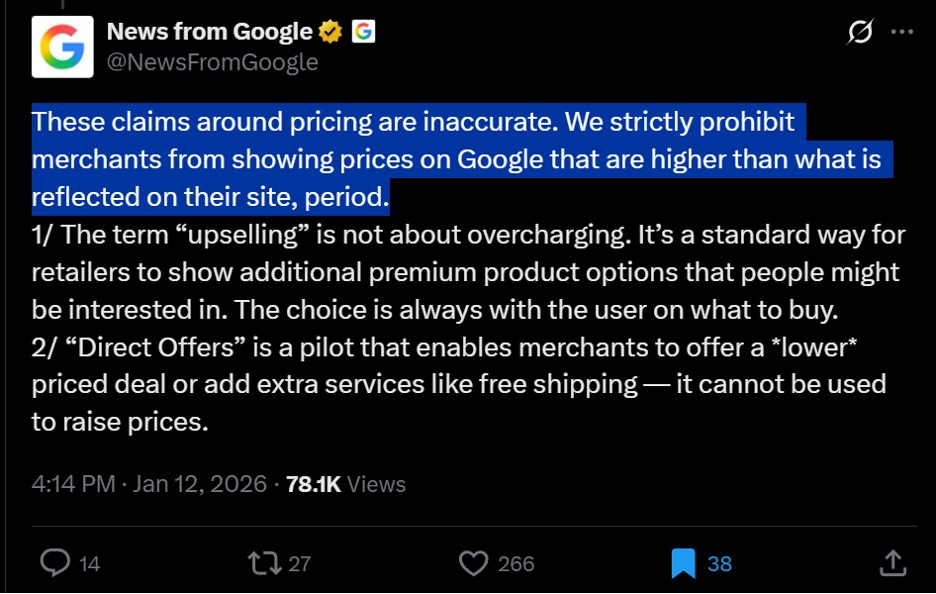
If you’re familiar with the ongoing Ad Tech litigation against Google, as well as the pricing parity cases against Amazon, you might have reacted with more than just a little surprise. This looks A LOT like the very same conduct for which both Google and Amazon have been accused of violating the antitrust laws. Simply put, the highlighted text reflects a most-favored nations agreement: merchants cannot sell the same product at a lower price elsewhere than the price at which they sell on Google. This reflects a reduction in choice.
Notably, in NCAA v. Board of Regents, the Supreme Court noted that widening choice reflects a procompetitive outcome. Consistent with this view, courts adjudicating the ad tech antitrust matters have recently found a similar policy that Google implemented with respect to display advertising to constitute anticompetitive conduct. The specific Google practice there is called Unified Pricing Rules (UPR). In the district court’s August 5, 2024 Memorandum Opinion, Judge Brinkema described UPR as “a policy that prohibited publishers using DFP [DoubleClick for Publishers] from setting higher price floors for AdX [Google’s ad exchange] than for other exchanges…Unified Pricing Rules also prohibited DFP publishers from setting higher price floors for Google AdWords demand than for demand from other ad networks or demand-side platforms.”
Google’s own description indicates that it implements a similar policy with respect to Google Shopping—namely that merchants cannot advertise lower prices on other platforms (including their own sites) than on Google. But in the ad tech case, publishers indicated that they had good reason to reject such a policy. In finding that UPC constituted anticompetitive conduct, the court explained,
But in implementing Unified Pricing Rules, Google simultaneously took away publishers’ ability to set higher price floors on AdX than on third-party exchanges, which was a primary tool that publishers had used to maintain revenue diversity and to mitigate Google’s dominance of the ad exchange market. Publishers viewed Unified Pricing Rules as not in their best interests, but felt stuck using DFP given its tie to AdX. Unified Pricing Rules is another example of Google exploiting its monopoly power and tying arrangement to restrict its customers’ ability to deal with its rivals, thereby reducing its rivals’ scale, limiting their ability to compete, and further compounding the harm to customers. Under these circumstances, Unified Pricing Rules constituted anticompetitive conduct because it involved Google using its coercive monopoly power to deprive its publisher customers of a choice that they had previously exercised to promote competition.
In the ad tech case, Google could have chosen to compete on the merits rather than imposing UPR. It could have reduced its AdX take rate to motivate publishers to choose its exchange. Instead, it chose an anticompetitive course of action (UPR).
The same concept applies here. A seller’s ability to set different prices across sales channels can benefit consumers. For example, suppose one shopping platform offers lower fees to sellers, just as some ad exchanges offered lower take rates than AdX. Sellers can take advantage of those lower fees and pass on the benefits to consumers in the form of lower prices. In turn, this places pressure on rival platforms to lower their own fees and offer consumers the same benefits. Similarly, if sellers can avoid such costs, they can offer lower prices on their own sites. This is how competition works. Imposing price parity requirements as Google indicates it that it does, avoids such competition, to the detriment of consumers.
This article focuses on Google, but Amazon has also previously implemented a price parity policy. Amazon dropped this policy in Europe in 2013, after facing multiple investigations from European competition authorities. (See FTC 2nd Amended Complaint ¶275.) Though it also abandoned the policy in the United States in 2019 after facing legislative pressure, particularly from Sen. Richard Blumenthal (D-CT), Amazon continues to face antitrust suits based on implicit enforcement of such policies. The FTC has alleged that Amazon implicitly enforced this policy “through an internal mechanism called Select Competitor – Featured Offer Disqualification” (See FTC 2nd Amended Complaint ¶277.). In other words, sellers who did not abide by the price parity policy could lose their Buy Box eligibility. For more information on how the Buy Box works and its role in algorithmic pricing, you can see my recent piece on The Sling on this topic.
Google’s public acknowledgment that it imposes a price parity policy seems at best an unforced error, thought it may also signal its confidence that its conduct can escape the “anticompetitive” label in this case. Google might argue that it does not have monopoly power in shopping, particularly given Amazon’s presence. But Google does have monopoly power in search advertising. UCP will integrate with AI Mode in Google Search, where Google continues to test ads. Google has also added Direct Offers, a new Google Ads pilot that “allows advertisers to present exclusive offers for shoppers who are ready to buy — like a special 20% off discount — directly in AI Mode.”
Leveraging Its Search Monopoly into Online Shopping
Google already serves ads in its other AI-powered search product, AI Overviews (the AI-generated summaries that appear above search results) as well as AI Max for Search. The competitive concern here are twofold: (1) that Google will leverage its market power in search to the online shopping industry and (2) the remedies contemplated in the Google search case, specifically the expectation that AI would begin to dilute Google’s market power in search, may prove less effective than anticipated, if at all.
Specifically, the competitive concern would arise because, as mentioned, Google is the dominant search engine, and it now offers AI Mode in Search, which uses Google’s family of Gemini LLMs. AI Mode allows a more in-depth, “conversational” interaction between an individual and the AI-powered Gemini-3 model. It is worth noting that Google already knows a lot about individual users from products other than search: Chrome, Gmail, Google Fiber, and so on. As Google itself has acknowledged, it “draws insights from across your Google apps to provide customized responses from Gemini.”
The information people feed into Gemini, ChatGPT, and other LLMs provide more information about that user, valuable data that allows platforms to monetize their user base. Take, for example, the OpenAI commercials of the sort (“let ChatGPT plan your vacation”, or “use ChatGPT to schedule your day”). The intent here is to integrate AI into every facet of life, maximizing a platform’s opportunities for commercial extraction. OpenAI’s Sam Altman provided perhaps the emblematic example of this goal when he told Jimmy Fallon “I cannot imagine figuring out how to raise a newborn without ChatGPT,” as though humans have not been doing this very same thing for millennia.
Suppose you type in your agentic commerce-empowered AI chatbot that “I’m looking for lightweight running shoes with a carbon plate and support for pronation” instead of “I’m looking for running shoes.” An LLM can glean more important information from the former than the latter, which in turn informs that back-end machine learning algorithms. (For more about how such algorithms can result in tacit algorithmic collusion, you can check out my new paper on this topic here.) The former description suggests you’re a serious runner, likely a racer, who is familiar with various purpose-designed shoe features. It can then “upsell” you on other products that similar individuals have purchased. You can see Google acknowledging this below.

Learning individual preferences “on a deeper level” from user interactions allows Google to build out your consumer profile more accurately. This practice also preys on information asymmetries. While some may regard LLM outputs as ground truth (note the tendency of Twitter posters to ask “hey grok is this true), platforms such as Google can exploit that misunderstanding. After all, consumers acting more financially responsible and making better decisions doesn’t keep the lights on in the data center, nor does it pay for those new NVIDIA Blackwell chips. It’s worth remembering Google’s own warning: “Generative AI is a type of machine learning model. Generative AI is not a human being. It can’t think for itself or feel emotions. It’s just great at finding patterns.”
Amazon’s AI Shopping Tool Also Inflicts Harms
Of course, agentic commerce has some ostensible appeal. Cross-platform checkout can potentially save time or otherwise improve comparison shopping (absent the price parity restraint that Google imposes). But such attempts by Amazon have met with mixed results. Businesses reprimanded Amazon for using its AI shopping tool through its Shop Direct program to list products on its site without their permission. Shop Direct allows potential customers to browse offerings from brands sites directly on Amazon. The individual can then complete the purchase by clicking the “Buy for Me” button, which prompts the AI agent to purchase product on the shopper’s behalf.
The problem arose when the AI agent attempted to purchase items that the shop does not even sell or when the seller does not even participate in the Amazon program. Hitchcock Paper, a stationary company in Virginia explained in an Instagram post,
I fiercely believe this is why we shouldn’t let AI control things with no human backup or accounting. Amazon should not be beta testing faulty programs on small businesses without ANY way for us to seek help when it inevitably goes wrong. @sellonamazon, unknowingly involving my business in this program – then requiring me to pay to get help – is deceptive and wrong.
Other sellers noted that Amazon’s AI agent attempted to buy discontinued products from third party sellers though Shop Direct, indicating that this was not an isolated incident but a program that affected sellers more broadly. Such practices point to another source of consumer and seller harm: platforms’ misuse of agentic commerce can impose transaction costs on sellers, which eventually translate into higher prices for consumers.
Amazon itself is not immune to the vagaries of agentic commerce. In November 2025, Amazon sued Perplexity, an AI-powered answer engine that operates the Comet web browser application. Comet AI incorporates agentic AI functionality, enabling it to take actions on users’ behalf, including placing orders on Amazon’s store. Amazon alleges that Perplexity did not identify its AI agents as such, and that Perplexity set up Amazon Prime accounts, enabling users to make purchases on Amazon and take advantage of Prime features without paying for them.
Agentic commerce makes many promises. Whether these actually manifest themselves remains to be seen. The outcome will depend, at least in part, on whether platforms engage in good-faith efforts to improve consumer experiences, or instead turn to exploitative practices that mirror those already challenged under antitrust statutes. If anything, consumers and sellers have cause for concern.
Housing prices are up, and would-be homeowners are shifting to rental units. The inventory of homes for sale is shrinking because investors are buying up properties with cash offers. Investors then rent the homes to households who cannot afford mortgages. Many feel that the American dream of homeownership is slipping away. Building more homes won’t alleviate the problem if those additions are not in the right location or if investors buy them first.
To address this pinch, right after the New Year, President Trump called for Congress to cap the holdings of institutional investors in the housing market. A very reasonable idea, so long as it is implemented correctly.
Within days of the president’s announcement, the New York Times Opinion section featured an essay titled “The Landlords Are Not The Problem,” noting that institutional investors collectively own “less than 1 percent of the nation’s single-family homes—and less than 5 percent of single-family rentals.” That figure presumes that the relevant geographic area for studying investor pricing power is the nation. But housing investors are not randomly acquiring properties across the nation. Instead, they are selectively acquiring properties in neighborhoods to maximize their pricing power. This purchasing strategy, sometimes called “rentlining,” entails buying homes that are most likely to permit rent extraction from tenants who lack options. Measuring investor ownership using the nationwide housing stock as the denominator artificially deflates the true investor share of the markets in which they operate.
The Wealth Defense Industry Strikes Back
President Trump’s proposal sent members of what Matt Stoller aptly calls the “wealth defense” industry into overdrive. Jay Parsons, former chief economist of RealPage, was quick to tout a study by the American Enterprise Institute (AEI), a libertarian think tank that has been one of the loudest opponents of recent federal and state efforts to restrict investor homebuying. The AEI report, from August 2025, estimated that institutional investors owned a small share of single-family homes when looking at the national, county, and even zip code levels. That report offers the following analysis of single-family home ownership:
Institutional ownership of single-family homes is highly concentrated and varies significantly at the county level. Just 162 counties (or 5% of U.S. counties for which Parcl Labs data are available) account for 80% of all institutionally-owned homes, according to Parcl Labs data. Yet not a single county has a share greater than 10%…[E]ven in metros that have received significant media attention for their more pronounced investor presence, such as Atlanta (4.2%), Dallas (2.6%), and Houston (2.2%), these investors do not dominate any single neighborhood[…] In Atlanta, for instance, the highest institutional investor share in any ZIP Code is 12.4%, while half of its ZIP Codes have a share below 1.5%. No ZIP Code in Houston has an institutional investor share of over 10%[.]
Although this analysis may inspire faint hope as far as it shows that institutional investors haven’t yet taken over most U.S. housing markets, this analysis misses two valid concerns of affordable housing advocates: (1) concentration can be caused by large local players, regardless of their national or statewide holdings, and (2) neighborhoods, not zip codes, are the relevant geographic market.
Institutional Investors Aren’t the Only Source of Pricing Power
The current policy discourse has poorly defined the valid concerns about institutional housing investors. In recent bills proposed to regulate institutional investors, these investors are generally defined as an owner of one hundred or more residences. For example, Florida’s House Bill 1593 regulates the home-buying of a business that “has an interest in more than 100 single-family residential properties in this state.” The AEI report quoted above uses the same one-hundred-home designation. This definition misses the crux of the pricing power issue.
No housing advocate or economist has ever drawn a bright red line at one hundred units as the threshold for corporate pricing power. When scrutinizing the ability of businesses to coordinate and set artificially high prices, economists measure the overall concentration of the relevant market, regardless of the asset portfolio of the participants. Moreover, sometimes different firms that purchase homes are subsidiaries of a larger firm, so a firm may appear to be a small investor but actually be just a tentacle of a larger corporate entity.
In this instance, a more accurate analysis of pricing power examines which local housing markets are controlled by a few big players, rather than analyzing arbitrary ownership thresholds. Owning just five homes in the same neighborhood reasonably conveys investor status, regardless of whether the owner is an institutional investor.
Taking this more expansive view of market concentration allows us to measure pricing power in individual housing markets regardless of national (or statewide) asset portfolios.
Measure Neighborhoods, Not Zip Codes
A second issue with AEI’s claims is that market power must be evaluated in a relevant geographic market. The Merger Guidelines compel us to ask, how much contiguous real estate would a hypothetical landlord have to acquire in order to raise rents over competitive levels? Although zip codes can be a useful and relevant unit of observation, zip code boundaries do not necessarily reflect the areas within which a renter or homebuyer considers their options. A medical student at University of Miami who lives in the trendy Brickell neighborhood for easy access to the metro station (and a short ride to the medical campus) would not consider any apartment in the 33130 zip code as a substitute.
To study this issue, we focused on Atlanta, as the AEI study provided institutional market shares by zip code there. Fulton County provides a map of all official neighborhoods in Atlanta, which we combined with a dataset containing all tax parcels in the county to identify all single-family homes in Atlanta by neighborhood.
Because there are approximately four times as many official neighborhoods as zip codes in Atlanta, neighborhoods provide a more narrowly defined set of smaller geographic housing markets relative to AEI’s zip code analysis. Furthermore, renters and buyers both seem more likely to deliberately target neighborhoods rather than zip codes when searching for their next home.
Neighborhood Market Power Analysis
We assembled a dataset of approximately 75,000 single family homes in Atlanta. We identified homes owned by an LLC or other business entity, and we also identified “investor owners,” which we define as homeowners who own at least five homes within a given neighborhood. The vast majority of investor owners are business entities. In line with AEI’s research, we find that investor owners hold a small share of homes in most Atlanta neighborhoods.
While AEI asserts that investor owners do not hold over 12 percent of homes anywhere in Atlanta, we identified Atlanta neighborhoods where investor owners held larger shares of single-family homes. Investor shares of the housing stock are especially large when we exclude owner-occupied homes from the analysis, considering only those homes that are currently empty or occupied by renters.
A prominent example is Historic Westin Heights/Bankhead, a neighborhood just outside of Atlanta’s downtown. Bankhead’s single-family housing stock is dominated by Canopy Development Group, which holds 11 percent of all homes in the neighborhood and 17 percent of homes that are not owner-occupied. (According to its website, Canopy “is leading the largest land and property acquisition effort in Atlanta’s Westside Beltline area.” Per the Atlantic Journal-Constitution, Canopy “has used anonymous limited liability corporations to buy up large portions of west Atlanta’s impoverished English Avenue neighborhood.” While Canopy has developed properties as well, it obtained its status via acquisition.). Mechanicsville, named for the mechanics who worked on the rail line, is another neighborhood community with substantial investor ownership, with investors holding 14 percent of all homes and 24 percent of homes that are not owner-occupied.

We identified three other Atlanta neighborhoods with at least 350 single-family homes where at least 10 percent of homes that are not owner-occupied are owned by investors.
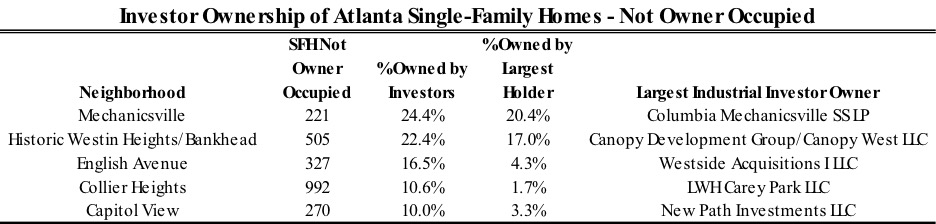
It is worth noting that three of the five neighborhoods highlighted by this analysis (Bankhead, Collier Heights, and Capitol View) are among the “Beltline” neighborhoods, communities adjacent to a major urban renewal project. The Beltline project has displaced many long-tenured homeowners in Atlanta, making their former homes available to large-scale landlord investors.
High Shares in a Neighborhood Are Consistent with Direct Evidence
Given the low investor shares at the zip code level (implying lack of pricing power), and given the high investor shares in certain neighborhoods, one can look to direct evidence of investors’ pricing power to resolve the dispute. If investors can be shown to inflate rents, then the narrower geographic market is consistent with the direct evidence of pricing power.
There is a large and growing literature demonstrating the inflationary effect of these types of institutional holdings on rental prices in local housing markets. A July 2020 working paper from St. Louis Fed economists investigated the effect of institutional investors —defined as “entities who purchase multiple housing units under the name of an LLC, LP, Trust, REIT, etc.” — on rental prices. The economists found that institutional investors increase the price-to-income ratio of rental properties, especially in the bottom price-tier. In an antitrust court, such evidence would be considered “direct” evidence of the pricing power of institutional investors, which obviates the need to define a market, estimate share, and infer market power through high market shares.
In another study of rental pricing, Watson and Ziv (2021) analyzed the relationship between ownership concentration and rents in New York City, finding that a ten percent increase in concentration is correlated with a one percent increase in rents. This finding suggests that policymakers should be concerned about concentration of ownership, regardless of whether concentration is comprised of institutional investors or smaller investors.
These findings importantly hold even when looking within individual neighborhoods over time. Using mergers of private-equity backed firms to isolate quasi-exogenous variation in concentration of ownership at the neighborhood level, Austin (2022) found that shocks to institutional ownership cause higher prices and rents. This finding suggests that the association between institutional ownership and higher prices isn’t merely selection bias (institutional investors happening to invest in hot housing markets).
Neighborhood Ownership Caps Make Sense
Although AEI and other housing concentration skeptics are correct that regulating corporate landlords is not a silver bullet to address the ongoing affordability crisis, their analysis and rhetoric understate the reality of housing investor ownership.
A landlord does not need to own one hundred properties in a state to contribute to the concentration of economic power. Corporate landlords target neighborhoods where homes can be purchased cheaply and rented out profitably because renters in that area have limited choices. These renters’ options are limited in part because this targeted approach creates market power in the neighborhood-level housing market.
Landlords, especially those owning many homes in a single community, are part of the housing crisis, especially in rentlined communities like Bankhead in Atlanta. Regulating the accumulation and exercise of market power will always be part of a holistic solution to market failure. Our analysis suggests that a modest cap on the share of rental properties in a neighborhood that a single investor could own—say, of five or ten percent—could weaken the grip of investors and give renters some much-needed relief.
In recent months, public attention has returned to a business practice that many consumers intuitively recognize as unfair and has provoked varying attempts to regulate: surveillance pricing. Investigations into Instacart’s grocery pricing, along with renewed scrutiny of algorithmic pricing by the Federal Trade Commission (FTC), have revived concerns that firms increasingly tailor prices to individual consumers based not on cost or competition, but instead on perceived willingness, or necessity, to pay.
The debate is often framed as a question of technology and fairness: Can algorithms responsibly personalize prices? Do data-driven pricing systems benefit price-sensitive consumers? Are these tools simply the next step in efficient market segmentation?
These questions miss a more fundamental issue of industrial organization. Surveillance pricing is not primarily a technological innovation; it reflects a lack of competition. The profitability, persistence, and coercive nature of surveillance pricing depend on the presence of market failures—especially high concentration, entrenched frictions, and severe information asymmetries. In genuinely competitive markets, surveillance pricing would be unstable and self-defeating. In oligopolistic ones, it becomes a powerful mechanism for extracting consumer surplus.
The rise of surveillance pricing therefore offers a diagnostic insight into modern capitalism: it reveals how concentrated markets transform data and algorithms into tools of consumer exploitation rather than competition.
A Familiar Pattern of Abuse
Surveillance pricing is not new. For more than a decade, journalists and regulators have documented variations of the practice. Ticketmaster’s “dynamic pricing” has transformed concert tickets into auctions that capture nearly all consumer surplus from the most devoted fans. Orbitz infamously offered more expensive hotel options to Mac users, assuming they were less price-sensitive. Staples and Target experimented with GPS-based pricing that charged more to customers situated close to their stores and far from competitors. A ProPublica investigation revealed that Princeton Review charged higher prices to users from ZIP codes with more Asian people.
What unites these examples is not merely personalization, but exploitation. These pricing strategies succeed by identifying moments when consumers are least able to walk away: emergencies, deadlines, emotional commitments, and logistical constraints. The algorithmic sophistication matters less than the underlying logic—using asymmetric information to extract maximum payment from captive demand.
Surveillance pricing relies on exploiting market frictions that are endemic to many modern consumer markets.
Stark information asymmetries mean that sellers now know vastly more about buyers than buyers know about pricing strategies. Firms collect data on browsing history, purchase patterns, location, device type, demographics, mouse movements, and even phone-battery life. Algorithms can infer “need points,” or moments of heightened urgency, such as last-minute flights for the funeral of a family member or late-night ride searches with a dying phone. Consumers, by contrast, have little-to-no visibility into whether a price is individualized, how much it differs from others’ prices, or which data triggered the increase.
Search costs further weaken consumer discipline. Comparing prices once meant driving between stores or walking through malls. Online commerce promised to eliminate these costs, but instead replaced them with digital equivalents: loading multiple sites, navigating opaque interfaces, deciphering bundled products, ascertaining the value of unique features of slightly differentiated offerings, and deciphering subtly differing seller policies through terms and conditions. Each additional click imposes friction that pricing algorithms exploit.
Switching costs compound the problem. Loyalty programs, termination fees, stored payment information, and personalized settings make leaving costly. Consumers must weigh the potential savings from switching against the time and effort already invested in a transaction: accounts created, finance and shipping details entered, digital cart configurations, product configurations, or accrued rewards. Even modest price discrimination can succeed when a consumer feels exhausted by the time, effort, and other sunk costs of conducting market research to make an informed decision to switch.
Learning costs also matter. Choosing a new grocery store requires learning a different aisle layout and where your items are located. A new clothing retailer might have different return policies that burden a customer’s usual practice of trying and returning apparel. In e-commerce, new sellers that a consumer has never heard of may require complex research to distinguish legitimate options from increasingly sophisticated scams that pose a constant threat of financial ruin and require only a single lapse in vigilance and judgment. These cognitive burdens all discourage switching even when alternatives exist.
Product differentiation and bundling further obscure value comparisons. Airlines package seats, bags, boarding priority, and insurance; travel sites bundle flights and hotels; retailers vary sizes, features, and subscription terms. Surveillance pricing thrives in environments where consumers struggle to identify a clear benchmark price.
Finally, in markets like airline tickets, the time gap between purchase and consumption, combined with the difficulty of resale, allows firms to identify inelastic demand. When a product is essential or temporarily critical, like food, last minute transportation, or attendance at an important family event, a customer’s willingness to pay increases dramatically. Algorithms need only detect necessity to capture more consumer surplus.
Why Concentration Is the Key Enabler
Even in a market with the frictions described above, surveillance pricing would be unstable without concentration. In a competitive market, a firm that raises prices for less price-sensitive customers would invite rivals to advertise uniform pricing and capture those consumers. Transparency and rivalry would discipline discriminatory strategies. Even the threat of such competition would deter firms from deploying surveillance pricing at scale.
Oligopolistic markets change the calculus. When a small number of dominant firms control most sales, each can reasonably expect rivals to follow suit rather than defect. The profits from mutual adoption of surveillance pricing outweigh the risk of lost customers when alternatives are limited. Any firm that refuses to participate risks retaliation: price wars with temporary below-cost predatory pricing, increased output, aggressive advertising, complex bundling, or loyalty programs designed to lock in consumers. In concentrated markets, the cost of defection is high, and conscious parallelism becomes the rational equilibrium.
Even in markets with some competitive fringe, dominant firms can deploy partial surveillance pricing. They may offer competitive prices to the most price-sensitive customers while charging inflated prices on niche or low-volume items to less elastic buyers. Or they may use competitive pricing on headline items to shape price perception while extracting surplus elsewhere. The result is higher overall margins without provoking meaningful competition.
At the extreme, a perfectly concentrated oligopoly using surveillance pricing could capture nearly all consumer surplus. In a frictionless, competitive market, the same strategy would drive customers away. Surveillance pricing therefore scales with concentration.
The Illusion of Pro-Consumer Benefits
Defenders of surveillance pricing sometimes argue that it benefits lower-income or more price-sensitive consumers by offering them discounts. This argument collapses under scrutiny.
For surveillance pricing to be profitable, total surplus extraction must increase, otherwise the scheme would be irrational. Discounts for some consumers are outweighed by higher prices for others. In practice, the “discounted” prices approximate what consumers would have paid in a genuinely competitive market, while the inflated prices represent pure extraction from those deemed able—or forced—to pay more.
This is not redistribution; it is maximal surplus extraction. The poorest consumers don’t gain new surplus. Everyone else loses it.
Surveillance pricing has expanded during an era of wage stagnation, declining labor share, rising markups, and elevated corporate profits. These dynamics have steadily reduced household purchasing power and slowed economic growth by suppressing aggregate demand, contributing to a host of social ills related to economic anxiety.
Retail competition once expanded consumer surplus through price matching, coupon honoring, and aggressive rivalry. These strategies once reflected a modicum of buyer power and informational symmetry. Sellers could not individually tailor prices based on personal data; competition disciplined margins.
Surveillance pricing represents a reversal of that equilibrium. It shifts power decisively toward sellers by weaponizing data in markets already tilted by concentration.
Antitrust Law and the Limits of Current Enforcement
While several state and federal legal regimes such as consumer protection, privacy, and anti-discrimination laws offer potential avenues for addressing surveillance pricing (as well as surveillance wage setting) with varying degrees of potential limitations, competition law faces some unique obstacles.
Surveillance pricing sits uneasily within existing antitrust doctrine. It often resembles collusive price-setting, but without explicit agreement. An algorithm or third-party data mining firm that pools competitively sensitive information from multiple competitors to help determine prices could, in theory, constitute an illegal hub in a hub-and-spoke conspiracy under Section 1 of the Sherman Act. But firms could theoretically avoid liability by independently customizing their algorithms and preventing them from using aggregated data from third-party brokers or directly incorporating competitor prices and data. Even independent pricing algorithms could lead to anticompetitive outcomes.
Efforts to prevent algorithmic collusion—such as the California bill banning the use of competitor pricing data—are directionally helpful, but incomplete. Even strictly siloed algorithms could infer market conditions, albeit imperfectly, through demand elasticity tests, purchase rates, cart abandonment, page views, and customer churn rates. Conscious parallelism, or competitors engaging in mutually beneficial common conduct without explicit agreement, remains lawful, and courts have long refused to punish firms for independently adopting strategies that are mutually profitable even when they produce consumer harms identical to cartel price fixing.
As a result, antitrust enforcement alone struggles to address surveillance pricing when it arises from ostensibly lawful parallel conduct rather than explicit price coordination in markets where lax merger enforcement failed to prevent the concentration levels that enable its success.
Mandating Disclosure as Critical First Step
A blanket ban on surveillance pricing would be the most direct solution, but it faces political and legal obstacles. Mandatory disclosure could be a promising first step and is already incorporated in some algorithmic pricing bills and being considered in others. Firms could be required to clearly inform consumers, at the point of sale, that prices may be individualized based on surveillance data. This mirrors the recent FTC rule on junk fees, which forced upfront price disclosure in travel and event markets. Once the entire market was covered, no single firm faced competitive disadvantage for transparency—and many began advertising “what you see is what you pay,” as a consumer-friendly feature.
A disclosure regime would not regulate prices or restrict business autonomy. It would restore informed consent and reduce buyer-side frictions. Ideally, by making discrimination visible, it could reactivate competitive market pressures and be a significant step in curbing its abuse.
A private right of action for violating disclosure could further enhance enforcement, reducing reliance on resource-constrained consumer protection agencies and regulators and allowing harmed consumers to police abuses.
Surveillance Pricing as a Structural Warning Sign
Surveillance pricing should be understood not as an isolated abuse, but as a structural warning sign. It thrives where competition has failed, where consumers lack meaningful alternatives, and where firms can safely exploit moments of vulnerability.
The core question is whether a business strategy that succeeds only by exploiting market failure should be allowed to persist at all. If surveillance pricing is profitable only in oligopolistic markets, then its spread is evidence—not of efficiency—but of the urgent need for stronger competition policy and market transparency.
In that sense, surveillance pricing does more than raise prices. It exposes the costs of having allowed so many markets to reach oligopoly levels of concentration in the first place.
Randy Kim is an assistant city solicitor for Philadelphia and a recent graduate of the University of Pennsylvania’s Carey Law School. The opinions expressed here represent those of the author and not those of his employer.
Price inflation has been the dominant economic concern for Americans in the post-Covid era. The rising prices of cars, groceries, and healthcare (especially given recent Congressional inaction) have all imposed increasing burdens on the average American. Despite the consistent price hikes for those items, all of them pale in comparison to the skyrocketing rental costs that Americans have endured since the pandemic. Per Harvard’s Joint Center for Housing Studies, a record 12.1 million renter households were spending at least half of their incomes on housing in 2022, putting them at increased risk of eviction and homelessness.
According to Zillow, rental prices have increased by more than a third since the pandemic, while the median household income has risen by only 22 percent. As the gap between earnings and rent prices widens, families are forced to stretch their budgets to afford shelter. In cities, these higher rental prices have forced families out of their neighborhoods in search of more affordable housing. The press and politicians have both acknowledged the affordability problem that has resulted from the recent housing crisis wave. Indeed, in September 2025, the U.S. Treasury Secretary Scott Bessent noted that the Trump administration was considering declaring a “national housing emergency” to address affordability.

So it was odd that The Economist last week sought to deny the reality that is in front of our faces. In a briefing titled “America’s affordability crisis is (mostly) a mirage,” the magazine asserts that “on the economics, Messrs Trump, Bessent and Duffy have a point” when they claim that the affordability crisis amounts to a “hoax” and a “con job.”
The Economist brings this same skepticism to the rental affordability crisis. A widely used industry rule-of-thumb is that rents are affordable so long as they account for less than 30 percent of a renter’s income. While acknowledging that “the squeeze for [home] buyers is real,” The Economist dismisses the concerns about rental affordability:
Until rates began rising in 2022, the average home in most counties was affordable by the 30% rule-of-thumb, even for buyers with only a 10% downpayment. Now, most are not (see chart 4). Homeowners who fixed their mortgages before rates went up have dodged this. The average rate on all outstanding mortgages is still only 4.3%, nearly two percentage points less than the average rate on new mortgages. Still, the squeeze for buyers is real. Rents, which are less directly affected by mortgage rates, are more affordable: the average in most counties is still below that 30% threshold. (emphasis added)
Whether The Economist intentionally aims to gaslight its readers or simply has not given the issue the requisite thought it deserves is unclear (we’ll generously assume the latter), but either way, this curious statistic does not support the claim that rents are generally affordable.
Lies, Damned Lies, and Statistics
Let’s start by ascertaining where The Economist likely came up with this figure. The exact methodology is uncertain, but Figure 4 in its briefing relies upon Zillow, The Census Bureau, FRED, and the Insurance Information Institute. Because Zillow’s Observed Rent Index only has information for a subset of counties in the United States, the magazine’s county-level analysis likely came from the Census American Community Survey (ACS). The ACS collects annual county-level data on rent prices, income, population, and other demographic variables. That gives us the exact information we need to kick the tires. Given this uncertainty, we use the 2023 American Community Survey 5-Year Estimates.
By comparing the median rental price to the median household income in each county in the 2023 ACS, we can replicate The Economist’s conclusion—namely, that “most” of the counties enjoy rents of less than 30 percent of income. There are at least two fatal flaws, however, with that analysis.
First, the number of counties is not the relevant unit of analysis. We want to analyze the cost of living for people. This mistake is akin to the misleading map of the United States showing which candidate won county, which ignores the fact that people vote, not land. Second, looking at the median household income understates the problem because it combines homeowners and renters into the same category. The median homeowner household has nearly double the income of the median renter household. Using the median renter’s income is a better estimate of how the usual renter is doing.
Adjusting the rental analysis to measure affordability using renter’s income and taking into account population gives a much different result: the median rent is affordable—that is, it is below 30 percent of income—for slightly more than a third of the population. The rental affordability issue shouldn’t be seen as a coastal problem affecting a handful of cities; it’s endemic across the United States. The figure below shows that just these two adjustments to The Economist’s statistic make a significant difference when measuring rental affordability. The first adjustment (measuring renter income rather than household income) brings the proportion of affordable counties down from 99.8 percent to 64.9 percent. A second adjustment, measuring the population in affordable counties (rather than naively treating all counties equally) shows that only 35.2 percent of the population lives in counties meeting the rental affordability threshold.
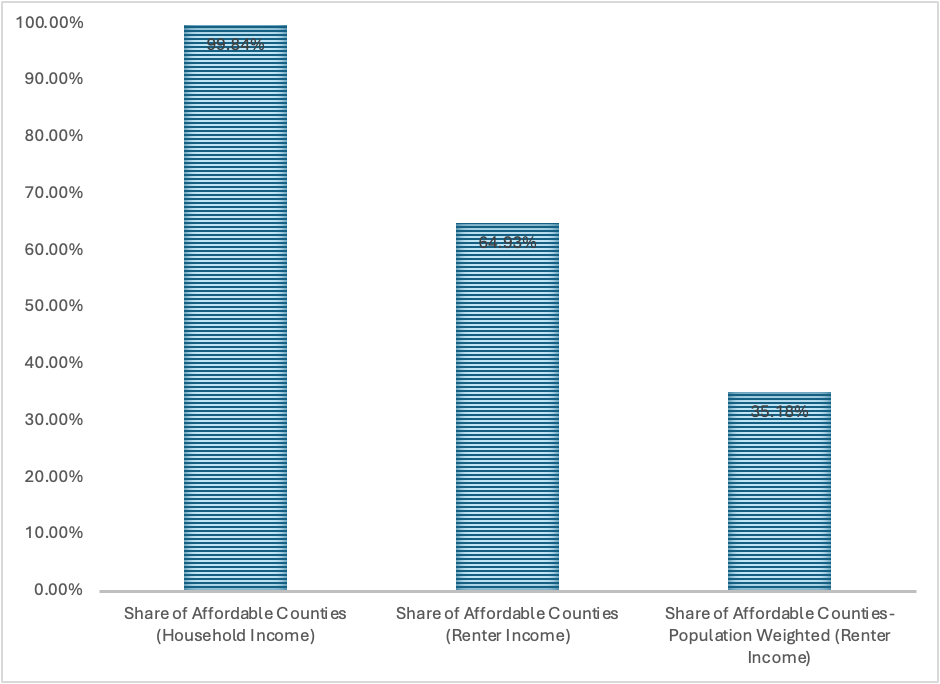
Source: 2023 American Community Survey 5-Year Estimates.
We cannot be sure whether The Economist’s “average-in-most-counties” statistic was based on the first or second bar; in any event, both overstate rental affordability. The extent of the affordability crisis can be verified using more recent 2024 ACS data. Among the 46.1 million renters recorded in 2024, 22.3 million renters (48.4 percent) paid 30 percent or more of their income on rent. Of these, 11.2 million renters paid half or more of their income on rent. Despite the assurances of the neoliberal magazine, the rental affordability crisis is real for millions of people.
Being Honest About The Crisis
As the saying goes, the first step to recovery is admitting you have a problem. We have a serious rental affordability problem in this country that demands real solutions. There has been much progress in recent years with rent control, zoning reforms, tenant protections, permitting reform, and antitrust action (such as against RealPage). Yet these are small victories that need to be built upon and extended. Ignoring the rental problem will only cause the overburdened renter to fall further behind.
Given the flimsiness of The Economist’s rental affordability figure and the stridency of its advocacy—the briefing reviewed here serves as supplement to last week’s cover story—one wonders why the editors of such an esteemed publication want to deny there’s an affordability problem. Presumably the corporatist class whose concerns The Economist seeks to assuage fears any interventions in the market to the solve the problem. One such intervention that’s rightfully gaining traction among economists is rent controls. Neale Mahoney and Bharat Ramamurti recently endorsed price controls, including for rents, in the opinion section of the New York Times, explaining that “Rent caps focused on existing units, combined with government investment in new housing and reforms to zoning, permitting and other land-use regulations, can protect tenants from rent spikes, while encouraging new construction to build the three to four million homes that economists believe we need to make up the shortfall in the housing supply.” Similar to climate-change deniers, if neoliberal economists deny the affordability problem, they don’t have to address it.
Warner Bros. Discovery (“Warner Brothers”) announced on Wednesday that it is poised to reject a takeover bid by Paramount, clearing the way for Netflix to acquire Warner Brother’s studio and subscription streaming platform, HBO Max. As shown in the figure below, lifted from The Economist, Netflix and Warner Brothers comprise the first- and fourth-largest streaming platforms based on third quarter 2025 global subscribers.
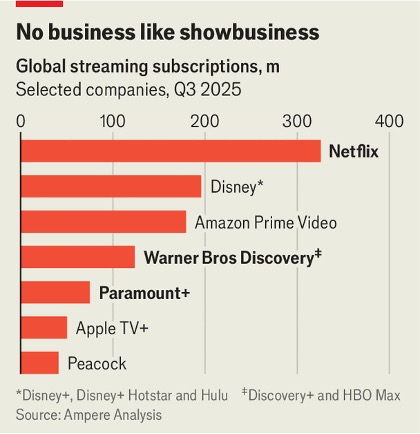
Hence, a merger between the two streaming platforms will further consolidate the industry, similar to Disney’s majority acquisition of Hulu in 2019. But that clear concentration of economic power didn’t stop The Economist from endorsing the merger.
Seemingly at the behest of Netflix, The Economist devoted one of its lead stories to bolstering the claim that Netflix and HBO Max compete for viewers’ attention with YouTube, which mostly offers long-form (around ten minutes), amateur, ad-supported videos; and with TikTok, which offers short-form (around 35 seconds), amateur, ad-supported videos, in a purportedly immense streaming market. Never mind that Netflix and HBO Max offer studio-produced, paid-subscription streaming services of series and movies that often last over an hour. The technical term for what Netflix and HBO Max offer is subscription video on demand (SVOD). And the technical term for what YouTube and TikTok offer is ad-supported video on demand (AVOD). After reviewing purported evidence of substitution between SVOD and AVOD, the neoliberal magazine concludes that “This new competitive landscape means that trustbusters should not rule Netflix out of the Warner race, as many in Hollywood argue. It may be dominant in streaming, but under the broader market definition it is a smaller actor.”
It’s the smallest set of services, stupid!
The question for the relevant antitrust market seems to elude many in the business press and on Twitter. To bring them quickly up to speed, we offer this brief tutorial: When defining a market, the inquiry turns on the smallest collection of services such a hypothetical monopoly provider of said service could profitably raise prices above competitive levels. This test is referred to as the hypothetical monopolist test (“HMT”). Start with a hypothetical monopoly provider of SVOD services. That’s right—one firm that controls all the streaming services listed in the above figure. Could a single SVOD provider with just those assets raise prices over competitive levels of say $10 per month? If the price increase is deemed unprofitable, then the market must be expanded to include nearby substitutes, with the test repeated. (For those who want a deeper dive, see the 2023 Merger Guidelines Section 4.3.A.)
It strains credulity that a hypothetical monopolist of all SVOD services could not raise prices above competitive levels, without also controlling YouTube and TikTok. To where might (say) a Netflix subscriber turn when the price of all of Netflix’s streaming substitutes (HBO, Prime, Apple TV, etc.) also increase? Presumably those paying subscribers would stay put. What The Economist would have you believe is that, when the price of all subscription streaming services increases, a substantial share of those customers would terminate their paid subscriptions and instead spend their time watching free, amateur, short-form and long-form videos. That those outside options are not even priced speaks volumes about the lack of price-discipline imposed by YouTube and TikTok on the SVOD services—that is, the amateur producers of these videos have to give away these services for free (ignoring the ads) as an inducement to watch their content. Indeed, if AVOD services constrained the prices of SVOD services, then why has Netflix been able to raise its subscription for standard and premium service by 29 percent and 39 percent, respectively, since 2020?
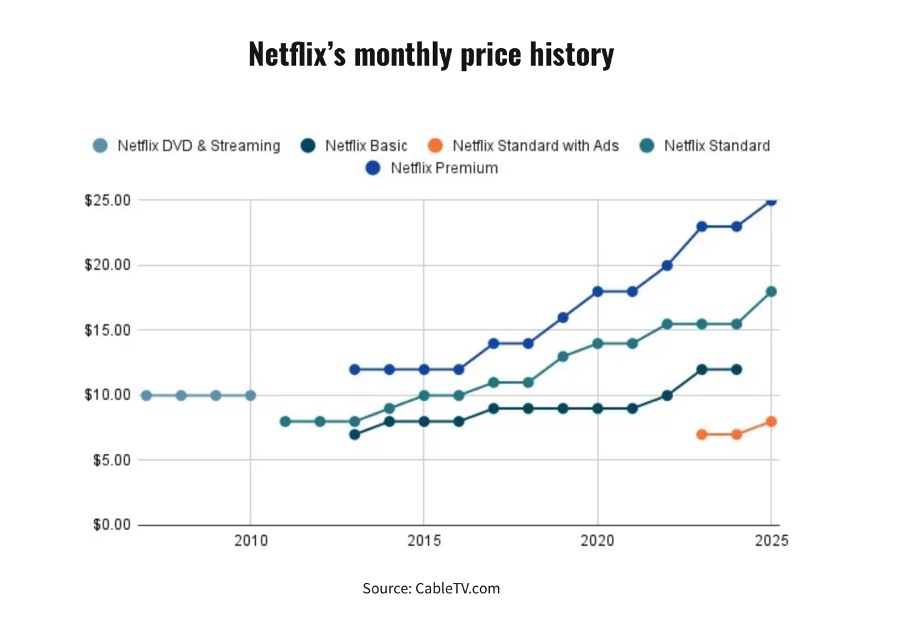
Of course, there are other ways to prove a market, such as by invoking the Brown Shoe factors. These are also known as “practical indicia” of a market, such as industry recognition as a separate economic entity, unique production facilities, or distinct prices. See the Merger Guidelines Part 4.3. By any of these standards, SVOD services are a relevant market. CNET, Esquire, Yahoo!Tech, and Consumer Reports maintain rankings of the best subscription streaming services, none of which include YouTube or TikTok. In March of this year, Netflix co-CEO Ted Sarandos reportedly described YouTube as being for consumers interested in “killing time” rather than “spending time” with professionally produced movies and shows. Compared to YouTube, co-CEO Greg Peters said Netflix is “playing a specific and differentiated role in the ecosystem.” The Intelligencer quotes a top agent saying that traditional streamers like YouTube and HBO Max “do things that YouTube can’t. There’s a good 50 to 60 percent of the audience that literally has never been on YouTube. When you make A Quiet Place, it goes into the Zeitgeist forever, whereas YouTube shows don’t seem to have long-tail resonance.”
With respect to the second factor, production of movies and series for SVOD services take place at professional studios, as opposed to the basement in some amateur’s home. And SVOD services are similarly priced—Netflix’s ad-free service starts at $17.99 per month, while HBO’s ad-free service starts at $22.99 per month—whereas YouTube, TikTok and other AVOD service are generally free.
We note that there is also YouTube Premium, which is essentially identical to YouTube, but with fewer to no ads. While such a service is closer to SVOD in its monetization strategy, it is still not a substitute for Netflix, HBO Max, or other SVOD services considering that YouTube Premium has the same content as ad-supported YouTube. Additionally, there is YouTube TV, which allows for live TV streaming and costs $82.99/month, and which also does not compete with SVOD services (as evinced by content differences between the two service types and by YouTube TV’s significantly higher price point relative to Netflix and HBO Max).
To play up the degree of substitution between SVOD and AVOD services, The Economist notes that “Americans spend longer watching YouTube on tv than on their phones. At the same time Hollywood is relying less on cinemas in favour of tv, and moving to even smaller screens.” That viewers increasingly watch both services on a tv doesn’t imply that the (free) AVOD service disciplines the price of the (paid) SVOD service. The Economist next argues that SVOD platforms are introducing ad-supported offerings, while YouTube is offering no-ad plans, further blurring the lines. So? While the ads can reduce the price of Netflix or HBO Max, the ad-supported price premium is still substantially above the free services of the shorter streamers. And that premium reflects a substantial difference in quality. Finally, The Economist notes some overlap in content across the two products, such as Amazon Prime offering a series starring YouTube’s biggest star (MrBeast), while social platforms are showing television-like content such as YouTube’s “Chicken Shop Date.” This modest overlap hardly constitutes evidence of how consumers of SVOD service would respond to a small increase in the price of their services.
The relevant output market is highly concentrated
Having defined the relevant output market as SVOD, the next task is to assess the degree of market concentration, both before and after the merger. To compute market shares, we used global streaming subscription data from The Economist (pictured above) for our initial analysis.
Table 1: Concentration Index of the Subscription Streaming Services Market
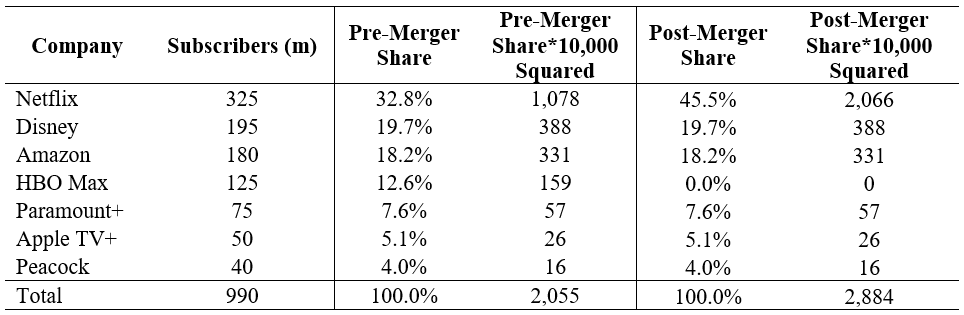
Source: Subscriber counts are from The Economist.
The pre-merger HHI is 2,055, which the 2023 Merger Guidelines consider “highly concentrated.” The change in HHI owing to the merger is 829 (equal to 2,884 less 2,055). The Guidelines explain that a merger in a highly concentrated market (pre-merger HHI over 1,800) that involves an increase in the HHI of more than 100 points is “presumed to substantially lessen competition or tend to create a monopoly.”
The Economist cites Ampere Analysis as the source of its subscription data, which we could not access. As a sensitivity check, we also used 2024 U.S.-based subscription data from Statista. The pre-merger HHI falls to 1,778, barely below the 1,800 standard for highly concentrated markets by the Guidelines. The change in HHI is 546 (equal to 2,324 less 1,778). Notably, the combined share of the merging parties using the Statista data is 34 percent. The Guidelines note that “a merger that creates a firm with a share over thirty percent is also presumed to substantially lessen competition or tend to create a monopoly if it also involves an increase in HHI of more than 100 points.”
Price effects in the market for subscription streaming services
One common method used by economists to estimate the anticipated price effects of a merger is referred to as a “GUPPI” analysis (which stands for “Gross Upward Pricing Pressure Index”). GUPPI analysis follows a simple economic logic—when a firm unilaterally increases price, some of its customers substitute away to its competitors. For instance, if HBO Max were to raise its price, then the law of demand would imply that it would lose some subscribers, with some proportion of these lost subscribers diverted to Netflix. If Netflix were to acquire HBO Max, then these diverted sales from HBO Max to Netflix would remain under the same corporate umbrella, thereby dampening the competitive price discipline that Netflix would have otherwise imposed on HBO Max (and vice-versa).
There are three inputs needed to estimate a GUPPI. First, one needs an estimate of the “diversion ratio” between the merging entities, which measures the proportion of customers a firm would lose to the merging entity if it were to unilaterally increase price. Economists routinely use market shares as a proxy for diversion absent having more detailed, firm-level data. Based on the figure from The Economist above, I estimate that Netflix has a 33 percent market share in streaming, compared to HBO Max’s 13 percent. The share-based diversion ratio from HBO Max to Netflix is therefore 37.6 percent (equal to 0.33 / [1 – 0.13]), and from Netflix to HBO Max is 18.8 percent (equal to 0.13 / [1 – 0.33]).
Second, one needs prices for the merging parties’ products. For our analysis, we use monthly base tier prices for each service. As of December 2025, the price of the Netflix base tier package with ads is $7.99/month, whereas the price of HBO Max’s base tier package with ads is $10.99/month.
Third, one needs an estimate of the merging partner’s economic margin. Economic margin is equivalent to the Lerner Index—it measures the difference between price and marginal cost as a percentage of price. As far as we are aware, the marginal cost for either of streaming service to produce an extra stream is likely close to zero. While these services incur fixed and quasi-fixed costs—most prominently, content costs for either acquiring or producing shows and movies—these costs do not change on a per stream or per user basis. We do not use gross accounting margins, which are sometimes used in place of economic margins, as gross margins are contaminated by the amortization of content costs and other fixed costs over time (which do not reflect true marginal cost in an economic sense). For illustrative purposes, we assume that both platforms’ marginal costs equate to 10 percent of their revenues, which we think is a conservative estimate, thereby implying an economic margin of 90 percent (equal to [1 – 0.1] / 1). More precise information on the merging parties’ economic margins can be obtained via discovery.
The GUPPI for Netflix under a Netflix-HBO Max merger can be calculated as:

where DR_NF->HBO is the diversion ratio from Netflix to HBO Max, M_HBO is the economic margin for HBO Max, and P_HBO / P_NF is the ratio of HBO Max’s base tier monthly price to Netflix’s base tier monthly price.
The table below provides estimates of GUPPIs for both streaming services under the hypothetical merger. It bears noting that GUPPI is a pricing pressure index, but it does not necessarily equate to actual price changes—although the index can often approximate price changes under certain conditions as specified by Miller et al. (2016) and Koh (2025). Generally, antitrust authorities are concerned with GUPPIs greater than 10 percent. For both Netflix and HBO Max, we estimate GUPPIs in excess of 23 percent. These high GUPPIs raise significant alarm as to the potential for this merger to harm consumers, by allowing both platforms to charge higher prices.
Table 2: Gross Upward Pricing Pressure Indices (GUPPIs) Under Netflix-Warner Bros. Discovery Merger
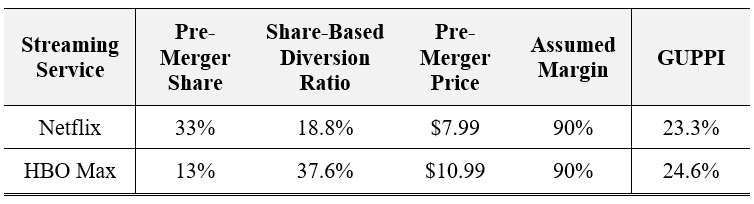
To put into context, in the proposed Penguin Random House-Simon & Schuster merger that was blocked by a judge in 2022, the DOJ’s economist estimated GUPPIs of 3.7 percent to 7.4 percent (note that these GUPPIs correspond to percentage reductions in author compensation as opposed to here, where they represent increases in output market prices). In a 2020 FTC merger case involving consolidation in the hydrogen peroxide industry (FTC v RAG-Stiftung, which involved an output market GUPPI analysis similar to here), the FTC’s economist estimated GUPPIs of 5.5 to 13.2. Any efficiency justifications that Netflix and Warner Bros. Discovery may proffer here are almost certainly outweighed by the magnitude of the upward pricing pressure implied by our estimates.
Not to mention the harms in the labor market
It bears noting that the above results speak only to merger-induced price effects in the output market for streaming subscriptions. They do not address wage effects in the labor (input) market, which tend to be harder to estimate absent detailed, firm-specific data on substitution patterns of talent.
Going back to the book publisher merger, the DOJ’s economist used data on market shares and profit margins to estimate the effect of the merger on author advances using what is referred to as a second-score auction model (for books that acquired an advance of at least $250,000). In this model, the highest-bidder must only bid slightly above the second-highest bidder to win the auction. Such a model finds harm when the two merging parties would otherwise be the first- and second-highest bidders—in such a scenario, the merging party must only pay slightly above what would otherwise have been the third-highest bidder absent the merger. The DOJ’s economist also applied variants of GUPPI tailored towards assessing price effects in an input market (rather than an output market), and towards the market involving auctions. Similar methods could be tailored towards assessing the Netflix-Warner Brothers merger’s effects on streaming market input providers.
There are notable reasons to be as concerned with this merger with respect to its effects on actors, directors, producers, and other input providers in the production of professional long-form streaming movies or series. Netflix and Warner Bros. Discovery both represent major buyers of high-budget films and series in a market with only a handful of meaningful competitors. For directors and producers (and the actors and other input providers they otherwise employ), a greater number of studios implies a greater number of buyers to which input providers can sell their content. Fewer studios available with which to negotiate would mean less competition, driving down compensation for input providers (as was the case in the book publisher merger).
In summary, the proposed Netflix-Warner Brothers mashup is an audacious deal that would be challenged under most administrations. That Netflix is even attempting a horizontal merger in such a concentrated market suggests that its management believes that the Trump administration will not be faithful to merger law or the 2023 Guidelines. As consumers of these services, we can only hope that Netflix has miscalculated.
Amazon Prime Day and Black Friday have become de facto national holidays of impulsive shopping, ostensibly offering a bevy of “great deals” to tempt consumers. A flood of media articles accompany this celebration of capitalism that masquerades as an event worthy of news coverage. Legions of outlets receive compensation from Amazon in exchange for driving traffic to its platform, often by offering “advice” on the best bargains to snag (e.g. CNN Underscored).
But, as some have already noticed, those advertised promotional discounts can be a mirage and often offer higher price than those regularly found throughout the year. Rather shockingly, even an article on the Washington Post, which Amazon founder Jeff Bezos owns, acknowledged this, with the author explaining that “I would have saved, on average, almost nothing during Amazon’s recent fall “Prime Big Deal Days”—and for some big-ticket purchases, I would have actually paid more.” Even so, Prime Day 2025 was Amazon’s biggest ever, with record sales and volume.
In the past few months, I took a deep dive into algorithmic pricing, the machine learning methods used, as well as various case studies, including how repricers work in conjunction with Amazon’s Buy Box to raise prices. Repricing algorithms on Amazon and their interaction with Buy Box rotation indicates that focusing exclusively on common pricing algorithms misses the risk of industry-wide algorithmic standardization. Even though sellers on Amazon can use various repricing providers and even though they may not share competitively sensitive information, the outcomes on Amazon still reflect supra-competitive prices, similar to those achieved from explicit coordination.
Price discrimination is just the tip of the iceberg
Recently, an investigation by the Institute for Local Self-Reliance (ILSR) found that school districts paid widely varying prices for the same products often on the same day, a practice known as price discrimination. While the report focused on schools specifically, businesses that purchase on Amazon should pay attention as well. Segmenting business purchases from those made by consumers is an example of third-order price discrimination.
Employees making purchases for their employer may be less price-sensitive than when making purchases for themselves, allowing Amazon to charge higher prices to the former. Those higher prices eventually get passed on to those businesses’ own consumers, adding to inflationary pressure. Those advocating for lower interest rates would do well to concern themselves with such pricing practices.
The ILSR report attributed the pricing variance it found to Amazon’s opaque dynamic pricing algorithm, the details of which I want to address here. Millions of sellers market their products on Amazon so, of course, one might think that the pricing discipline they (should) exert on each other would result in competitive prices for consumers. After all, as the Lending Tree commercial reminds us, “when banks compete, you win”. So, why aren’t consumers really winning? Why are prices going up?
In my new paper, I discuss the role of algorithms in pricing as well as the various machine learning tools used to implement them in various industries, including E-commerce, hospitality, airlines, real estate, and others. I also talk specifically about pricing on Amazon, which involves the relationship between rules-based and machine learning algorithms.
How repricers’ algorithms interact with Amazon’s Buy Box
On this topic, there’s another factor at play that has flown comparatively under the proverbial radar: the role of Amazon repricers’ respective algorithms and how their interaction with Amazon’s “Buy Box” algorithm enables successful price hikes. Repricing refers to the process of dynamically changing the offer price according to various guidelines. Many companies such as Repricer.com, BQool, Seller Snap, Flashpricer, and Amazon’s own Automate Pricing repricer offer this service.
The Buy Box, now called the “Featured Offer” on Amazon, refers to the box that appears on the right of an Amazon page prominently, displaying the price and shipping details for the seller who currently holds the Buy Box for this product. To see other competing options, a consumer needs to click on “Other Sellers on Amazon,” which appear on a pop-up page.
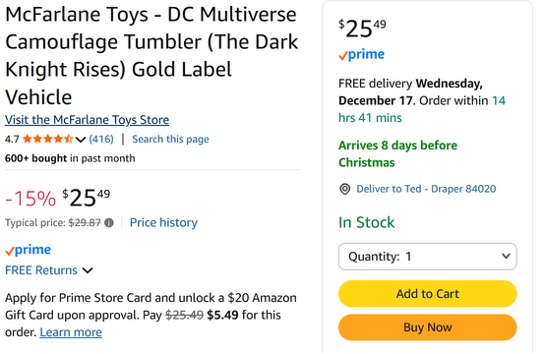
Not every seller is eligible for the Buy Box—Amazon imposes various eligibility criteria, including prioritizing its own delivery service, Fulfillment by Amazon (FBA) over Fulfillment by Merchant (FBM), conduct that prompted an investigation by the European Commission.
Needless to say, the vast majority of purchases, around 80 percent, occur though the Buy Box, which is why sellers want to secure it. Eligibility criteria also matter, because eligible sellers can choose not to compete at all with sellers of the same product, such as those that do not qualify for the Buy Box. So, that seemingly vast landscape of competitors just got smaller. And note that we’re talking about two different types of algorithms that work in concert: Amazon’s algorithm to determine the Buy Box winner and the repricing algorithms that sellers use to set prices.
Repricing on Amazon offers a particularly interesting case study of algorithmic pricing because (1) sellers can use different repricers, (2) repricers can use different algorithms, AI-based (i.e., machine learning), simple rules-based algorithms (e.g., if-then-else statements), or a combination of both, and (3) though sellers can obtain their own data and limited competitor information using the Amazon SP-API, (e.g., though the getcompetitivesummary call), no obvious sharing of competitively sensitive information occurs. In other words, the conditions that have garnered the most focus in algorithmic pricing cases such as the RealPage litigation and Gibson v. Cendyn, do not seem to apply here (at least with repricing).
And yet, these repricers openly advertise that their products seek to “avoid price wars” and “look to raise prices 24/7” after their client seller acquires the Buy Box, which one would expect they could only obtain if they were the lowest price offer and would immediately lose upon raising the price.
Not quite. As BQool advertises, its algorithm (in the third bin pictured below) “matches the Buy Box price then increases the price to capture greater profits.”

Hold on, you say. If you raise the price after you get the Buy Box, would you not lose it immediately to a lower priced seller? After all, that’s how competitive markets work—a given seller is a price taker not a price setter, and any attempt to raise the price would result in losing sales to rivals.
Not in this case. Repricers can adopt similar strategies (e.g., “avoid price wars” and “raise prices at every opportunity,” including setting similar floor prices, ignoring each other’s pricing, slowing reaction time (a time delay), and “match but do not undercut.” In other words, repricing algorithms can tacitly collude without any explicit coordination by mutually recognizing each other’s strategy, a process known as “cross-platform recognition.” For example, observing that a seller alters its price every 15 minutes would suggest the use of a repricer.
Simply put, the issue isn’t so much that sellers on Amazon use a common pricing algorithm (though many sellers use one or more repricers), but rather that they use repricers that adopt common strategies based on a common knowledge structure, without directly coordinating. This reflects industry-wide algorithmic standardization. If algorithms settle on a common standard, collusive outcomes can occur even if no obvious rim to an alleged “hub-and-spoke” conspiracy exists. A bevy of research, which I review and describe in my paper, has already observed the same collusive outcomes with Q-learning algorithms (a type of algorithm that falls under reinforcement learning).
Focusing solely on common algorithms can create a tunnel vision that misses other conditions in which algorithmic pricing can harm competition and raise prices. Building a modern-day Maginot Line against the use of common algorithms may accomplish little to defend competition if sellers can outflank it through industry-wide algorithmic standardization.
How tacit coordination occurs
But wait, you say, if Seller A holds the Buy Box, wouldn’t Seller B still have some incentive to undercut Seller A’s price to secure the Buy Box for itself? Otherwise, how does the Buy Box change hands?
This is where the coordination that Amazon’s Buy Box rotation algorithm effectuates comes into play. With rotation, Amazon gives the Buy Box to one seller for a period of time, say two hours, then rotates to another similar seller for the next two hours and so on. Rotation allows sellers (even at slightly different prices) to adopt a “wait my turn” strategy and share the Buy Box rather than aggressively competing for it. The seller holding the Buy Box knows when it can profitably raise the price incrementally without being undercut, and the other sellers that use repricing algorithms have little incentive to undercut the price because they will get their turn to sell at the same higher price.
Basic game theory can illustrate the payoff scenarios here. Suppose Seller A has the Buy Box and prices at $12.50. Without rotation, Seller B cannot simply match, it must undercut to get the Buy Box. This will prompt A to respond in turn by undercutting B, resulting in a price war (the bottom right box in the “Without Rotation” scenario). This is the sort of aggressive price competition that would benefit consumers.
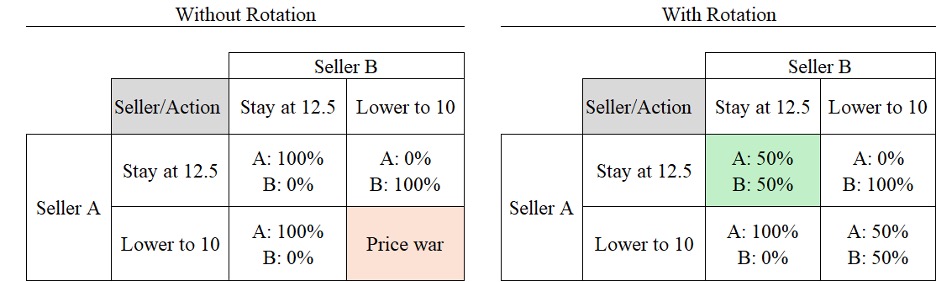
With rotation added, however, the incentives change. Seller B knows that by matching A at $12.50, it will eventually get its share of time with the Buy Box. So B doesn’t undercut A, and the price stabilizes at $12.50 (upper left box in the “With Rotation” scenario”). So, both Sellers A and B have the incentive to explore upward, not downward pricing scenarios.
Repricers themselves say as much, advertising that they look to raise prices 24/7. Here’s Flashpricer saying exactly this.
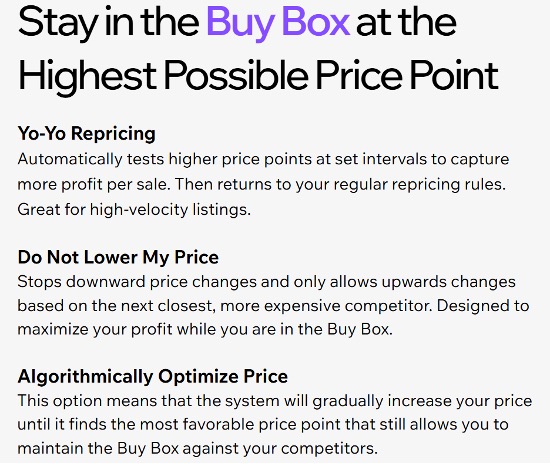
And here’s Sellersnap echoing it.

And here’s a case study from marketing agency BellaVix, titled “Successfully raising price while retaining the Buy Box,” that discusses how “A premium skincare brand selling on Amazon faced challenges when attempting to raise the price of their best-selling Crepe Repair Cream from $59.99 to $79.99” (a 33 percent price increase!).

And here’s how BellaVix describe its strategy to overcome those challenges and successfully raise the price to $79.99.
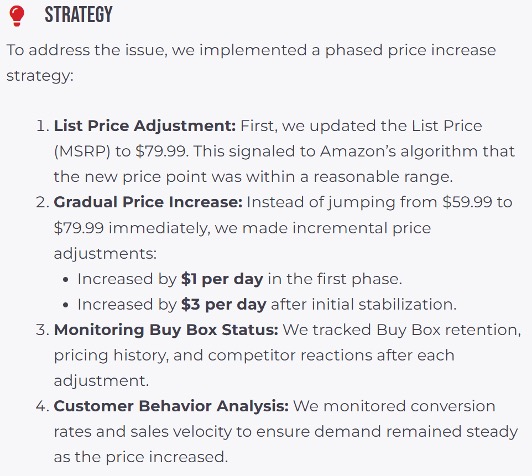
Note that BellaVix first changed the list price, which provides an anchoring effect, not only for consumers but also for Amazon’s algorithm. This move also exploits information asymmetries between the seller and buyers, well discussed in the literature. Such asymmetries result in a market failure, where the price no longer reflects the true market value of the product. Then, BellaVix gradually raised the price, exactly the process that rotation enables and that repricers openly advertise.
In my paper, I discuss the concepts of information asymmetries and anchoring and the latter’s effects on accepting or rejecting price recommendations from algorithms. Perhaps rather shockingly, BellaVix successfully raised the price by 33 percent without losing the Buy Box entirely (though the Buy Box likely rotated), offering a practical example of the strategy I described above.
But, you say, a shopper can just switch to Walmart to avoid the repricers. Sorry, repricers such as Flashpricer, which advertises “AI-powered algorithms for every competition scenario and business model that look for opportunities to raise prices 24/7,” as well as Streetpricer, which “Checks if we still hold the BuyBox after each price increase – backtrack if necessary” are there as well. In fact, repricers are ubiquitous across various platforms, such as Airbnb, Vrbo (e.g., PriceLabs) and others, not just e-commerce.
Bad AI risks driving out the good
Nothing discussed above means that prices always rise. Nor do they need to do so for anticompetitive harm to occur. Remember, the benchmark isn’t whether prices go up or down in the absolute sense, but rather relative to the competitive benchmark. Prices may fall in the absolute sense if, for example, a new entrant unfamiliar with the tacit agreement qualifies for the Buy Box and begins exerting some pricing discipline. Moreover, just because competition occurs in some cases on Amazon does not offset the anticompetitive conduct or render it trivial. After all, not everyone gets lung cancer after smoking, but we still warn against its dangers.
Of course, firms employ algorithms for various beneficial uses, such as identifying fraudulent sellers or counterfeit products. As such, anticompetitive uses of pricing algorithms has another harmful effect—nefarious uses of artificial intelligence can drive out the beneficial ones, an outcome known as Gresham’s Law that occurs through adverse selection.
Much of the problem here results from information asymmetries, both between sellers and buyers and between regulators and algorithmic pricing providers and the platforms on which they occur. Many machine learning algorithms that power AI are “black boxes,” such as neural networks, ensemble models like boosting, random forests, and so on. Having a rudimentary understanding of such algorithms goes a long way toward protecting against anticompetitive consequences they might cause.
Moreover, as this article shows and my paper discusses in some length, harm to competition can occur even using simple rules-based pricing algorithms from independent providers and even in the absence of sharing competitively sensitive information. The old Latin saying caveat emptor (buyer beware) has perhaps never been more poignant than in this dawning age of algorithmic pricing.
Common pricing algorithms can be used to coordinate prices among sellers, to the detriment of buyers. RealPage is the seminal case, but there are (alas) plenty of others. The problem is particularly acute in a two-sided transactional platform setting, where the platform influences—and sometimes coerces—the pricing decisions of its sellers.
Take the case of Airbnb. Even before considering its “Smart Pricing” tool aka common pricing algorithm (discussed below), Airbnb inflicts tremendous costs on society. The short-term rental platform keeps rents artificially high by converting capacity for long-term (e.g., monthly or annual) rentals into short-term (e.g., daily) rentals. When the supply of long-term rentals artificially contracts, holding demand for apartments fixed, rents zoom upwards.
And high rents keep residents from spending money on other things—a drag on economic activity—and even contribute to homelessness for those who are priced out of the rental market entirely. According to a study by Harvard’s Joint Center for Housing Studies, a record 12.1 million Americans in 2024 were spending at least half of their incomes on rent and utilities, putting them at increased risk of eviction and homelessness.
Economists have studied the inflationary impact of Airbnb on rents. Calder-Wang (2021) found that the presence of Airbnb in New York leads to a transfer from renters to property owners of $200 million per year or $2.7 billion in net present value. Barron, Kung and Prospero (2017) found that a one percent increase in Airbnb listings leads to a 0.018 percent increase in rents; in aggregate, the growth in home-sharing through Airbnb contributes to about one-fifth of the average annual increase in U.S. rents. Seiler, Siebert, and Yang (2022) found that Irvine’s short-term rental ban reduced contract rental prices in the long-term rental market by 2.7 percent between 2018 and 2021. (Airbnb consultants point to evidence that Airbnb puts downward pressure on hotel prices for travelers, but absent some redistribution mechanism, that purported benefit to out-of-towners cannot offset the harms to local residents from higher rents.)
To bring down rents, Barcelona recently moved to end licenses for Airbnb homes, requiring owners by 2028 to offer them as long-term lodging at capped rents or put them up for sale. Closer to home, since September 2023, New York imposed a requirement that hosts must be present for stays under 30 days, and limited guests to two, reducing available listings on Airbnb. Similarly, in Santa Monica, the host must be present during the guest’s stay and unhosted rentals are banned, and Las Vegas bans non-owner-occupied short-term rentals. New Orleans banned Airbnb rentals in the French Quarter.
Airbnb’s “Smart Pricing” tool
Converting housing into short-term rentals is not, on its own, a cognizable violation of the antitrust laws, notwithstanding the clear price and output effects. What is cognizable, however, is price fixing, or the coordination of pricing strategies and output between horizontal rivals. Here the horizontal rivals are homesharers in the same geographic market. And while evidence of an illegal agreement to fix prices is typically challenging to detect—after all, minimally savvy competitors are unlikely to leave breadcrumbs that trace back to illegal behavior—Airbnb has at least invited homesharers on its platform to participate in one such conspiracy.
Here’s how: Airbnb offers homesharers on its platform a tool called “Smart Pricing,” which is an internal pricing algorithm that automatically updates homesharers’ listing prices. Hosts can opt in to Smart Pricing and set certain parameters, including minimum and maximum prices, then Smart Pricing does the rest by pinning prices to the “competitive” price. Of course, “competitive” is a misnomer to the extent prices are no longer a function of independent price setting among homesharers, but instead an automated prediction by the algorithm of what the market will bear.
The primary harm from Airbnb’s Smart Pricing tool is inflated rents that flow from a price-fixing conspiracy. Airbnb’s Smart Pricing tool also raises concerns regarding price discrimination, as it not only considers the features of the property and economic conditions, but also the characteristics of the guests themselves—for example, Airbnb acknowledges that Smart Pricing considers guest behavior in its algorithm. While maximizing the quality of the guest experience is a worthy goal, exploiting information asymmetries to extract supra-competitive prices can evince a market failure. Alas, the antitrust laws generally condone price discrimination. (For a great example of price discrimination achieved via algorithm aka “surveillance pricing,” check out Groundwork’s recent study of Instacart, another online platform that sets prices for sellers such as Target and Safeway.)
While Smart Pricing offers homesharers a convenient tool for managing their prices, Airbnb’s interests may not be aligned with the interests of homesharers. Some hosts have expressed frustration at the Smart Pricing algorithm for automatically pinning prices to the high end of their price range. Other hosts have complained that applying additional “rule sets” to their properties kicks them out of the Smart Pricing tool, creating friction for hosts who otherwise prefer to automate their prices. In other words, Airbnb’s Smart Pricing tool betrays a conflict of interest, and what’s good for the platform may not be, in the end, what’s good for individual homesharers. Insight into where precisely a listing will be ranked is limited because Airbnb’s recommendation algorithm is private. For example, the algorithm might punish non-adopters of the Smart Pricing tool by lowering their placing on the results page.
Airbnb incentivizes use of its Smart Pricing tool by telling homesharers that setting a “competitive” price helps improve a property’s ranking in search results. And the easiest way to set a “competitive” price without “constantly monitoring it”? Well, by using Airbnb’s Smart Pricing tool, of course. Want to automatically change your price in response to “travel trends” in your area? Turn on Smart Pricing.
Even when a homesharer declines Smart Pricing and elects to use its own pricing algorithm, doing so does not extinguish the concern of inflated prices. The economics literature recognizes how independent algorithms can learn to collude with each other by avoiding price wars. Moreover, the mere existence of a default option establishes a price floor around which all other prices are established.
If not dispositive of an illegal price fixing scheme, these facts provide at least circumstantial evidence that Airbnb is coercing homesharers into adoption of its price coordination tool, including by withholding access to consumers through search page rankings. If so, both Airbnb and participating homesharers may be on the hook.
An unwelcoming legal environment
Companies across a large swath of industries, from meat processing to hotels to real estate, are increasingly using common algorithms to set prices—and facing federal enforcement actions for doing so. Despite a defendant-friendly legal terrain, many of these arrangements have been challenged by either private or public enforcers. In large part, these cases focus on the exchange of competitively sensitive, often non-public, information between competitors, from which courts have begun to infer the existence of an illegal agreement. Self-styled “revenue management” or price- and rate-setting services like RealPage or Yardi in the rental housing industry, Cendyn in the hospitality industry, or Agri Stats in the poultry processing industry, have in recent years defended themselves against protracted litigation alleging their facilitation of these information exchanges. (Disclosure: I served as the economic expert for plaintiffs in two Agri Stats cases.)
That the DOJ recently settled its litigation with RealPage on decisively unfavorable terms suggests an unfriendly legal terrain. (Alternatively, it could reveal the subversion of law enforcement by a politicized agency.) And if there was any doubt about the steep evidentiary hurdles faced by plaintiffs, one needs only look at a strange and economics-free decision in the Ninth Circuit.
The Ninth Circuit’s decision in Gibson v. Cendyn reveals a basic misunderstanding of the economics of pricing. To dismiss any vertical relationship between Cendyn and its hotel clients, the Court claimed that “While hotels may use Cendyn’s revenue-management software to maximize profits, the software is not an input that goes into the production of hotel rooms for rentals.” (emphasis added) Yet the revenue-management software is precisely an input in the selling of hotel rooms, the output that forms the relevant product market (not producing or constructing hotel rooms from scratch). While hotels could technically function without it, the common pricing tool improves a hotel’s ability to extract additional surplus from their guests in the sale of the relevant product (again, not constructing hotel rooms).
The Cendyn decision also asks, “Why don’t the independent choices of Hotel Defendants to obtain pricing advice from the same company harm competition, as alleged here? Because here, obtaining information from the same source does not reduce the incentive to compete.” Yet the entire purpose of a common pricing algorithm is to reduce the incentive to compete unilaterally. If firm A knows that its rival, Firm B, is going to default to the joint profit-maximizing price as determined by the common pricing algorithm, it is in Firm A’s interest to mimic that price and not undercut it. In this sense, the algorithm facilitates a coordinated monopoly outcome that would not be as easily achievable in its absence. And for many common pricing algorithms, the clients are further incentivized to accept the recommended pricing for fear of being disappeared in search results.
The Cendyn decision also identified the sharing of competitively sensitive information as a key ingredient that enables collusion. This is also wrong as a matter of economics. Turning over one’s pricing authority to a common agent—whether a dude named Bob or an AI-based algorithm—increases the chances of reaching the monopoly price relative to a world in which companies make independent pricing decisions. This is true even when information about a rival’s costs or capacity is commonly known. Can firms in an oligopoly setting with complete information feel their way to the monopoly price in a repeated setting? Perhaps. But at least with independent pricing, there’s a chance that your rival will undercut your inflated price to gain share. And that threat tempers one’s enthusiasm to raise prices. Once rivals agree to turn over pricing to a common agent, however, that threat is extinguished. (This is not to say that sharing of confidential information isn’t a viable pathway to a finding of liability. It just shouldn’t be a necessary condition. In any event, homesharers are likely sharing confidential information with Airbnb, including the number of days for which the seller plans to occupy her home.)
That’s enough of the economics. For a nice explainer on the legal flaws in the panel’s decision, check out this brief by the American Antitrust Institute (AAI), urging the Ninth Circuit Court of Appeals to grant rehearing en banc. By insisting on a causal link between the licensing agreements and a restraint in the relevant market, AAI’s brief explains, the panel confused proof of an agreement with proof of the agreement’s anticompetitive effects. The brief also explains how the decision conflicts with Board of Trade of the City of Chicago v. United States, 246 U.S. 231 (1918), by creating a new category of agreements not subject to rule-of-reason analysis.
The case against Airbnb
Common pricing algorithms, like Airbnb’s Smart Pricing tool, can erode the fair functioning of markets when they deprive competitors of their independent decision-making authority. In a well-functioning competitive market, a series of (ideally, atomistic) suppliers would set their price independently. But when sellers can coordinate their prices, it is easier to move from a competitive output to something that approximates the monopoly outcome. Despite the propensity for market distortion, enforcing the antitrust laws against common pricing algorithms may prove challenging absent additional circumstantial evidence of an acceptance of that invitation to collude.
Airbnb’s facilitation of pricing decision among horizontal competitors should be assessed under the per se standard, which eliminates any consideration of efficiencies and obviates the need to establish market power. If assessed under the more burdensome rule-of-reason standard, plaintiffs would have to establish that Airbnb has market power, either directly, via evidence that it has the power to raise prices over competitive levels, or indirectly, via evidence that it commands a high share of a relevant product market. Empirical evidence that Airbnb’s smart pricing algorithm has led to higher short-term rents on the platform would suffice for direct proof. Regarding indirect proof of Airbnb’s power, per one estimate, Airbnb commands 43 percent of the U.S. market for online travel agents (aka short-term rentals), with Vrbo and Booking.com occupying significantly smaller shares. This estimate includes “direct bookings” in the relevant market, however, which arguably do not provide the same services as Airbnb and thus could plausibly be removed from the market, resulting in an even higher Airbnb share.
Airbnb isn’t just facilitating a data exchange; it is incentivizing or coercing homesharers on its platform to participate in a common pricing scheme. A coercion-based approach to enforcement should obviate the need to provide heightened evidence of acceptance, because participation in the scheme is a condition of a participation on the platform. Platforms wielding access to non-price business services, like advertising or market research services, on the condition that sellers accept price recommendations deprives sellers of their independent pricing authority. Airbnb’s “Smart Pricing” tool coerces their participation in a price-fixing cartel. With luck, the authorities are watching.
On November 18, the Federal Trade Commission (FTC) lost its landmark case against Meta over its acquisition of Instagram. The opinion was issued by Judge James Boasberg. The FTC spokesperson commented to the press decrying the loss as is usual agency practice. But the whole statement was far from usual. FTC spokesperson Joe Simonson told the press: “We are deeply disappointed in this decision. The deck was always stacked against us with Judge Boasberg, who is currently facing articles of impeachment. We are reviewing all our options.” This attack on Judge Boasberg aligns the FTC’s leadership with the partisan attacks on Judge Boasberg emanating from the Trump administration and its supporters.
I will not focus on the substance of the Meta case—Tim Wu has treated that subject well in the New York Times and on The Sling’s podcast. Instead, I would like to focus on how the FTC has chosen to describe Judge Boasberg and the destructive impacts that choice could have on the FTC.
To my knowledge, the FTC has never issued a statement like this impugning a federal judge’s neutrality. Doing so when there is no evidence of such a bias would always be reprehensible. But to make such a claim against Judge Boasberg is particularly counter-productive.
The FTC does not even attempt to suggest why Judge Boasberg would be biased against the agency in its statement. That is likely because the FTC’s leadership believes no such thing and is merely joining the right-wing criticism of Judge Boasberg for ruling against the administration. Because there is no substance to these allegations, I will concentrate on why attacking Judge Boasberg is counter-productive.
Judge Boasberg has served as a judge on the District Court for the District of Columbia, known as DDC for short, since 2011 and has served as Chief Judge of the district since 2023. He is one of the most highly respected district judges in the United States. Moreover, as chief judge, he is responsible for the administering DDC’s operations. He also represents his colleagues on DDC at the Judicial Conference, the policymaking body of the federal courts. In the past five years alone, he has been the assigned judge in four FTC antitrust cases according to Westlaw.
But more important than anything about Judge Boasberg specifically, DDC is the most important district court to the FTC. As the FTC’s home district court, the agency litigates in DDC more often than any other district. This year, the FTC has six cases in DDC. In the last five years, the agency has had 37 cases before the court. The other judges on this court are almost certainly paying attention to the insults the FTC chose to bestow on their colleague and chief judge.
This childish statement by the FTC therefore jeopardizes not only the agency’s credibility in front of a prominent district judge but also its credibility with the most important district court to the agency.
But it is not FTC leadership that will pay the price for this choice. The career attorneys who must litigate these cases will have their hard work put on the line because Chair Ferguson wanted to score political points with President Trump.
The FTC has a deep store of credibility with the bench. FTC attorneys are careful, professional, and deliberate in how they litigate cases. But credibility is easy to burn and hard to earn. And with each unprofessional, craven political stunt Chair Ferguson pulls with the FTC—from investigating Elon Musk’s political opponents to threatening Google over allegedly “partisan” email filtering to this attack on Judge Boasberg—Chair Ferguson burns the FTC’s credibility. Regardless of one’s views of Judge Boasberg’s Meta ruling, antimonopoly advocates should denounce this statement by the FTC.
Bryce Tuttle is a student at Stanford Law School. He previously worked in the office of FTC Commissioner Bedoya and in the Bureau of Competition.