
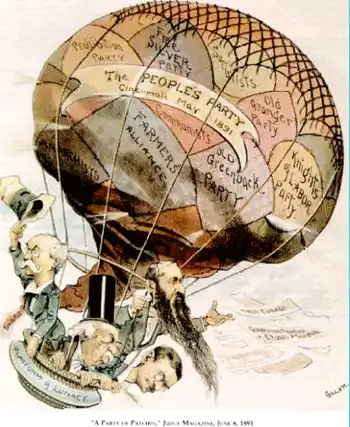
With a few exceptions, in left and progressive American political commentary in the last couple of decades, the use of the word “populist” has suggested right-wing political ideas and attitudes, sometimes with significant anti-democratic notions, especially when associated with working- and middle-class Americans. “Populist” concerns include ending immigration, protecting national borders and a Christian social and cultural heritage, and preserving racial purity and dominance. It is often associated with the supporters of popular political leaders on the right seeking to return their country to its former greatness and social and cultural purity, and to rid the country of unwanted people and corrupting influences.
Most recently, the left and progressives in American have often used the term, for instance, to describe and denounce the support for President Trump’s MAGA followers. This negative use of “populist” is not new to the last decade. Since the1950s, the use of the term to describe popular right-wing political programs and support has grown increasingly common among progressives and left political analysts as well as some academic commentators.
The People’s Party, the “Populists” of the 1890s, were not the “populists” of the last ten years, nor those who earlier supported right-wing ideas. They were born of an American society facing many of the same challenges the country has faced in the last few years. Between the Civil War and the early 20th century, the country witnessed unprecedented growth of industrial wealth—railroads, steel, coal, the telegraph, oil, and others—and in individual fortunes of Rockefeller (the first billionaire in 1916), Carnegie, J. P. Morgan, Vanderbilt, Jay Gould, and others. A rapidly increasing wealth inequality accompanied the rise in individual fortunes. Rockefeller in 1890 controlled 90 percent of the oil industry from production to sale. In 1890, one percent of the population had half of all the nation’s wealth (as compared to 30 to 35 percent in 2022).
Political corruption rose correspondingly. It exploded during the Civil War with the Whisky Ring, followed by Credit Mobilier during Reconstruction. In the 1880s and 1890s, businessmen routinely bribed local, state, and national governments. Tammany Hall was only the best known machine living off fraud and manipulation of politics. Seats in “the Rich Man’s Club”—the U.S. Senate—often went to the highest bidder. Between 1875 and 1885, the Central Pacific Railroad spent $500,000 a year (a little less than $16 million today) on state and national political bribery. In the middle of the depression following the Panic of 1893, the federal government had to borrow $16 million in gold from financiers, including Morgan, because the decline in revenue from taxes the business community and the wealthy opposed.
The Birth of the Populist Party
Neither the Democratic nor the Republican party showed any interest in dealing with these issues, especially the huge disparity between the very wealthy and the mass of ordinary farmers and laborers. Indeed, private armies like the Pinkerton’s were used to defeat strikes, the Homestead strike of 1892 being only the best known. The Populist Party was a response to the disparity and concentration of wealth, the declining wealth coming from a deflationary monetary policy desired by the wealthy, the corruption, and the failure of major corporations to look to anything but their own interest.
The Populist Party of the 1890s responded to these challenges in their Omaha Platform of July 4, 1892. The platform contained the purposes and political goals of the original People’s Party of America, for which the name “Populist” then stood. Its preamble described “…a nation brought to the verge of moral, political and material ruin.” They were pro-democracy. The American democratic system was threatened: “Corruption dominates the ballot box, the legislatures, the congress, and touches even the ermine of the bench; most of the states have been compelled to isolate the voters at the polling places to prevent universal intimidation or bribery.”
The country was on track for economic collapse: “The newspapers are largely subsidized or muzzled, public opinion silenced; business prostrated; our homes covered with mortgages; labor impoverished and land concentrating in the hands of capitalists.” These Populists were not anti-union and opposed only “imported pauperized labor which beats down” workingmen’s wages.” “The urban workmen are denied the right of organization for self-protection…a hireling standing army, unrecognized by our laws, is established to shoot them down….”
Wealth was increasingly inequitably distributed: “The fruits of toil of millions are boldly stolen to build up colossal fortunes for a few, unprecedented in the history of mankind; and the possessors of these, in turn, despise the republic and endanger liberty. From the same prolific womb of governmental injustice we breed the two great classes—tramps and millionaires.” The Populists charged that the national government’s deflationary manipulation of the currency in particular magnified this development: “The national power to create money is appropriated to enrich bondholders. A vast public debt, payable in legal tender currency, has been funded into gold-bearing bonds, thereby adding to the burdens of the people.” The demonetization of silver has added “to the purchasing power of gold by decreasing the value of all forms of property as well as human labor and the supply of currency is purposely abridged to fatten usurers, bankrupt enterprise and enslave industries.”
The platform’s only reference to “conspiracy” appeared in the context of the currency deflation. It complained that silver “has been demonetized to add to the purchasing power of gold by decreasing the value of all forms of property as well as human labor, and the supply of currency is purposely abridged to fatten usurers, bankrupt enterprise and enslave industries. A vast conspiracy against mankind has been organized on two continents and it is rapidly taking possession of the world….[I]t forbodes terrible social convulsions, the destruction of civilization or the establishment of an absolute despotism.”
The platform noted that neither of the two national political parties had done anything in the last 25 years about these problems. The parties’ efforts instead had been channeled “for power and plunder, while grievous wrongs have been inflicted upon a suffering people.” The interests controlling both parties “have permitted the existing dreadful conditions to develop, without serious efforts to prevent or restrain them.” The parties promised no “substantial reform,” so that “capitalists, corporations, national banks, rings, trusts, watered stock, the demonetization of silver and the oppressions of the usurers may all be lost sight of. They propose to sacrifice our homes, lives and children on the altar of mammon; to destroy the multitude in order to secure corruption funds from the millionaires.”
The Populist party, on the other hand, advanced a plan in the Omaha Platform to expand “the powers of government—in other words, of the people…as rapidly and as far as the good sense of an intelligent people and the teaching of experience shall justify… to the end that oppression, injustice and poverty shall eventually cease in the land.” The phrase “man over money,” which the Populists sometimes used, encapsulated the policies of the two old parties as well as promising a new focus on the needs of ordinary people rather than those of the wealthy and the corporations.
The Populist Party summarized the Omaha Platform preamble by condensing it into a series of propositions. “That the union of labor forces of the United States…shall be permanent and perpetual.” That “[w]ealth belongs to him who creates it, and every dollar taken from industry without an equivalent is robbery.” That “The interests of rural and civic labor are the same; their enemies identical.” That “the time has come when the railroad corporations will either own the people or the people must own the railroads, and should the government do so, all its employees should be guided by “a civil service regulation…to prevent the increase of the power of national administration by the use of such additional government employees.” That the country required “a national currency, safe, sound and flexible, issued by the general government only, a full legal tender for all debts, public and private…without the use of banking corporations and “a just, equitable and efficient means of distribution to the people” at a tax of 2% or less and using the Farmers’ Alliance subtreasury plan or “some better system” to regulate the currency and make it flexible enough to avoid excessive inflation or deflation.
A call for intervention in the economy
Far from being opposed to government intervention on behalf of the less powerful, the Omaha Platform called for legislation that would:
- Expand the currency by adding silver and increasing the supply to $50 per person.
- Create a graduated income tax.
- Establish national postal savings banks earnings deposits and “to facilitate exchange.”
- Because transportation was “a public necessity,” provide for the national government to own and operate the railroads “in the interest of the people.”
- Because telegraph and telephone systems were “a necessity for transmission of news,” the national government should own and operate them “in the interest of the people.”
- “The land, including all the natural resources of wealth, is the heritage of all the people, and should not be monopolized for speculative purposes….All lands now held by railroads and other corporations in excess of their actual needs, and all lands now owned by aliens, should be reclaimed by the government and held for actual settlers only.”
- “State and national revenues,” however, should be “kept as much as possible in the hands of the people” by limiting state and national revenues to “the necessary expenses of government, economically and honestly administered.”
The Populists, of course, were products of their time. They could not be 21st century progressives. The Omaha Platform did not contain many issues that have become important to progressives in the last 130 years. The party’s focus tended to be, outside a few urban areas like Chicago, almost exclusively on farmers, although major industrial labor events such as the Pullman strike garnered support in some areas. A slight odor of conspiracy was apparent, particularly regarding international currency developments, as was some hostility to immigration and immigrants.
Women were left out of the Omaha Platform. Women’s suffrage nearly made it in, but was defeated. Nevertheless, women participated widely in the party. The Farmers’ Alliance, the organizational precursor to the Populist party, had more women members—250,000—than the Women’s Christian Temperance Union. Women provided significant leadership to the Populist party, especially in the Midwest (and even sometimes in the South), played important roles in Populist gatherings and political meetings, including as speakers, and contributed their share of letters to the editor in Populist papers, at times mentioning women’s suffrage.
The Populists’ approach to race was marred by white supremacy, although not often explicitly in the Midwest. The South was another matter. There it was a major issue. Some southern Populists actually campaigned for black support, and there were black Populists and some black Populist speakers, and a few even served as members of some state conventions. but But no white Populists in the south, however they might encourage black votes, ever questioned the necessity for segregation, black subordination, and white supremacy.
Despite these failings, the Omaha Platform presented a progressive political program, especially for its time. In the face of corruption pervading state legislatures, congress, even the bench, it was committed to a free ballot and a fair count, even in a few cases for black voters. It supported labor and the right of workers to organize themselves. It opposed the concentration of wealth stolen from those who produced it. It called out the national government for aiding in this theft by contracting the currency, thereby reducing the value of property and human labor in the interest of the wealthy few.
The People’s party instead called for the national government to help the actual producers of wealth, farmers and laboring people, through involvement in the economic life of the nation. It called for the expansion of the circulating currency and partial provision of it, without involvement of the banking corporations, through the sub-treasury system or something similar. It called for the establishment of postal savings banks. It called for national government ownership and operation of the railroads “in the interest of the people,” and sought an end to the alien ownership of land by railroads and other corporations “in excess of their needs” and its reclamation for “actual settlers only.”
Americans, especially those outside MAGA, should not lose the heritage of the Omaha Platform and the late nineteenth century People’s party. We should refute the false popular memory reflected in the widespread use of “populist” to refer to conspiracy-minded, anti-democratic and anti-labor, right-wing voters. We should again embrace the phase used frequently by Populists to summarize their political goals: “man over money.”
Bruce Palmer is a history professor emeritus at the University of Houston, Clear Lake, and author of “Man Over Money: The Southern Populist Critique of American Capitalism,” UNC Press, 1980.