
United made news last month when its CEO, Scott Kirby, floated the audacious idea of acquiring American Airlines. Such a move would be blatantly anticompetitive, given the intense rivalry among the nation’s largest carriers. For certain routes, such as Charlotte to Washington Dulles, United and American are the only two carriers offering non-stop service—the deal would create a monopoly on that route. In January, American announced a new service from Chicago’s O’Hare to Maui, which is the only non-stop competitor to United on that route.
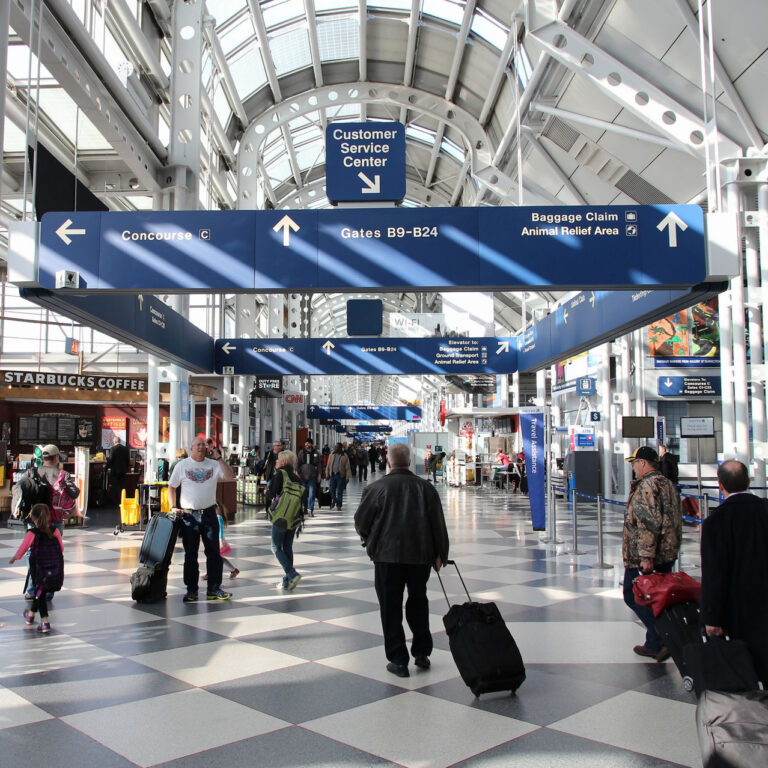
A more subtle anticompetitive strategy is taking place under the radar at Chicago’s O’Hare airport. There, United is aggressively over-scheduling flights. Why? Because gates are reallocated every so often by the airport authority, and that reallocation is based on an airline’s flying frequency in the prior year. O’Hare handles about 2,800 arrivals and departures each day. United, already O’Hare’s largest airline, planned to add roughly 200 flights daily, an increase of 34 percent, bringing its total to roughly 780 a day. In the parlance of antitrust, United’s conduct can be understood as foreclosing rivals from accessing a key input (gates).
Many of those additions made little commercial sense—for example, eleven daily flights to Grand Rapids, ten to South Bend, and seven to Peoria. As former Transportation Secretary Ray LaHood noted in March, “I’m delighted when my hometown and other communities get more flights, but these numbers aren’t driven by demand. They are driven by an anticompetitive strategy.”
Because of United’s aggressive expansion at O’Hare, American ended up losing four gates to United during the last reallocation in October; at about six departures per day across those four gates, the outcome amounts to roughly 24 lost American flights per day. In February, United acquired two more O’Hare gates from Spirit (before Spirit shuttered entirely in May). And Southwest is leaving O’Hare this upcoming June in favor of Midway, citing operating challenges at O’Hare; its gates will be divided among United and American. Exit by a major rival is a marker of anticompetitive foreclosure. Presently, United has 99 gates at O’Hare (equal to roughly half of the total gate capacity of 199) compared to American’s 66. As a share of passengers, United controls about 46 percent of the market at O’Hare.
United’s gate hogging—essentially trying to “dehub” a competitor—will inundate an already burdened O’Hare with more traffic and frustrate hundreds of thousands of flyers. To wit, in December of last year, Kirby reportedly told some United pilots that American may have to “dehub” O’Hare. This exclusionary plan has been brewing for a while; in 2017, Kirby reportedly told employees that “I hope to someday take over those [O’Hare] gates that currently have the AA on them.” And in January of this year, Kirby said United would add “as many flights as are required” to stop American from gaining additional gates in 2026.
In April, the Federal Aviation Administration (FAA) stepped-in to ensure relative operational consistency. The agency reduced flights at O’Hare, most of which were United’s, citing over-scheduling and “severe congestion.” The proposed increase in flights, across all carriers including United, would “stress the runway, terminal, and air traffic control systems at the airport.” But the FAA order applies only for the summer travel season (through October), and United could very well try over-scheduling again once the order expires. Notably, when the FAA convened discussions to address United’s over-scheduling, United’s response was remarkably hostile; its executives claimed the government ran the process “like a banana republic” and warned it would be “an existential crisis for the company.”
Dual hubs v. fortress hubs
O’Hare is one of the only airports with a hub for two major airlines, which engenders fierce rivalry between the airlines. So called “dual-hub” competition, of the kind seen at O’Hare, has been good for consumers. Indeed, airline prices fell by nearly four percent at O’Hare in 2025 relative to 2024. In contrast, the CEO of budget airline Frontier explained that “Allowing one airline to control a majority of gates at so-called ‘fortress hubs’ is hurting competition and customers.”
If United is successful in dehubbing American at O’Hare, travelers would face higher fares. United dominates Washington Dulles and San Francisco International Airport (SFO). Measured in terms of share of domestic and international seats, United’s market share is nearly 50 percent at SFO, five times its next largest rival. United has an even larger market share of roughly 70 percent at Dulles. Not coincidentally, Dulles and SFO are two of the most expensive airports in the country for domestic travel according to Finance Buzz.
In myriad, more sophisticated analyses, economists have studied the relationship between airport concentration and fares:
- Borenstein (1989), in a paper published in the Rand Journal of Economics (1989), found that an increase in market concentration on a route is economically and statistically significantly related with higher ticket prices, controlling for other factors that affect prices.
- The Government Accountability Office (1990) estimated that fares per passenger-mile at concentrated airports were about 20 percent higher than those at unconcentrated airports.
- Berry et al. (2006) estimate a structural differentiated product model of the airline industry, and finds that airlines’ ability to command airport dominance premium was limited to the upper end of the price distribution.
- Bilotkach and Pai (2009) find that while the airline’s dominant position at an airport is associated with market power, dominant carriers exercise this power on an average customer rather than a price-insensitive business traveler. Carriers operating a hub at an airport, but not enjoying the dominant position, are shown to charge a quality-based hub premium.
A concentration of gates within a single airline can also lead to worse service for consumers and greater exploitation of local workers. Service degradation can include delayed flights and mishandled baggage. FAA Administrator Bryan Bedford reportedly told airlines in a closed-door meeting the agency was concerned about the ability of O’Hare to function this summer. And when a rival carrier exits an airport, as was the case with Southwest or Spirit at O’Hare, airport workers lose an outside employment option with which to bargain for competitive pay and benefits.
Higher gate concentration could also lead to allocative inefficiency. As noted above, United might acquire gates to fly to less efficient destinations compared to those offered if a rival airline controlled those gates. Simply put, the airline with the most gates can employ a “use it or lose it” strategy rather than routing flights most efficiently.
The competition problem stretches beyond O’Hare
If this problem were limited to O’Hare, it would be bad enough. But airlines with a dominant presence at an airport wield their power, often to the detriment of passengers. For example, Delta uses its power over Salt Lake City Airport to ensure that rival gates, including United’s, are located extremely far from the baggage claim. And British Airways does the same at Heathrow. (Your fearless blogger thought he was going to expire on a walk from the United terminal to Heathrow Express.) It is instead meant to show that whenever an airport becomes beholden to a single carrier, the carrier can influence gate assignments as a means to impair rivals.
Regulators and antitrust authorities should use their tools to prevent an airport from tipping towards monopoly. At roughly a 50 percent market share, United’s foothold at O’Hare is already consistent with market power—that is, the ability to raise prices over competitive levels or exclude rivals. In light of Southwest’s exit from O’Hare, United’s plan to dehub American is the kind of conduct that is generally cognizable under antitrust law. Passengers traveling through Chicago should not have to endure inflated fares and longer delays.